2006/10/18
How Lancet calculated Iraqi death toll
As a sociologist, I say the methodology looks pretty solid to me. Here´s how The Lancet determined that 655,000 Iraqis, over and above the normal death rate for the country, have died as a result of the U.S.-British invasion and its consequences. That´s 20 times as many as Bush is willing to acknowledge. But, alas, it's a very credible figure. "More deadly than Saddam," by Gwynne Dyer The Japan Times Online Articles


Iraq Through a Rebel's Eyes
À propos of my comment below about insurgent "terrorists" in the American Revolution, here's a more developed argument:
"Thomas Jefferson was a rebel, as so many of his comments demonstrated. He also was a gun enthusiast, and not the bird-shooting kind. His gang of insurgents fought the British with the eighteenth century equivalents of assault rifles, RPGs, and roadside bombs — and that is why they are worth recalling when our conversation turns to Iraq." Iraq Through a Rebel's Eyes
"Thomas Jefferson was a rebel, as so many of his comments demonstrated. He also was a gun enthusiast, and not the bird-shooting kind. His gang of insurgents fought the British with the eighteenth century equivalents of assault rifles, RPGs, and roadside bombs — and that is why they are worth recalling when our conversation turns to Iraq." Iraq Through a Rebel's Eyes
2006/10/17
The War Prayer
 A very short story, very angry, very pertinent to today's events -- though Mark Twain was thinking about the U.S. war in the Philippines at the time.
The War Prayer
Photo from rotten.com: Mark Twain
Revolutionary terrorists: Benjamin Franklin?
Regarding Luis Posada Carriles, Cuban former C.I.A. operative and free-lance assassin and mass murderer (he planted the explosive toothpaste tupe that blew up a Cuban airline in 1976, killing all its 76 occupants):
"How can you call someone a terrorist who allegedly committed acts on your behalf?" asked Felipe D. J. Millan, Mr. Posada's El Paso-based lawyer. "This would be the equivalent of calling Patrick Henry or Paul Revere or Benjamin Franklin a terrorist." Castro Foe With C.I.A. Ties Puts U.S. in an Awkward Spot - New York Times
No, Mr. Millan, not those guys. Henry was an orator, Revere a silversmith famous for a midnight ride warning of an attack, and Franklin -- well, Franklin was many things, printer, author, diplomat, inventor. Not one of them was an assassin or, as far as I can tell, ever fired a shot at a human being. Ethan Allen and the Green Mountain Boys would be better examples of terrorists among the American revolutionaries, if we apply the Bush standards. In fact, by those standards (the ones applied in Afghanistan, that fighters without regular uniforms or with authorization of a recognized state are not "soldiers"), the entire Continental Army should have been sent to Guantánamo. But not Franklin, Revere or Henry. Though if they had fallen into British hands they would have been hanged as abettors of terrorism, or insurrection as it was then called.
2006/10/15
Orhan Pamuk
Now that he has won the Nobel Prize for Literature, you may be curious to see my comments on three of his books, a memoir of Istanbul and two novels. As you will see, I was less enthusiastic than the Nobel jury.
Istanbul: Memoirs of a City (Scroll down to see reviews of The White Castle and My Name is Red.)
Istanbul: Memoirs of a City (Scroll down to see reviews of The White Castle and My Name is Red.)
2006/10/14
Short Stories: The Spirit of Emulation

Fernando Sorrentino, an Argentinean author with a fantastic (literally) imagination, has sent this translation of one of his delightful stories. Short Stories: The Spirit of Emulation by Fernando Sorrentino
This however remains my favorite: Short Stories: There's a Man in the Habit of Hitting Me on the Head with an Umbrella by Fernando Sorrentino
2006/10/13
Constructions
 As you may recall, my partner and I are engaged in two major projects. Above is a picture taken 3 days ago of our progress on the one we're constructing of bricks, a condominium of 7 units on the coast of Carboneras, province of Almería, Spain.
And below, here's an idea of what we will be looking at as we complete the other project, built of words, a history of architecture and urbanism in Latin America.

2006/10/11
Caracas, 1963-64: Buckets of cement
Someone signing as "Curious" has asked: "You say in your personal description that after college you "worked in the barrios of Caracas, Venezuela"-- that seems to have been a pivital experience for you, so we'd like to know--under whose auspicios was that experience (we may not have the right English word, we mean, which group provided that opportunity for you to do that)?"
The organization was called "ACCION en Venezuela" ("ACCION" was an acronym for a long name that we in the organization could never remember -- "Americans for Community Cooperation" in something or other). Created by an American (i.e., U.S. citizen), Joseph Blatchford, and some young associates around (I think) 1961, and funded by private corporations with investments in Venezuela, it recruited both young foreigners like me and Venezuelan nationals, mostly college students, to work in poor urban neighborhoods to foment community associations, or asociaciones de vecinos, for social improvements. I personally worked and lived in Barrio Sucre in Petare and later in Bo. Las Minas de Baruta, in close association with Venezuelan co-workers who, like me, were in their early 20s. Our projects included building cement stairways, digging ditches for sewer and waterline installation, and even building a small school, all in operaciones cayapas -- campaigns of collective volunteer labor by the men and women of the community. Our little organization used its contacts to acquire bags of cement and other materials needed, including usually the food that the women prepared for us laborers in every operación cayapa. Years later I went back to visit, and could see one of our stairways in constant use. It gave me a thrill. I even found one of the men I'd worked with on that occasion, shouldering buckets of cement mix to climb the hill and dump into the frame. Toribio Blanco, in Bo. Sucre, Petare -- if you see him, please give him my regards.
For an interesting discussion of the history of community development and asociaciones de vecinos in Venezuela, see DHV para nosotros. "ACCION en Venezuela" is one of the many programs mentioned there.
2006/10/07
Guiris and other immigrants


I had it in mind to give a full analysis of Spain's immigration dilemmas, but my buddy Baltasar made a face like Mafalda when her mother serves soup.
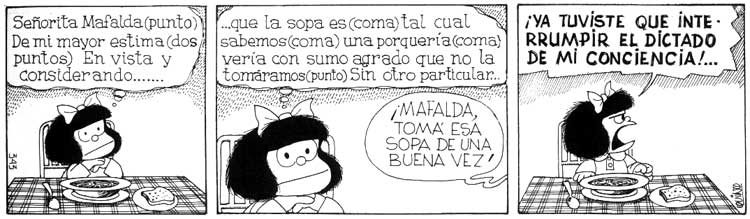
Balta, who is now editing our Spanish-language blog Lecturas y lectores, thinks our blogs should be amusing and snappy. In his opinion, Spain's biggest immigration problem is the invasion of the guiris -- meaning (the origin of the word is obscure) Englishmen and other northern Europeans and their kin (including North Americans) who wear ridiculous clothes, never get the jokes, and dance like the mechanical scarecrows in Grass's Dog Years. Balta has found this view of guiris partying, which he finds hilarious: YouTube - EL GUIRI
 But it's another kind of immigrant that gets more attention in the Spanish news these days. These folks seem to dance even as they walk, sometimes wear colorful clothes from their homeland, and do get the jokes -- even jokes that nobody else gets. Even though a lot of what they go through to get here doesn't seem very funny. They come from Senegal, Mauritania, Mali and other countries of Africa, in cayucos (big open fishing boats used in Senegal) to the Canary Islands or in pateras (smaller open boats, often inflatable, originally used on the Spanish coast and in the Strait of Gibraltar to carry supplies to ships).
But the really big numbers of immigrants come from Eastern Europe, especially Rumania, Bulgaria and Poland, in chartered buses. And the next biggest numbers from South America, especially from Ecuador and Colombia, by plane and usually with tourist visas. Most of all of these groups (except the guiris) are looking to make a buck, bucks (or rather euros) being much more plentiful in Spain these days than in their home countries. They work in construction, in restaurants, or (especially the Africans) fishing boats, or in agriculture. Low-paid and often dangerous jobs, especially construction where rushed foremen ignore safety regulations.
And a lot --a minority surely, but a big minority -- in criminal enterprises of one sort or another. Spain is especially attractive to criminals from northern Africa (Morocco, Algeria), Eastern Europe and South America, partly for geographical reasons (as a gateway between one of these regions and the others) but more because (a) the economy is booming and (b) it floats on an ocean of black and gray money, that is, money that can't be traced. A lot of that money comes from the construction industry, where people make unregistered cash transactions to avoid heavy taxes. And a lot of the rest of it comes from prostitution rings, drug traffic and various other frauds.
So, all of that is going on, making some Spaniards rush to close the gates -- except maybe to the guiris, who spend a lot money. Spain, for over a century an exporter of migrants (first to South America, later to France, Germany and other northern countries), is suddenly the receiving country, and that's hard to get used to.
BUT closing the gates can't be done! Spain cannot physically close the oceans to the cayucos and pateras, and as a member of the European Union it can't legally close its land or airport borders to other Europeans. And for sentimental and historical reasons, it is not easy to close the borders to South Americans either.
But there is an even more serious reason why Spain can't close the gates. "Spain will need at least four million immigrants from now until 2020," headlines El País (6 October 2006: "España necesitará al menos cuatro millones de inmigrantes hasta 2020"). Without them, the country will not be able to fill the jobs it is creating. That is because the Spanish birthrate is so low ("In the 1970s we decided to stop having kids," says a Spanish demographer, referring to the lack of state support for families), and because the population is aging.
So the only viable option, if Spaniards want to preserve Spanish identity, is to make it as easy as possible for the newcomers to learn the language, accept and be protected by the laws, and to become Spaniards. It's happened before in this country, though not always peacefully: Iberians and Celts (including Basques?) were followed by Phoenicians who were followed by the Vandals and other Goths who were followed by the Berbers who were followed by the Arabs and the Jews and the Gypsies and on and on, to all the many peoples who have made modern Spain.
Chart at top of page from El País, 14 February 2000
Photo of immigrants in a cayuco from Leyendo a la sombra
Mafalda cartoon (by Quino) from historieteca.com
Subscribe to:
Posts (Atom)