2013/10/29

Waltzing to revolution

Eugène Varlin, chronique d'un espoir assassinéEugène Varlin, chronique d'un espoir assassiné by Michel Cordillot
My rating: 5 of 5 stars

Clearly written, extensively documented intimate biography of one of the most impressive leaders of the Paris Commune. We learn not only of the very serious side of Varlin, a country boy eager to learn, who became a master bookbinder (very proud of his trade), organizer first of the bookbinders union then of other unions, and a leader of the International Workingmen's Association (the "First International"). He also learned to sing in choral groups and to dance, becoming a tall, handsome idol to thousands of the low-paid women brocheuses, assigned to the menial folding and assembling of "brochures" (paper-covered books) in the book binderies. In London at the farewell party of a meeting of the International, he preferred to waltz with Marx's daughters to spending the evening debating economics with their father. A firm and fierce feminist (opposed to his Proudhonnien comrades' view that a woman's place was in the home and she therefore should not hold union office), he worked with Nathalie Le Mel, already a leader of women bookbinders, in numerous projects. Reading his story helps us understand how such a momentous upheaval as the Paris Commune could occur and why at that moment, and also how and why it collapsed before the massacre of the "week of blood" by troops from the extremely conservative government in Versailles. It will also help answering the third question, how it has shaped revolutionary movements up to our day, as the song says: "She [the Commune] is not dead" (Elle n'est pas morte).

View all my reviews

2013/10/27

If War is Peace, Ignorance is Strength

Nineteen Eighty-FourNineteen Eighty-Four by George Orwell
My rating: 4 of 5 stars

Re-reading this book today, as so many people are doing, reminds us of how gloomy the world looked in 1949. And especially how gloomy it looked to Orwell, who had spent his entire life and lost his health in struggles for what he imagined as a more decent society — one where people care about and care for one another. The book is a biting satire of what he thought of as the muddle-headed reformism of the British Labour Party, heading toward a totally controlled society called "Ingsoc", Newspeak for "English Socialism", but the permanent anxiety-inducement, psychological manipulation through the distortion of language, and crude but effective torture were inspired more by Nazi Germany and, especially, Stalin's Soviet Union. The technology of surveillance by "Big Brother" seems laughably primitive today, in the face of Edward Snowden's revelations about the working of the NSA, but Orwell's vision of pseudo-friendships among individuals too frightened to really connect seems almost to foreshadow those on Facebook and Twitter.

Orwell's great strength was as a moral essayist, a writer with a very definite view of how things ought to be and a critique of all that fell short of that. And it is as a moral essay that this book continues to matter, not as an effort of belles lettres. It is not pleasing to read, the flow of the language is jarring, the characters unlovable and barely understandable as people — and that is surely just what Orwell intended. But those unlikeable characters all serve his two purposes: to point out the dangers of an all-controlling state and to remind us once again of how language can be corrupted in ways not to advance and express thought, but to impede it. And also perhaps to express one faint hope: Winston Smith, by resisting as long as he does, even though he finally succumbs, demonstrates that the system's control can never be absolutely complete.

View all my reviews

2013/10/19

A police thriller overwhelmed by real events

Le Cri du peupleLe Cri du peuple by Jean Vautrin
My rating: 3 of 5 stars

This is an immensely agitated, minutely detailed, ridiculously plotted police thriller, full of exaggerated characters, improbable coincidence and lots and lots of blood and sex, set in Paris during the 1871 Commune.

An emotionally disturbed cop and ex chain-gang convict (Charles Bassoucissé, a.k.a. Horace Grondin) obsessively pursues his murder suspect, who is now the gallant army captain Antoine Tarpagnan, and who we know almost from the beginning is quite innocent — like Inspector Javert on the heels of Jean Valjean in Les misérables, but Grondin is even crazier than Javert. These and other invented characters — other cops, crooks, prostitutes and various low-lifes — come into contact with historical figures, including Louise Michel and Gustave Courbet (very briefly) and especially Jules Vallès, whose newspaper Le Cri du Peuple provided Vautrin his title.

It is fast moving. I kept flicking the pages on my Kindle to find out what these crazy characters were going to do next, and one of the sex scenes, though a cliché, is quite lovely (a whore with a heart of gold tutors a timid youth in his first encounter). But the reason I read this instead of some other police thriller was to find out more about the Paris Commune, a far more dramatic story and with far more extraordinary personalities than the cop, the gallant and lovesick army captain he believes murdered his protégée, the troupe of loveable carnival freaks or even the gang of murderers with their grotesque symbol of brotherhood — glass eyes to be left in the hands of their victims.

The gruesome slashings of the "Glass Eye" gang, presented in bloody detail, pale into insignificance beside the more extreme and massive violence of the "week of blood" (la semaine sanglante) when government troops from Versailles virtually annihilated the communards, women and children included. Vautrin makes that suffering extremely vivid, and the (real, historical) violence is so massive that the (fictional) pursuit of Tarpagnan by Grondin seems of small importance. Vautrin is especially good at conveying the smells, most of them awful — of people, mildew, exhausted horses, bombs and rotting corpses. But the writing is so overwrought — people don't merely "say" something, they "snort" it or "grunt" it or even "whinny" it (I'm translating from Vautrin's over-abundant use of underworld argot) — that you know the story must have been conceived as a comic book, which it has now become, with illustrations by Jacques Tardi.

In short: You can learn some things about the commune, especially the minuscule details of how people lived and ate and traveled through the city, and a sense of the fear and smells and rage during the massacres of that last week. What you won't get clear is what it was all about and what it means to us.

That wasn't what Vautrin set out to do, so I'm not objecting. But it looks as though if I want to read the kind of novel I have in mind, I'll just have to write it. It's underway now.

View all my reviews

2013/10/09

Transcending literary genres

My quote from André Maurois (yesterday — see below), on the "recipe" for historical fiction, provoked reaction from friends on LinkedIn which has led me to these reflections:

From the tone of his remark, Maurois classed "historical fiction" as popular entertainment, probably along with murder mysteries and most other genres. That is, as distinct from more serious literature, of the sort that challenges the readers emotionally or intellectually. I think that is fair for most of what is put on the shelves, or in the Amazon lists, in that category. Nothing wrong with that — it's perfectly fine, I suppose, to amuse yourself. But it also made me think again of Mario Vargas Llosa's and Julia Navarro's insistence that what they write is not "historical fiction" — a puzzling stance if by "historical fiction" you mean any fiction set in the past, but not puzzling if you take the term the way Maurois describes it.
 

We don't usually think of "Julius Caesar" or any of Shakespeare's other tragedies as "historical fiction" because, although they do everything that Maurois describes, they also do much more. War and Peace and Charterhouse of Parma also do more. They are much more complex character studies, and suggest more complex philosophical inquiries, than required for light entertainment. But (as I use the term) they spring from, and then transcend, the genre. I think fiction of any genre (historical fiction, murder mysteries like those of Borges, even erotica in the pen of "O" or Henry Miller) can rise beyond our usual expectations of the form. In fact, playing with the supposed rules of any of these genres is a good approach to creating surprising, complex fiction. I'm thinking once again of Don DeLillo's Libra, but there are many other examples.

2013/10/08

Recipe for a historical novel

From a review by André Maurois:
THE recipe for an appetizing historical novel is relatively simple: take an exciting event (or period of history); study carefully your background; create an imaginary character (or a group of characters); let them have a sentimental life, distinct from the central theme; then tell the well-known story as seen by your imaginary characters, and sprinkle with local color. The result should be a nourishing and palatable dish, for a winter evening or a long journey.

The Saturday Review, February 7, 1942. Review of novel about the comic-opera life and death of général Georges Boulanger, 1837-1891: BRAVE GENERAL. By Herbert Gorman. New York: Farrar & Rinehart. 1942. 625 pp. $3.

2013/09/28

A unique event, a common topic

A fellow author on LinkedIn has congratulated me on my choice of a unique event for my novel. Yes, of course he's right, the Paris Commune was unique, as the first (briefly) successful uprising in a modern, capitalist society. Urban revolt has been occurring almost since there have been cities, and there were immediate precedents in France: 1789, 1830, 1848. But the context had changed so much by the late 19th century (France was multi-continental imperial power, its major cities now included big industrial proletariats, communications had advanced enormously, and Paris itself had become "the capital of the 19th century" in Walter Benjamin's famous phrase), and running such a huge city had become so complex, that the communards had to invent everything as they went along.

What is not unique is my choice of subject matter. Like any powerful, dramatic event, the Commune has attracted scores of novelists and probably thousands of historians. I'm reading a recent novel now,  Le cri du peuple, by Jean Vautrin. It's a lot of fun, fast moving and thoroughly researched, but not like what I'm aiming to do. But I'll say more about that after I finish Vautrin's novel — it's slow going for me (despite the speed of the action), mainly because Vautrin inserts so much underworld argot that I'm clicking on the dictionary every couple of paragraphs. At least, I'm learning a lot of vocabulary. But it will be hard to work it into conversation, unless I want to insult my French friends.

Vautrin has collaborated with illustrator Jacques Tardi to produce this marvelous bande dessiné, for which the two authors studied (among many other sources) the collection at the Musée de Saint-Denis, where I also have spent emotion-filled hours. For a video on this collaboration (in French), see "Le Cri du peuple" de Tardi et Vautrin - Vidéo Ina.fr.

2013/09/27

Writing revolution

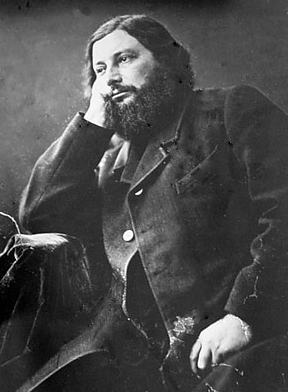
Gustave Courbet, pondering the art of revolution
As I've mentioned before, my next novel is about the Paris Commune of 1871. But not just about Paris or those 72 days of "people's power", but also about the possibilities, aspirations and contradictions in a revolutionary movement in a modern industrial capital and center of financial and military power. That is, it is also about us, today, whether in Cairo or New York or anywhere, and about the episode that has been a model for urban revolutions ever since.

So how's it going? I think I'm on track, but I'm not producing anything like 1,000 usable words of draft per day, which I think should be a reasonable quota. I hope to work up to that rhythm, though, once I work through my notes and tinkering with my outline. Meanwhile I'm still gathering more and more knowledge about Paris, French railroads, police, etc.

My novel starts with the lurch of my young protagonist, an apprentice bookbinder, from Lyon to Paris, by rail (his first trip anywhere), because he's decided to change his life — so I wanted to find out about the PLM (Paris-Lyon-Marseille or Méditerranée) line, tried but failed to get an 1870 timetable, did get an idea of how long it would take, am guessing about the fare (2 fr. 40 would be a day's wages for my guy) and the neighborhood where he would end up (3ême arrondissement, Gare de Lyon).

Why a bookbinder? Because that was one of the most politically engaged industries in the Commune. But why from Lyon? Because aside from Paris, Lyon was one of the most revolutionary cities in all France, especially in the silk industry, where women ovalistes had just formed the first feminine section of the International.

Another of my characters is a police official, and I've had to determine whether in the Sûreté (secret investigative police, staffed mainly by former criminals) or the Préfecture, and get some idea of how that was set up. For now, my character is a sous-préfet, meaning high-ranking but not at the top of the Préfecture. I already know (enough for my novel, probably) about the new police set-up under the Commune.

I'm delighted to be learning all this, but it doesn't make for rapid novel production. It does however enable me to understand the Commune in much greater complexity than we usually see.

To find out more about the Commune and to see some marvelous images, check out the blog of writer Yves Fey:

The Commune | YVES FEY

2013/09/19

Writers retreat (or advance)

At the beginning of this month I had the happy experience of participating in the Paris Writers Retreat created and led by Wendy Goldman Rohm. Held September 2-6 in a loft on the Place des Vosges, the "retreat" was more like a charge forward,  an energizing experience, propelling me (and I think all the participants) to work more wisely and enthusiastically on our respective projects.

The experience was valuable for several reasons, including: updated information about how the book business is operating currently, including a frank presentation via Skype by a guest speaker in Los Angeles on optioning books for TV or film production; tips and practical exercises on writing techniques, and recommendations of readings that may serve as models or as sources of ideas to stimulate our own creative imaginations. But beyond all that was something hard to get from on-line forums or self-help books: the synergy of face-to-face contact and interchange, with Wendy Rohm and with the 10 other participating writers.

Wendy is a very experienced freelance magazine writer, book author and agent (as you'll see if you check out her website), so there was a lot to learn from her. She was also closely attentive and constructively critical of the work as we produced it in workshop exercises. And it was also very helpful to engage with the other participants and they developed books completely unlike mine, suggesting other approaches and seeking solutions to some of the same problems of narrative structure, pacing, etc.

Online forums can be great — I have colleagues to share ideas with in LinkedIn and Goodreads, and some close friends and colleagues in our Thoth Books editorial collective. But the face-to-face exchange with an experienced professional, in real time and in a real place, is insurpassable.