2005/12/01

The fish that snored


Things have been pretty agitated here in Carboneras lately, with the local Socialist (PSOE, Partido Socialista Obrero Español) municipal administration at loggerheads with the national PSOE government's Ministry of the Environment over a development project (a big hotel) on a nearby beach. The Ministry wants to tear down the hotel as a violation of coastal protection, the Carboneras town hall was counting on it as a source of employment for the citizens. It's a complicated issue, and we have good friends on both sides -- the local ecologists (Greenpeace actually seized the hotel briefly a week ago) and the local Socialists (who organized, of all things, a general strike in the village last Friday). I've started to write up an analysis of it, because it's symptomatic of a much bigger issue involving all of Spain (and probably every country on the Mediterranean), but I'm writing it English because I don't want to become a participant in the battle -- not yet, anyway, until I can offer some helpful alternatives.

What is happening is that chunk by chunk, Spain's beautiful rugged coast is getting cemented-over by hotels and enormous developments of hundreds or even thousands of second homes for opulent retirees from all over Europe. The retirees are attracted by the climate, the culture, and the excellent and free health care, better and cheaper than most of them could get at home. Golf courses, swimming pools, and the extravagant personal hygiene and gardening habits of the newcomers are sucking up scarce water, even as this part of Europe is growing drier and drier. Carboneras' big new hotel is a minor culprit – Marbella, in Malaga, has thousands of illegal shore side constructions, granted licenses by the local administration in clear and repeated violation of law, and nearer at hand, Mojácar’s once wild beach is now a solid strip of tourist traps big and small. But the nearly-completed 411-room hotel built by the big Azata company (based in Madrid) is the most recent offense, and the Ministry wants to make an example of it. The example comes a little late – but better late than never; there is still some pristine coast left to be saved, in Carboneras and other parts of the region.

But the need for jobs is real, too. Carboneras used to live mostly on fishing, but bigger fishing interests with dragnets, etc., have so depleted the stock that fewer and fewer fishermen can continue. Their sons are more like to go into construction, building those fancy second homes (like ours), but that can't last long -- space for new building in Carboneras is just about gone. So service jobs in tourism seem like the best option -- waiting tables, making beds, whatever.

A better option that has been suggested by some people here would be to encourage the development of what are called “rural hotels” inside the Nature Park (Parque Natural Cabo de Gata-Nijar) that occupies 75% of Carboneras’ territory. These would not be new constructions, which are (properly, I think) strictly forbidden in the park, but conversions of existing farmhouses, as has been done throughout Spain. There are families and farmhouse-owners eager to do this, since they can’t very well farm economically in the park and need the income, and such hotels would surely create jobs directly (hiring a gardener or cook, for example) and indirectly (through demands for services), and of course more and more attractive places for tourists to stay near town. So far, though, the authorities have denied applications for licenses for such conversions, fearing that they would in fact lead to new construction that would alter the natural environment of the park. But that has to be a better idea, both environmentally and economically, than a cement ziggurat of 411 rooms right on the water’s edge that profits mainly some huge and distant hotel management company.

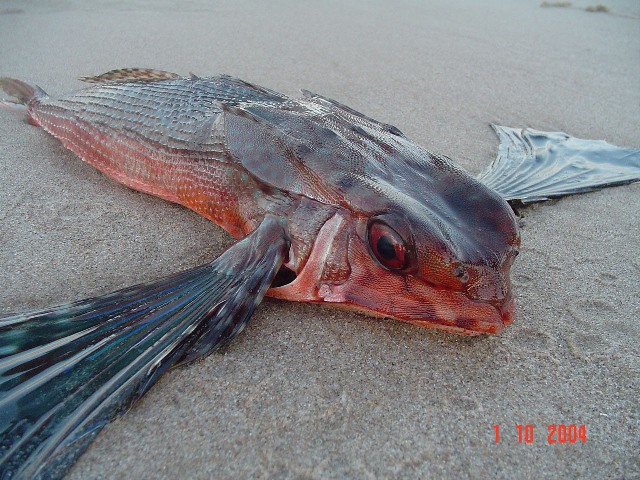
The coastal area in dispute includes, first of all, the Playa de Algarrobico and extends to the pebbly shore known as the Piedra de Roncaores. The roncaor, or “snorer” fish (“roncador” in more formal Spanish, “croaker” in English) seems like a good symbol for Carboneras in its present plight. It’s about a foot long with a bulldog-like face and lateral fins like wings that, when attacked, it thrusts out to make it look much bigger than it is, while it makes an angry (snoring?) noise with its jaws. Like Carboneras (pop. about 7,000) with its “general strike” and angry speeches against the Minister of the Environment last Friday. But all that fin-thrusting and snoring doesn’t always keep the roncaor from getting caught and eaten by bigger, human predators.

(The roncaor pictured above had washed ashore in Valencia, just up the coast from Carboneras. For sketches and further data on this peculiar beast, check out Mare Nostrum. Because of its "wings," the roncaor is also known as the pez golondrina.)

2005/11/21

The Old South in Black and White

Jones, Edward P. 2003. The Known World. New York: Amistad (HarperCollins).

This powerful novel, like a Brueghel painting, is a crowd scene of individual portraits where each character is engaged in some intense, private activity. The collective ritual in this case is slavery in the ante-bellum South of the U.S., and the characters include black slaves, black freemen and women some of whom are themselves slave owners, whites of various social statuses and backgrounds, and an Indian of ambiguous status – not quite enslavable, but not quite a white. Some of these characters, black and white, attempt to behave honorably without always succeeding; some do cruel things thoughtlessly or selfishly. All are trapped in a system that rewards whites for cruelty even when they want to be just, and servility from blacks no matter how hard they struggle to attain and retain dignity. The women – especially the black women -- are as vivid as the men. Though most of the action gets started in one county in Virginia in the 1840s, Jones wants to know what became of his creatures after they left the county, some as far as Philadelphia, New York, and Washington, and shows us the lives of the surviving blacks many decades later, after the Civil War and emancipation. Some of them do achieve dignity.

2005/11/09

The view from Carboneras

In this small town on the Mediterranean coast of Spain, the people who have been here a while are always looking for an opportunity to turn a stranger into a vecino, that is, into a known quantity that can be integrated into the community. This is why newcomers are so often surprised by unsought conversations in a shop, a bar, or on the street, even when the language barrier is high.

Community is woven of many threads of information, some of them as light and fragile as a person’s sigh or tic, others– remembrances of ancestors and of living family, or knowledge of one another’s political or religious preferences –tightly wound into stronger cords. The denser the weave, that is, the more the threads that cross through it, the more firmly attached are the members to each other. A vecino is not necessarily an amigo – among families that have dealt with one another for generations, threads of ancient conflicts pull against other, newer ties. But for the same reason, the multiplicity of ties, a vecino can never be entirely an enemy. And a newcomer is always a potential amigo, someone you know well enough to know what might please and what might hurt, and care enough about to avoid the latter.

People here are friendly and open not just to one another, but even to unmonied immigrants from Africa, black and brown, Eastern Europe, and China, to foreign retirees of means – mostly English or other European –and even gypsies. And here in Carboneras, as Susana & I happily allow ourselves be woven ever more tightly into this community, we watch – on TV and in the papers – how different things are in other parts of the world.

Right now the most dramatic contrast is with France, where youth of all colors, but especially those whose parents came from Africa or Asia, are hurling firebombs in protest against their exclusion from the community. And yet France has far fewer immigrants from those areas than Spain, which in 2004 received 610,000, more than any other country in the world except the U.S. (“Un milagro español,” by Andrés Ortega, El País, 7 Nov. 2005). Not all parts of Spain are as welcoming and harmonious as Carboneras, but this country has made far more successful efforts than France at bringing immigrants into the community. The reasons are complex, but surely the policies of inclusion of Spain’s socialist government, in sharp contrast to the punitive policies of Chirac and Sarkozy, are part of the explanation.

2005/11/03

Chávez & Perón


Carmen makes an important observation in her comment on my essay below, "Chávez & the chavistas." The parallels between Hugo Chávez's "Movimiento de la V República" (MVR) and Juan Domingo Perón's "Justicialismo" are striking, including the complicated problem each movement has created for intellectuals on the left (me included). Each movement is a mix of progressive and authoritarian-militaristic impulses.

By the way, I also have a book on Argentina, where I attempt to comprehend Perón's relationship to his movement; did Perón create Peronism, or was it the other way around? I hope to come back to this subject. Meanwhile, if you're interested, check out The Land and People of Argentina. Though written for young readers, it may also be a handy starting point for intelligent adults to understand that country's politics. (Photo of Perón is from the Instituto de Formación y Capacitación Política "GRAL. JUAN DOMINGO PERON", who are true believers.)

2005/10/31

Some more of those babies

Aren't they beautiful? And can you believe that rooftop forest our neighbors are growing? It's a whole 'nother city up here.

The view from my window

It's a beautiful day. This is from the 8th floor of our building on 4th St., between Broadway & Lafayette, looking north. The tall glass tower at the right is the new Gwathmey-Siegal building on Astor Place. The railing on the rooftop at left goes around a swimming pool where celebs sometimes hold parties and fashion photographers often take their models. But mainly this is a photo about water tanks. If I look a little to the right of this photo, I can see at least eight more on various roofs. Each is beautiful, individually weathered, and seeing them clustered makes me feel well accompanied. I took this with our new Fuji FinePix E550.

2005/10/28

Chávez & the Chavistas

A friend writes: "I've been reading in the NYRB about Hugo Chávez. I have a soft spot for him but he sounds really weird. Maybe you should put up something about him."

Thanks for the suggestion. Yes, I should say something about Chávez. I kind of like him, too, and think he is a good phenomenon -- that is, that it's good for Venezuela that he happened. About him personally: He's a very quick thinker but not a deep one. What I mean is that he latches onto ideas that he reads or hears about without working out their likely consequences -- to an even greater degree than Fidel. He's also a very quick talker (I had a five-or-ten-minute impromptu conversation with him once; see Chatting with Chávez). He's also got a strong authoritarian tendency, which could bode ill.

First, about chavismo being a good phenomenon, apart from whether Chávez is or is not a good president.

The overthrow of the last military dictator, Lt. Gen. Marcos Pérez Jiménez, on January 23, 1958, raised great democratic hopes, but in the decades since, a narrow elite of business leaders, political party bosses and their allies managed to turn the institutions of Venezuelan democracy into a machine to guarantee their privileges and exclude the masses. The electoral laws, party structure, judicial system, etc., protected them and their property from scrutiny, while the national petroleum company channeled the oil wealth into their bank accounts or into projects benefitting mainly the elite. The two major parties entered into a pact to share the spoils of the country's oil wealth, while neglecting the needs of the mass of the population and of the nation as a whole: public schools, public health, affordable housing, economic development to create jobs. Those who were born poor faced ever decreasing chances to become less poor. The elite, because they were mainly descendants of generations of privilege, were and are mostly white; the great majority is dark.

Pressure from below threatened to blow this system apart several times, most dramatically in the guerrilla war of the 1960s and the riots of 1989. In the unions, the barrios, professional associations, the armed forces and minority parties, many people were working more or less independently of one another to change things. Finally, in 1998, all that pent-up energy for change found its almost-ideal leader in a hyper-energetic, quick-witted, dark-skinned, up-from-poverty military man, who had tried and failed to lead a coup six years earlier and now was ready to try politics.

Chávez has by now survived a coup and won a whole series of elections, the most recent by over 59%. But the huge movement we call "chavismo" is bigger than Chávez and parts of it are much older than his political presence, stemming from movements founded in 1989 or even earlier. Those older movements need him, and he still needs them, and for now the uneasy alliance between them leaves space for a lot of divergent opinion -- as we saw in the recent, hotly contested internal elections inside the chavista party.

Is this democracy? What else would you call it? You have a popularly elected president and legislature, and a lot of room for debate -- although the guarantees of freedom of speech are not really secure, and the meaning of certain constitutional restrictions (by the new "Bolivarian" constitution) not entirely clear. But the opposition to chavismo has hardly been muzzled (just sometimes threatened), and the debate within chavismo continues.

I haven't been back to Venezuela recently, and it's hard to judge the tenor of political discourse without actually being in it. But I do know the country's recent past, and have some idea of the dynamics of revolutionary regimes, and here's my hypothesis: The danger for democracy in Venezuela will come if and when Hugo Chávez establishes such a wide base of power in organizations of his own creation, that he no longer needs to heed the other organizations that so far have been supporting him. At that point we may expect a Creole and (probably but not certainly) bloodless version of the "night of the long knives," as the Germans called the 1934 purge of the SA.

But I don't think that will happen, or -- if it should happen -- that consolidation of absolute dictatorial power would last very long. Partly as a consequence of all the agitation and political education that has been going on for the past seven years, including the government's health and education misiones in the barrios, Venezuelans across the land will know how to recognize and resist any sort of dictatorship. And so far, Hugo Chávez has been very good at reading the national mood.

For more detail, look at my 1991 book, The Land and People of Venezuela (written for young readers), or these more recent essays: Venezuela, 2004/05/01, and Venezuela Now, 2003

See also:
Steve Ellner, Venezuela’s “Demonstration Effect”: Defying Globalization’s Logic

Alma Guillermoprieto, Don't Cry for Me, Venezuela, New York Review of Books, 10/6/2005, and The Gambler, NYRB 10/20/2005 -- and be sure also to check out the Corrections to several errors in the first piece (Alma must have been in a hurry when she wrote it).

2005/10/26

Recent reading: Wiarda, "Civil Society"

"While the United States may vaunt its "liberalism" at home, it projects a kind of corporatism abroad, in that it seeks to subordinate other people's civil societies to the U.S. government," I wrote in my review of Howard J. Wiarda, Civil Society: The American Model and Third World Development (Boulder: Westview Press, 2003). The review has just been published and should be posted in a day or two at H-Net Reviews (Humanities and Social Sciences Net).

2005/10/20

And speaking of genocide...

Let's not forget our own troubled history. A new documentary by Don Vasicek reminds us. Check out the trailer for The Sandcreek Massacre. And of course, a book mentioned here earlier, Evan S. Connell's Son of the Morning Star, about the Battle of the Little Bighorn and all the characters and politics that made it. (On that occasion, the guys in feathers won.)