2006/10/07

Guiris and other immigrants


I had it in mind to give a full analysis of Spain's immigration dilemmas, but my buddy Baltasar made a face like Mafalda when her mother serves soup.

Balta, who is now editing our Spanish-language blog Lecturas y lectores, thinks our blogs should be amusing and snappy. In his opinion, Spain's biggest immigration problem is the invasion of the guiris -- meaning (the origin of the word is obscure) Englishmen and other northern Europeans and their kin (including North Americans) who wear ridiculous clothes, never get the jokes, and dance like the mechanical scarecrows in Grass's Dog Years. Balta has found this view of guiris partying, which he finds hilarious: YouTube - EL GUIRI

But it's another kind of immigrant that gets more attention in the Spanish news these days. These folks seem to dance even as they walk, sometimes wear colorful clothes from their homeland, and do get the jokes -- even jokes that nobody else gets. Even though a lot of what they go through to get here doesn't seem very funny. They come from Senegal, Mauritania, Mali and other countries of Africa, in cayucos (big open fishing boats used in Senegal) to the Canary Islands or in pateras (smaller open boats, often inflatable, originally used on the Spanish coast and in the Strait of Gibraltar to carry supplies to ships).

But the really big numbers of immigrants come from Eastern Europe, especially Rumania, Bulgaria and Poland, in chartered buses. And the next biggest numbers from South America, especially from Ecuador and Colombia, by plane and usually with tourist visas. Most of all of these groups (except the guiris) are looking to make a buck, bucks (or rather euros) being much more plentiful in Spain these days than in their home countries. They work in construction, in restaurants, or (especially the Africans) fishing boats, or in agriculture. Low-paid and often dangerous jobs, especially construction where rushed foremen ignore safety regulations.

And a lot --a minority surely, but a big minority -- in criminal enterprises of one sort or another. Spain is especially attractive to criminals from northern Africa (Morocco, Algeria), Eastern Europe and South America, partly for geographical reasons (as a gateway between one of these regions and the others) but more because (a) the economy is booming and (b) it floats on an ocean of black and gray money, that is, money that can't be traced. A lot of that money comes from the construction industry, where people make unregistered cash transactions to avoid heavy taxes. And a lot of the rest of it comes from prostitution rings, drug traffic and various other frauds.

So, all of that is going on, making some Spaniards rush to close the gates -- except maybe to the guiris, who spend a lot money. Spain, for over a century an exporter of migrants (first to South America, later to France, Germany and other northern countries), is suddenly the receiving country, and that's hard to get used to.

BUT closing the gates can't be done! Spain cannot physically close the oceans to the cayucos and pateras, and as a member of the European Union it can't legally close its land or airport borders to other Europeans. And for sentimental and historical reasons, it is not easy to close the borders to South Americans either.

But there is an even more serious reason why Spain can't close the gates. "Spain will need at least four million immigrants from now until 2020," headlines El País (6 October 2006: "España necesitará al menos cuatro millones de inmigrantes hasta 2020"). Without them, the country will not be able to fill the jobs it is creating. That is because the Spanish birthrate is so low ("In the 1970s we decided to stop having kids," says a Spanish demographer, referring to the lack of state support for families), and because the population is aging.

So the only viable option, if Spaniards want to preserve Spanish identity, is to make it as easy as possible for the newcomers to learn the language, accept and be protected by the laws, and to become Spaniards. It's happened before in this country, though not always peacefully: Iberians and Celts (including Basques?) were followed by Phoenicians who were followed by the Vandals and other Goths who were followed by the Berbers who were followed by the Arabs and the Jews and the Gypsies and on and on, to all the many peoples who have made modern Spain.

Chart at top of page from El País, 14 February 2000
Photo of immigrants in a cayuco from Leyendo a la sombra
Mafalda cartoon (by Quino) from historieteca.com

More journalists killed

BBC NEWS | Europe | Chechen war reporter found dead
BBC NEWS | South Asia | Journalists killed in Afghanistan

Day


Dawn comes late to the east coast of Andalusia. Here in Carboneras, we are almost 2 degrees west of Greenwich (1.53 degrees, to be precise), but the clocks of all of Spain (except the Canary Islands) are set to the same hour as Paris, which is 2.2 degrees east of Greenwich. At seven in the morning the sky and sea are black. (In Greenwich, it is only 6 a.m.) Then, without warning, a glimmer of bright pink marks the line where sea meets sky, just a few minutes before eight. The glimmer grows wider and diffuses, soft layers of light above and ripples of pink and orange below, where the light from the sky flashes against the broken sea. The fishing boats have not yet extinguished their deck lights, but the sky is now light enough for us to see the silhouette of a small sloop, a black shape like a saucer on the water, its black mast bare and its stays slack. Softer grows the light, and wider. More little boats become evident through the disappearing gloom, even now a a tiny low craft with human lumps, like a motorized log or maybe a kayak, and a more serious working boat, just large enough for three men to work the nets and pulley, and with a box-like cabin in which maybe two of those thin and knotted men could crouch to fetch or store their gear. And now at last it is day, inspiring the raucous hilarity of the gulls.

2006/10/06

Fashions in fanaticism: Redeker & the mullahs

The usual agitators of the Muslim masses have expressed their outrage at French philosophy teacher Robert Redeker for saying things like this:
Exaltation de la violence : chef de guerre impitoyable, pillard, massacreur de juifs et polygame, tel se révèle Mahomet à travers le Coran.
("Exalting violence: a pitiless warlord, robber, mass killer of Jews and polygamist, that is the Mohammed revealed in the Koran.") Somebody claiming to be a defender of the faith has even emailed death threats and called for attacks on him, posting a map to his house.

How fashions in fanaticism change! Tamerlane of Samarkand, who was as vociferous a Muslim as ever was, would have had no problem with Redeker's description of Mohammed or himself as a pitiless mass killer. He styled himself the "Scourge of God" as he piled up the skulls of those he had massacred in the name of Allah in Baghdad and in India. To Tamerlane and countless other Muslim warriors, from Saladdin to modern Chechen guerrillas, Mohammed's trickiness and mercilessness in war have been considered admirable.

Or maybe what really set off the European Muslims was Redeker's concluding statement:
Haine et violence habitent le livre dans lequel tout musulman est éduqué, le Coran. Comme aux temps de la guerre froide, violence et intimidation sont les voies utilisées par une idéologie à vocation hégémonique, l’islam, pour poser sa chape de plomb sur le monde.
("Hate and violence live in the book in which every Muslim is educated, the Koran. ...") That may be debatable. But if so, let's debate it. The stupidest response is to send the message, "If you call me violent, I'll kill you!"

Here's the original text: 20minutes.fr - Le texte de Robert Redeker qui fait polémique

2006/10/04

Network of Spiritual Progressives - An Interfaith movement

Sounds good, but is there room for us nonspiritual progressives too? We support most of the same things, it's just that we don't try to palm off any of the responsibility on a Higher Being. Network of Spiritual Progressives - An Interfaith movement Religious people sometimes have trouble believing that we non-religious people can have any ethics, while we non-religious wonder if the ethics of the religious are real -- that is, a responsibility assumed by the individual as his/her own, rather than an edict from an imagined spiritual father.

2006/09/29

The smell of sulphur

Hugo's UN performance was political comedy, which played very well for his intended audience. "Taste" had nothing to do with it , any more than it does for George Carlin or Stephen Colbert. It's a kind of comedy very familiar in Venezuela, where everybody makes outrageous statements as the only way to attract attention. The alcalde mayor of Caracas -- part of Chávez's team -- got off some real zingers a week or so ago, and is probably still spouting off, but the most outrageous of all come from Chávez's opposition, who pride themselves on being better educated and should know better. The lamentable historian Guillermo Morón (I had the dubious honor of being his house guest for a few weeks, many years ago) formally and pompously declared that "magnicidio" would be appropriate in the case of Chávez ("“es lícito matar a un gobernante cuando éste incumple las leyes, comete injusticias y deja de gobernar”).

See La bárbara e irreflexiva oposición venezolana

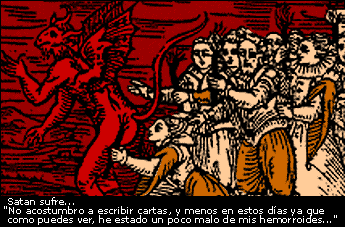
Portrait of Satan pursued by the people is from El Phineas » Blog Archive » La Carta de Satanas

2006/09/28

Why do people read?

Our reading club in the public library of Carboneras has started off with a workshop, aimed to help us all "read better." It has been more fun than I had expected -- our librarian María José Rufete has brought in

Waples, Douglas, Bernard Berlson, and Franklyn R. Bradshaw. 1940. What Reading Does to People. A Summary of Evidence on the Social Effects of Reading and a Statement of Problems for Research. Chicago: University of Chicago Press.

Excruciatingly dull--"pedestrian" the authors themselves call their conclusion, which is actually their starting point: that one has to take into account all the relevant "major factors"; survey of literature on reading tastes (who reads what), effects of propaganda (esp. Lasswell's work), etc. It is literally no more than "a summary of evidence," with no critique of any study mentioned. People read for (1) "instrumental effects" (learning something they want to know), (2) "prestige effects" (feeling better about themselves, e.g. by identifying with a dashing hero/heroine), (3) "reinforcement effects" (to strengthen their previously held opinions), (4) "aesthetic effects" (some people appreciate "belles lettres" for themselves), and/or (5) "respite effects" (to take a break). "Prestige" seems the most amusing as a category, could maybe become a short story.

2006/09/27

Politics & demography: Spain's immigration problem

Every day TV news brings images of open boats crowded with Africans arriving in the Canary Islands. Sometimes a boat is crowded with people from further away, from Pakistan. Medical, judicial and customs personnel claim to be overwhelmed by the sudden increase in these "illegal" arrivals.

The Canaries (named not for the birds but for the fierce dogs or canes that used to roam there) were conquered by Spain in the 15th century and are now -- though geographically African -- a region of Spain, like Andalucía or Catalunya. If you can reach the Canaries, you have reached the European Union, and (if the Spanish authorities don't do something about it) you face no legal impediment to traveling anywhere in the EU. The Pakistanis who arrived the other day were probably heading to the United Kingdom, the French-speaking Africans from Mali, Senegal or Mauritania are probably thinking of France or Belgium. Thus, even though most of the French-speaking magrebíes (Morrocans and Algerians from the Maghreb) and Sub-Saharan Africans remain in Spain (where jobs are relatively plentiful), Spain's problem of immigration control is Europe's problem.

Or anyway, that's what the Spanish government is arguing in the European Parliament. Spain wants help in financing helicopters, patrol boats and vigilance systems (Spain has deployed several infrared detectors of outboard motors and human body warmth, but not enough to cope with the great numbers of clandestine immigrant craft). But so far countries remote from the African coast, and especially those with "conservative" (meaning, among other things, anti-immigrant) governments insist that controlling its borders is Spain's problem. Same with Malta and Italy, the other "front line" countries targeted by would-be immigrants from the south.

But then, how can it be just Spain's problem, if there are no longer any real borders among the European countries? Spain's coasts are now the southern frontier of all of Europe. It's the age-old philosphical debate, Whose responsibility is it to see to the welfare of all?

But there are also practical questions, not philosophical so much as sociological. First, What has spurred the great increase in illegal immigration in the past five or six years? Second, is this increase a problem for the richer countries that are receiving the immigrants? And if so, what kind of problem? Economic, political, cultural? And is it a problem (or perhaps a solution) for the poorer, sending countries? And thirdly, a sociological question which is also a big political question these days, regardless of whether it is really a problem or not, can it be stopped or even significantly reduced?

Here are some hypotheses.

1 - The main causes of increased illegal immigration may be a sudden relative impoverishment of the sending countries (relative to the beckoning prosperity of Spain and its northern neighbors). We'll need to look at the economic stats of the countries that sent the most migrants to Spain last year. OR it may be the increased efficiency of underground people-exporting business. OR the active recruitment by employers in Spain and elsewhere in Europe. Likely employers include construction industry, agriculture (big employer in southern Spain), and brothels, among others. All three of these things are going on, but which are more important probably varies by country.

These (rounded) figures are for numbers of applications for residence in Spain last year (thus, not counting the undocumented), but they may give an idea of the proportions:
AFRICA
Morocco 63,000
Algeria 8,000
Senegal 7,000
Nigeria 5,000
Mauritania 3,000

SOUTH AMERICA
Ecuador 21,000
Colombia 14,000
Brazil 3,000
Argentina 3,000

EUROPE
Rumania 9,000
Poland 4,000
Ukraine 4,000
Bulgaria 3,000

ASIA
China 10,000
Pakistan 6,000

Further thoughts to come.

(This note is two days later than promised. My apologies. Things happen.)

2006/09/25

Günter Grass

It's hard to take seriously the expressions of shock and disdain at Günter Grass's recent revelation that he was, very briefly in the last months of the war when he was 17, a member of the SS. It's not as though we hadn't known that he was a Nazi sympathizer as a youth or that he had served in the armed forces (in an anti-aircraft unit initially). He had reserved this embarrassing added detail, as he told interviewer Hermann Tertsch in El País, until he was ready and had found a way to tell it. But in fact his most famous work is all about coming to terms with, and unsuccessful denials of, the unacceptable past. That in any event is the theme that came through most strongly in the novel I just finished reading, Dog Years.

I had picked up this novel just by chance, a week or so before Grass reappeared in the headlines for his new memoir. Now I want to read its predecessors in the Danzig Trilogy, The Tin Drum and Cat and Mouse. (Little by little and author by author, I'm trying to make up for my cultural deficits.)

See Günter Grass - Wikipedia, the free encyclopedia

2006/09/22

Back in touch!

Just a little more than an hour ago, we got our ADSL connection established in the place we're renting here in Carboneras, Spain. To celebrate, I plan to inaugurate a new series of "Letters from Spain," aimed at telling U.S. readers what I think my countrymen might want to know about the many things happening, very rapidly, in this country. Beginning next Monday, I intend to post such an essay weekly, to attract some new readers, to interest those I already have, and to come to a better understanding of Spain myself.

There are several reasons why Spanish politics and cultural dynamics should interest U.S. readers. Since 1492 the country has been the most powerful node amplifying and retransmitting currents between Europe, Asia, Africa and America, and a large part of its internal turmoil has to do with the static from all those currents. The topics I plan to take up here (one at a time or in combination) suggest how wide are the effects of Spanish political and cultural events. These topics include:

• Immigration (from Africa, Latin America and Eastern Europe) and the dilemma it presents to the social equality and civil liberties agenda of the Socialist Party.
• The water crisis, and the urgency of strengthening Spain’s weak instruments for water management and conservation.
• Depradations of the consumer society: the paving of the coast and countryside and the corruption of municipal governments, more blatant here than in most places (except maybe Italy)
• Church, state and civil liberties: in the face of Catholic tradition and (possibly related) tradition of machismo, Spain is pioneering laws against domestic violence and facilitating abortion, divorce and homosexual marriage
• Confronting terrorism: ETA, Al-Qaeda, and Spanish troops in Lebanon and Afghanistan.

And much else. For starters I want to say something about immigration -- which is more of a political than a demographic problem.

But first, a clarification of an earlier note. Some of you have taken the trouble to look up this town (as I suggested) in Google Earth, and were wondering exactly where to find our building project. These are the coordinates: 37˚00'32.22" N, and 1˚53'12.12" W.