2006/05/23

Immigration: preparing to enter the debate

I know, I know. My participation is long overdue. After all, I did write a book about it, and more recently (2003), an op-ed on a the growing census numbers. The huge demos last March caught me by surprise -- I was in Spain and, frankly, had not been closely following the politics of what I had called the Hispanic Nation. I don't want to just give an opinion; this question is too important for pundits. Rather, I want to come up with some hypotheses, and maybe even a proposal, that will help us understand and deal with all the conflicting issues. Big job. A job for a sociologist.

Here are some things I've been reading to get back up on it, in rough order of interest:
• Nina Bernstein,100 Years in the Back Door, Out the Front, NYT Week in Review; also, click on Bernstein's link to see her other articles on the issue -- serious reporting.
• E. J. Dionne Jr., Divisive In Any Language (washingtonpost.com)
• Alicia A. Caldwell, Security plan worries N.M. town officials (AP, boston.com)
• Shikha Dalmia, No Free Ride (Knight Ridder, Tom Paine)
• Sandi Burtseva, Yes, We Know They're Illegal (Tom Paine)

To know the truth-- you have to try!

Check out the National Coalition Against Censorship, or subscribe to their printed newsletter (address on the site).

2006/05/22

The truth must not be told

Borjesson, Kristina. 2004. Into the Buzzsaw: Leading Journalists expose the Myth of a Free Press. Pp. 453 + index. Amherst NY: Prometheus Books.
"The government has the legal authority to prosecute journalists for publishing classified information, Attorney General Alberto R. Gonzales said yesterday," reports Adam Liptak deep inside today's NYT (p. 14). The article goes on to say that Gonzales repects the right of the press under the First Amendment, "But it can't be the case that that right trumps over the right that Americans would like to see, the ability of the federal government to go after criminal activity."
And if it is the government that is committing the crimes? That's just the case in many of the stories told in Into the Buzzsaw, a collection of first-hand accounts of suppression of important news stories and attempts to silence the journalists who reveal them. Among the suppressed stories: CIA involvement in drug trafficking (chapters by Michael Levine & Gary Webb) and murder (J. Robert Port); excesses and even atrocities by U.S. forces in Iraq (Ashleigh Banfield) and 50 years ago in Korea (J. Robert Port); evidence that TWA Flight 800 may have been brought down by U.S. Navy missile in 1996 (Was it? I don't know, but the crime is suppression instead of investigation of testimony that suggests it was), and much more.

The suppression of stories inconvenient to the rulers is the oldest suppressed story in the world, and much of the time it has probably worked -- how many of those clay tablets from ancient Sumer were deliberately smashed by the king's censors, and what did they say? When Atahualpa defeated his half-brother Huáscar to become the Sapa (or "Supreme") Inca, he ordered the destruction of all previous history, which in the Andes was recorded mainly in a complex system of knotted cords called khipus (or quipus), decipherable only by the khipu-experts or khipukamayuqs. The only reason we even know this is that Atahualpa was captured and slain by the Francisco Pizarro's Spaniards before he could consolidate his power and erase all memory of the event.
In a gathering convoked by viceroy Cristóbal Vaca de Castro (c. 1600), the ancianos “explained that prior to the arrival of the Spaniards, Atahualpa had attempted to revise Inca history by burning all the khipu he could find and killing the khipukamayuqs.” (Brokaw, Galen. 2003. "The Poetics of Khipu Historiography: Felipe Guaman Poma de Ayala's Nueva corónica and the Relación de los quipucamayos." Latin American Research Review 38:111-147.)
So regime change is one way we can find out about suppressed news. But what came next in the Andes was even worse. Subsequent to Atahualpa's overthrow, the conquerors introduced a new official story and a terrifying way of sustaining it: the Inquisition. So revolution or other regime change is no guarantee of freedom of information.

The only guarantee is some system where competing power-groups sponsor competing narratives, which is what has worked for the U.S. for the past two centuries -- unevenly, of course. The Alien and Sedition Acts were ultimately undone by Jefferson's Democratic Republicans, McCarthyism hit its major snag when the senator from Wisconsin took on the Army, Johnson's war in Vietnam ran up against not only massive street protests but eventually even the establishment press when the NYT decided to go with the Pentagon Papers. And that is the kind of competition that worries Gonzales and his boss in the White House. Whether they are right in every detail or not, the reporters in Buzzsaw help keep open a little more space for further competing narratives. And as Jefferson, Lincoln and other American heroes stated over and over again, that is the only way to forestall the new American Inquisition.

Drawing by Guamán Poma de Ayala of a khupucamayuq displaying his work. Click to enlarge.

2006/05/19

Don't just read this -- Do something!

Lindorff, Dave and Barbara Olshansky. 2006. The case for impeachment: the legal argument for removing President George W. Bush from office. New York: Thomas Dunne Books.

Last night, at a panel sponsored by the National Writers Union at the Coliseum Bookstore in New York, I heard Dave Lindorff (long-time investigative reporter) describe how he came to write this book with constitutional rights lawyer Olshansky, and what he discovered in the process. He got me excited enough to buy the book, which I just now finished reading.

Like me and probably like you, Dave was skeptical at first that impeachment, however justified, would be at all possible in the present political climate. But it is not so far-fetched at all. Especially if we can change the political climate, both by re-taking Congress in the coming elections and, especially, doing everything we can to turn the widespread disgust with this administration into a popular movement.

This book can help us do that. It has two great strengths: First, a clear, concise review of the history and legal issues -- the procedure and Constitutional bases -- that we will need to understand and to explain to others who want Constitutional authority restored. Second, an equally concise and clear summary of the many "high crimes and misdemeanors" -- political offenses, abuses of power, violations of the U.S. Constitution and betrayals of the people's trust. Lying about WMD, about a supposed Hussein-al Qaeda connection, failing to protect us prior to 9/11 in the face of many explicit warnings, disregard of the law of the land (including the Geneva Convention and other international treaties signed by the U.S.), stripping U.S.-born citizens (José Padilla and Yaser Hamdi) of their rights and declaring them "enemy aliens," kidnapping civilians in other lands and shipping them to countries where they will be tortured, and on and on. And then there's the spying on U.S. citizens, from requiring librarians to secretly report on your library habits to the massive phone snooping now in the headlines.

The matter is urgent. We have to use every power at our command to stop this Administration's destruction of constitutional values. And most urgent of all, prevent them from launching yet another war, this time on a country -- Iran -- with greater power of retaliation, just so they can win or steal another election.

More info on the book.

See related articles by Lewis Lapham, John Dean, or just do a Google search for Case for Impeachment. It's amazing how many legal thinkers are already on our side!

And if you're a writer, check out the National Writers Union.

2006/05/18

Swinging from the family tree

Your grandma married a chimp! And mine too. Well, not exactly our grandmas, but our great- great- great ... great- grandmas. And the ceremony probably wasn't as formal as what we today call marriage. But they were getting it on! And as recently as 5.4 million years ago. This is what the new analysis of the human genome suggests. I find it really exciting (as it no doubt was for them) to think of these early couplings. I love the way the New York Times puts it: "Hybridization [of humans and chimps] could have speeded adapation to this challenging new environment [the drier woodlands opening up between the forests]... But the males in hybrid populations are often sterile. So the females may have had to mate with males in the chimpanzee lineage in order to produce viable descendants." Here, more accessible if you don't have a NYT account, is the BBC report on the findings.

Portrait of Freud, a great-great-great...great grandpa look-alike, courtesy of the Jane Goodall Institute.

2006/05/15

Mothers & sons

Turgenev didn't write this, so somebody has to. Actually somebody did, Sophocles for one. And Freud, of course. And Tennessee Williams and quite a few others. But the legend of the purity of maternal love (cf. the Virgin Mary) is so pervasive in our culture that most fear to state the obvious: Tensions between mothers and sons are terribly intense and become moreso as the son approaches maturity; unless they are carefully managed -- or unless the son succumbs -- they become unbearable, and the son must break out or do other damage. Maybe by signing on to a tramp steamer, or going to war. Or running off to a foreign continent.

Just a little reminder on Mother's Day. For much more on the subject, see the list of books here. Some day I may add another work to this list, but it will have to be fiction so that I can tell the truth.

Photo: Monica Peters in the role of Iocasta. Click to enlarge.

2006/05/12

Back in port


Monday night I got back from Spain, where my significant other and I have been living for the past six months. On the British Air flight from Heathrow to JFK, I got to see the tiny-screen version of "King Kong". Hilariously ridiculous. What I liked best, and what stirred something deep inside me, was the tramp steamer "Surabaya Venture." Wonderful name! It summoned recent memories of the harbor in Java crowded with colorful pinisi, overlaying earlier memories of Brecht's Surabaya Johnny. But most of all, the scenes awakened a deeper memory of adolescent romance. Perhaps it was in Heart of Darkness -- which the boy on board is reading in the movie -- where I first discovered such a magical vessel, or perhaps it was some other novel. I read many sea novels of sail, steam and even oars, eager to climb aboard again in my imagination. In at least one of those novels the point-of-view character was a boy like me, maybe 13 o 14 years old, except that he had shipped out as an "oiler." This meant he spent most of his time down in the dark, hot, smelly and noisy engine room, watching and learning from the older men sweating beside him. Oh glory! The smells of the sea and the oil and that sweat, the noise of the engines and of the boat itself creaking in the waves, the incessant movement toward -- toward nothing, really, because every port was merely an interruption in the perpetual rocking on the briny deep. That was the life for me, when I was reading. The rest of the time I was stuck on dry land in a suburb of Chicago.

Now I've crossed the sea by air. I'll probably have to wait until my return to Spain to experience in real life the sweat and motion and smell and noise of a working vessel -- "El Cuco," owner and captain of the María y Gabriela based in Carboneras, a diesel-powered fishing boat that normally carries a crew of 8 to 10, has promised to take me out on one of his expeditions, maybe to the Baleares in the Mediterranean, or maybe off the coast of Africa, near Madeira.

Internet connection was a bit of a hassle for us in Spain, which is one reason I haven't posted for a long time on this blog. The few chances I got (when I could get to the public library and when the library's ADSL connection was working) I put into my other blog, the one in Spanish. (If you read Spanish, you may want to look at my recent book synopses there.) But this is my announcement that I'm back in New York, with ADSL in my very own home office, and I hope to be posting here much more frequently. Coming up: My take on Spain's social and political evolution and how the country is dealing with its terribly violent history; some urbanizing lessons (what not to do) from Spain; and, once I've done the necessary research to say something new, more on Latin America and on Latinos in the U.S.

Photo: "A typical Cardiff tramp steamer - the SS Pontwen, built in 1914." From website Wales Past.

2006/03/06

Unscientific secular humanism

A friend forwarded me this note:
Here is a powerful and amazing statement defending secular humanism on Al-Jazeera television. The woman is Wafa Sultan, an Arab-American psychologist from Los Angeles. I would suggest watching it ASAP because I don't know how long the link will be active. Link
I wasn't able to see the clip (something must be wrong with my settings), but I found a transcript, and many other pages devoted to her. My enthusiasm soon flagged. Most of those pages are by fans who cheer her every riposte like a winning goal, and a lot of her claims are as wildly exaggerated as her foes'. For example,
The Crusader wars about which the professor is talking – these wars came after the Islamic religious teachings, and as a response to these teachings. This is the law of action and reaction. The Islamic religious teachings have incited to the rejection of the other, to the denial of the other, and to the killing of the other. Dhimmi Watch
This is literally true (that the Crusades came after Islam), but misleading in the implication that the Crusaders were acting in self-defense. Each of the several Crusades was a little different (the Children's Crusade being the maddest adventure), but in several the chief motivation of the instigators was a land-grab. Also, our psychologist ignores utterly the four-century experience of Arab Spain, which with all its faults, was generally a collection of much more enlightened and far more tolerant regimes than the genocidal Christian monarchy that succeeded them.

Or this, from the Al-Jazeera broadcast cited:
The Jews have come from the tragedy (of the Holocaust), and forced the world to respect them, with their knowledge, not with their terror, with their work, not their crying and yelling. Humanity owes most of the discoveries and science of the 19th and 20th centuries to Jewish scientists. MEMRI TV transcript
Darwin? Pasteur? Boyle? Marie Curie? Edison? Marconi? The Wright brothers? And on and on, the list of non-Jewish scientists of note. Many important scientists have been "Jews" in some sense (mostly the DNA sense; I don't know but I doubt that Jonas Salk, for example, was a frequent attendant at temple). Many more (naturally) were not. The idea that Jews have a superior genetic ability for science is not merely racist, it's unscientific. Currently some of the most important inventors in chemistry, medicine and electronics are Indians (see Indian Scientists)-- but not because of genes. Here for example is a page listing major inventors of the 20th century: Learning Site.

My Jewish roommates in college (both temple-goers) liked to boast that the three greatest scientists of recent times were all Jewish: Marx, Freud and Einstein. In fact none of them was in the only sense that should matter: each rejected Jewish mysticism and religion quite forcefully.

I'm all for secular humanism. I just wish it could be more secular and more scientific.

2006/03/05

Fashionable anti-Semitism


A friend in New York (from which I've been away now for several months) shared this:
"From an article in the current issue of the Jewish Week:

Garrison Keillor's "The Writer's Almanac," on PBS, recently discussed how famous artists disagreed about French Jewish officer Alfred Dreyfus when he was on trial for treason in 1894. Among the artists who supported Dreyfus: Pissarro (my favorite artist, Jewish and socialist), Manet, Monet, and Proust. Among those against Dreyfus: Cezanne, Rodin, Degas (whom I've read elsewhere was rabidly anti-Semitic), Rimbaud, and Jules Verne."
The only thing odd about this is Cézanne, who was a close friend and even disciple of Pissarro, according to an article I saw in El País on the recent exhibition of their works at MoMA (which I unfortunately missed).

Of course, anti-Semites have always made exceptions for their friends. I'm no expert on late 19th century French intellectual history, but I have the impression that fashionable anti-Semitism (which of course has always meant "anti-Jewish", not including the Semitic Arabs) was not, or not always, "racial" but rather a repudiation of allegedly Jewish cultural traits. That is, the view was that a person could escape "Jewishness" by adopting other traits (whereas a Hottentot would always be a Hottentot, no matter how well he spoke or held a fork). That was why an anti-Semite could have a friend of Jewish ancestry but who was not (in the friend's eyes) really "Jewish." And it was why Marx (grandchild of rabbis) could write such cutting sarcasm in his essay "On the Jewish Question".

The Third Reich changed all that, of course. It reverted to the more ancient "racial" view, which always had a constituency in Europe, even in the late 19th century when people like Wagner thought it was just a clever joke to say that the French and the Jews would do civilization a favor by committing suicide.

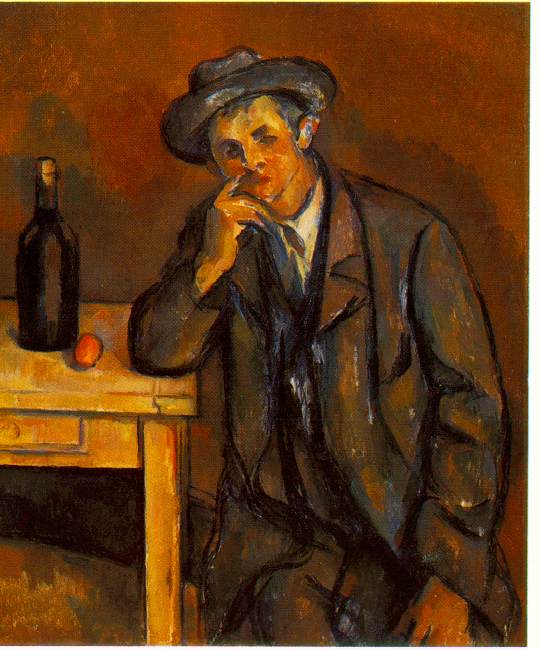
Image: Paul Cézanne, The Drinker. Oil on canvas, 45.7 x 37.5 cm (18 x 14 3/4 in); The Barnes Foundation, Merion, Pennsylvania.

2006/03/01

A philosophical doubt


"Erst kommt das Fressen, dann kommt die Moral" declare both Macheath and Jenny in the ballad "Wovon lebt der Mensch" in Bertolt Brecht's Die Dreigroschenoper. Like you, I suppose, I've quoted this phrase many times as a profound truth. Now I wonder whether even Brecht believed it -- he puts it into the mouths of two of his most rascally characters. More to the point, I'm wondering if it's even historically correct: that people have been concerned about getting their grub, and only then attending to their spiritual needs.

I've been pondering the archaeological evidence from ancient Peru and from work I did earlier on the ancient civilizations of Mexico and Guatemala, from the Olmecs to the Mexicas (Aztecs). Just now I was trying to make sense of the temple and sculptural remains of Chavín de Huántar, an imposing power center that flourished from some time before 500 BC to about 200 BC, in the northern highlands of Peru. It seems clear that the most impressive architecture, representing by far the greatest collective effort, was performance spaces for sacred rites (such as a priest's turning himself into a jaguar, for example). By spreading their jaguar religion, the people of Chavín (or at least their rulers) spread their power and trade. That is, first came the missionaries, then came the merchants.

But Macheath's dictum, "First comes the grub, then the morality," is not just a cynical gangster's way of belittling morality. It is also a central tenet of modern liberal thought, the pragmatic view that used to be dominant in the U.S. First we need to take care of people's material needs, including food, shelter, health care, etc. Then we can argue about mystical and religious matters if we like. That's what every progressive (or Progressive) American used to believe. Now I think it's very unfortunate that we have an administration that wants to push us back to the mentality of the jaguar priests: "First comes Holy Scripture, then comes Haliburton."

Here's a discussion of the "First comes the grub..." phrase from The Threepenny Opera, in everything2. You can get info and see a terrific video on Chavín de Huántar at The Global Heritage Fund site.