2006/05/12

Back in port


Monday night I got back from Spain, where my significant other and I have been living for the past six months. On the British Air flight from Heathrow to JFK, I got to see the tiny-screen version of "King Kong". Hilariously ridiculous. What I liked best, and what stirred something deep inside me, was the tramp steamer "Surabaya Venture." Wonderful name! It summoned recent memories of the harbor in Java crowded with colorful pinisi, overlaying earlier memories of Brecht's Surabaya Johnny. But most of all, the scenes awakened a deeper memory of adolescent romance. Perhaps it was in Heart of Darkness -- which the boy on board is reading in the movie -- where I first discovered such a magical vessel, or perhaps it was some other novel. I read many sea novels of sail, steam and even oars, eager to climb aboard again in my imagination. In at least one of those novels the point-of-view character was a boy like me, maybe 13 o 14 years old, except that he had shipped out as an "oiler." This meant he spent most of his time down in the dark, hot, smelly and noisy engine room, watching and learning from the older men sweating beside him. Oh glory! The smells of the sea and the oil and that sweat, the noise of the engines and of the boat itself creaking in the waves, the incessant movement toward -- toward nothing, really, because every port was merely an interruption in the perpetual rocking on the briny deep. That was the life for me, when I was reading. The rest of the time I was stuck on dry land in a suburb of Chicago.

Now I've crossed the sea by air. I'll probably have to wait until my return to Spain to experience in real life the sweat and motion and smell and noise of a working vessel -- "El Cuco," owner and captain of the María y Gabriela based in Carboneras, a diesel-powered fishing boat that normally carries a crew of 8 to 10, has promised to take me out on one of his expeditions, maybe to the Baleares in the Mediterranean, or maybe off the coast of Africa, near Madeira.

Internet connection was a bit of a hassle for us in Spain, which is one reason I haven't posted for a long time on this blog. The few chances I got (when I could get to the public library and when the library's ADSL connection was working) I put into my other blog, the one in Spanish. (If you read Spanish, you may want to look at my recent book synopses there.) But this is my announcement that I'm back in New York, with ADSL in my very own home office, and I hope to be posting here much more frequently. Coming up: My take on Spain's social and political evolution and how the country is dealing with its terribly violent history; some urbanizing lessons (what not to do) from Spain; and, once I've done the necessary research to say something new, more on Latin America and on Latinos in the U.S.

Photo: "A typical Cardiff tramp steamer - the SS Pontwen, built in 1914." From website Wales Past.

2006/03/06

Unscientific secular humanism

A friend forwarded me this note:
Here is a powerful and amazing statement defending secular humanism on Al-Jazeera television. The woman is Wafa Sultan, an Arab-American psychologist from Los Angeles. I would suggest watching it ASAP because I don't know how long the link will be active. Link
I wasn't able to see the clip (something must be wrong with my settings), but I found a transcript, and many other pages devoted to her. My enthusiasm soon flagged. Most of those pages are by fans who cheer her every riposte like a winning goal, and a lot of her claims are as wildly exaggerated as her foes'. For example,
The Crusader wars about which the professor is talking – these wars came after the Islamic religious teachings, and as a response to these teachings. This is the law of action and reaction. The Islamic religious teachings have incited to the rejection of the other, to the denial of the other, and to the killing of the other. Dhimmi Watch
This is literally true (that the Crusades came after Islam), but misleading in the implication that the Crusaders were acting in self-defense. Each of the several Crusades was a little different (the Children's Crusade being the maddest adventure), but in several the chief motivation of the instigators was a land-grab. Also, our psychologist ignores utterly the four-century experience of Arab Spain, which with all its faults, was generally a collection of much more enlightened and far more tolerant regimes than the genocidal Christian monarchy that succeeded them.

Or this, from the Al-Jazeera broadcast cited:
The Jews have come from the tragedy (of the Holocaust), and forced the world to respect them, with their knowledge, not with their terror, with their work, not their crying and yelling. Humanity owes most of the discoveries and science of the 19th and 20th centuries to Jewish scientists. MEMRI TV transcript
Darwin? Pasteur? Boyle? Marie Curie? Edison? Marconi? The Wright brothers? And on and on, the list of non-Jewish scientists of note. Many important scientists have been "Jews" in some sense (mostly the DNA sense; I don't know but I doubt that Jonas Salk, for example, was a frequent attendant at temple). Many more (naturally) were not. The idea that Jews have a superior genetic ability for science is not merely racist, it's unscientific. Currently some of the most important inventors in chemistry, medicine and electronics are Indians (see Indian Scientists)-- but not because of genes. Here for example is a page listing major inventors of the 20th century: Learning Site.

My Jewish roommates in college (both temple-goers) liked to boast that the three greatest scientists of recent times were all Jewish: Marx, Freud and Einstein. In fact none of them was in the only sense that should matter: each rejected Jewish mysticism and religion quite forcefully.

I'm all for secular humanism. I just wish it could be more secular and more scientific.

2006/03/05

Fashionable anti-Semitism


A friend in New York (from which I've been away now for several months) shared this:
"From an article in the current issue of the Jewish Week:

Garrison Keillor's "The Writer's Almanac," on PBS, recently discussed how famous artists disagreed about French Jewish officer Alfred Dreyfus when he was on trial for treason in 1894. Among the artists who supported Dreyfus: Pissarro (my favorite artist, Jewish and socialist), Manet, Monet, and Proust. Among those against Dreyfus: Cezanne, Rodin, Degas (whom I've read elsewhere was rabidly anti-Semitic), Rimbaud, and Jules Verne."
The only thing odd about this is Cézanne, who was a close friend and even disciple of Pissarro, according to an article I saw in El País on the recent exhibition of their works at MoMA (which I unfortunately missed).

Of course, anti-Semites have always made exceptions for their friends. I'm no expert on late 19th century French intellectual history, but I have the impression that fashionable anti-Semitism (which of course has always meant "anti-Jewish", not including the Semitic Arabs) was not, or not always, "racial" but rather a repudiation of allegedly Jewish cultural traits. That is, the view was that a person could escape "Jewishness" by adopting other traits (whereas a Hottentot would always be a Hottentot, no matter how well he spoke or held a fork). That was why an anti-Semite could have a friend of Jewish ancestry but who was not (in the friend's eyes) really "Jewish." And it was why Marx (grandchild of rabbis) could write such cutting sarcasm in his essay "On the Jewish Question".

The Third Reich changed all that, of course. It reverted to the more ancient "racial" view, which always had a constituency in Europe, even in the late 19th century when people like Wagner thought it was just a clever joke to say that the French and the Jews would do civilization a favor by committing suicide.

Image: Paul Cézanne, The Drinker. Oil on canvas, 45.7 x 37.5 cm (18 x 14 3/4 in); The Barnes Foundation, Merion, Pennsylvania.

2006/03/01

A philosophical doubt


"Erst kommt das Fressen, dann kommt die Moral" declare both Macheath and Jenny in the ballad "Wovon lebt der Mensch" in Bertolt Brecht's Die Dreigroschenoper. Like you, I suppose, I've quoted this phrase many times as a profound truth. Now I wonder whether even Brecht believed it -- he puts it into the mouths of two of his most rascally characters. More to the point, I'm wondering if it's even historically correct: that people have been concerned about getting their grub, and only then attending to their spiritual needs.

I've been pondering the archaeological evidence from ancient Peru and from work I did earlier on the ancient civilizations of Mexico and Guatemala, from the Olmecs to the Mexicas (Aztecs). Just now I was trying to make sense of the temple and sculptural remains of Chavín de Huántar, an imposing power center that flourished from some time before 500 BC to about 200 BC, in the northern highlands of Peru. It seems clear that the most impressive architecture, representing by far the greatest collective effort, was performance spaces for sacred rites (such as a priest's turning himself into a jaguar, for example). By spreading their jaguar religion, the people of Chavín (or at least their rulers) spread their power and trade. That is, first came the missionaries, then came the merchants.

But Macheath's dictum, "First comes the grub, then the morality," is not just a cynical gangster's way of belittling morality. It is also a central tenet of modern liberal thought, the pragmatic view that used to be dominant in the U.S. First we need to take care of people's material needs, including food, shelter, health care, etc. Then we can argue about mystical and religious matters if we like. That's what every progressive (or Progressive) American used to believe. Now I think it's very unfortunate that we have an administration that wants to push us back to the mentality of the jaguar priests: "First comes Holy Scripture, then comes Haliburton."

Here's a discussion of the "First comes the grub..." phrase from The Threepenny Opera, in everything2. You can get info and see a terrific video on Chavín de Huántar at The Global Heritage Fund site.

2006/02/21

Religion, parasites & Danish cartoons

Thanks to buddy Don Monkerud, I just saw this article from yesterday's New York Times, by one of the NYT's most engaging essayists, Edward Rothstein. It begins:
An ant climbs a blade of grass, over and over, seemingly without purpose, seeking neither nourishment nor home. It persists in its futile climb, explains Daniel C. Dennett at the opening of his new book, "Breaking the Spell: Religion as a Natural Phenomenon" (Viking), because its brain has been taken over by a parasite, a lancet fluke, which, over the course of evolution, has found this to be a particularly efficient way to get into the stomach of a grazing sheep or cow where it can flourish and reproduce. The ant is controlled by the worm, which, equally unconscious of purpose, maneuvers the ant into place.

Mr. Dennett, anticipating the outrage his comparison will make, suggests that this how religion works. People will sacrifice their interests, their health, their reason, their family, all in service to an idea "that has lodged in their brains." That idea, he argues, is like a virus or a worm, and it inspires bizarre forms of behavior in order to propagate itself. Islam, he points out, means "submission," and submission is what religious believers practice. In Mr. Dennett's view, they do so despite all evidence, and in thrall to biological and social forces they barely comprehend.

I admire Dennett, and was thrilled by his earlier book, Consciousness Explained. As for his argument here though, I think it's plain wrong. Religious belief is not analogous to the worm in the brain of the ant, forcing the ant to do things that are of no benefit to it.

Richard Dawkins' expression of a similar idea was more subtle, and also allowed more room to see it as a metaphor rather than an actual biological fact. (See my earlier blog of 2005/9/25.) What Dawkins calls a "meme" (such as "Allah is great," or any ad jingle) is not a gene, and has no physical presence in anybody, but in some ways it acts like a gene, and the metaphor can help us perceive the process of transmission. I borrowed the "meme" metaphor in Hispanic Nation, for that reason. But, like the Danish cartoons, "meme" (or "parasite") is only a metaphor: it points to some other reality, exaggerating some aspects without defining or describing it.

This is serious, this biological reductionism, when it's taken seriously. It's serious, because as a diagnosis it prescribes exactly the wrong remedy. If religious belief is a parasite in the brain, then to get rid of it you have to attack the brain in some physical way. For example, stripping men naked and putting women's underwear over their heads, chaining them and treating them like dogs, or, as Rumsfeld advocates, making them stand (preferably naked and chained) for many hours, or shocking them physically (water, electricity) or emotionally (tossing a Koran into the toilet, for example). So far, it doesn't seem as though the Guantanamo cure has worked for anybody.

Religious believers (the "hosts" of the belief) persist in believing because they do derive benefit from it. Among people I know, the benefit is often esthetic (the beautiful music, or paintings, etc., seem to glow more warmly for the believer). Usually, it's something to cling to to get you through the dark night, the bad times -- the notion that, whatever the hardships of the moment, there will be some final justice in the end. And there is also the benefit of belonging, of feeling part of the crowd, so that one's personal minuteness in the vast and confusing whirl of the cosmos joins a powerful flow. As our friend Karl put it famously, "Religion is the sigh of the oppressed creature, the heart of a heartless world, just as it is the spirit of a spiritless situation. It is the opium of the people."

We non-addicts, and non-believers, have to find other ways to feel good, but people without our resources have a hard time getting along without their gods. If we want to free them from the addiction, the opium, the parasite (all metaphors for a kind of yearning), we need to supply them with the necessary resources for a life free of gods, demons, mullahs and priests: e.g., education, income, medical insurance, a reasonable expectation of civil justice, care for the elderly, etc.

2006/02/09

What I'm up to these days

In case anybody has been wondering why I haven't posted in a while, here's why (paraphrased from a note I just wrote to a friend & fellow writer who was urging me to get more of my stories published).

One, or maybe two or three, things at a time. I think I'm accumulating experience for a new series of stories, just by doing these other new things. Right now the business of running a small business (our land development project), in a place with unfamiliar laws and customs, is absorbing enough. I'm also spending much more time than I used to with friends (mostly Spanish, but also a small crowd of English folk in the area), and discovering (through their recommendations and the reading club in the local public library) novelists I had never read. That's already about three or five things, more if I add the book on architectural history I'm co-writing.

And I also want to write some Spanish stories, meaning stories in and about Spain, and I even think I want to write them in Spanish. I'm not sure about that last, though; writing in Spanish would make them accessible to the people all around me here, and to the many other Spanish-speakers I've come to know over the years. But I don't know yet whether I can get it right, the tone of voice and so on. It should be fun to try. As practice, I've been keeping a blog in Spanish.

2006/01/24

Why we are in Spain

This is a view from our plot of land in Carboneras, where Susana and I are about to build. I took this shot last week (18 January), at 8:25 a.m. Daybreak comes late over the Mediterranean coast this time of year.

The sea looks tranquil here, but just days earlier, at the nearby Playa de los Muertos, it was bursting with energy and swallowed three veteran fishermen -- the motor had died in their little boat just like the one in the photo, and the great waves, blindly and exuberantly, rolled it over. One of the men we knew and had spoken with. Lorenzo, who was nearly 80, so loved the sea that, long after he had given up his own boat, he would go down to the port and offer his service to anyone going out -- in the case, Antonio Cayuela and his son, other well-known vecinos of Carboneras. Lorenzo knew the sea was treacherous, but it is easy to see why it is also seductive.

2005/12/01

The fish that snored


Things have been pretty agitated here in Carboneras lately, with the local Socialist (PSOE, Partido Socialista Obrero Español) municipal administration at loggerheads with the national PSOE government's Ministry of the Environment over a development project (a big hotel) on a nearby beach. The Ministry wants to tear down the hotel as a violation of coastal protection, the Carboneras town hall was counting on it as a source of employment for the citizens. It's a complicated issue, and we have good friends on both sides -- the local ecologists (Greenpeace actually seized the hotel briefly a week ago) and the local Socialists (who organized, of all things, a general strike in the village last Friday). I've started to write up an analysis of it, because it's symptomatic of a much bigger issue involving all of Spain (and probably every country on the Mediterranean), but I'm writing it English because I don't want to become a participant in the battle -- not yet, anyway, until I can offer some helpful alternatives.

What is happening is that chunk by chunk, Spain's beautiful rugged coast is getting cemented-over by hotels and enormous developments of hundreds or even thousands of second homes for opulent retirees from all over Europe. The retirees are attracted by the climate, the culture, and the excellent and free health care, better and cheaper than most of them could get at home. Golf courses, swimming pools, and the extravagant personal hygiene and gardening habits of the newcomers are sucking up scarce water, even as this part of Europe is growing drier and drier. Carboneras' big new hotel is a minor culprit – Marbella, in Malaga, has thousands of illegal shore side constructions, granted licenses by the local administration in clear and repeated violation of law, and nearer at hand, Mojácar’s once wild beach is now a solid strip of tourist traps big and small. But the nearly-completed 411-room hotel built by the big Azata company (based in Madrid) is the most recent offense, and the Ministry wants to make an example of it. The example comes a little late – but better late than never; there is still some pristine coast left to be saved, in Carboneras and other parts of the region.

But the need for jobs is real, too. Carboneras used to live mostly on fishing, but bigger fishing interests with dragnets, etc., have so depleted the stock that fewer and fewer fishermen can continue. Their sons are more like to go into construction, building those fancy second homes (like ours), but that can't last long -- space for new building in Carboneras is just about gone. So service jobs in tourism seem like the best option -- waiting tables, making beds, whatever.

A better option that has been suggested by some people here would be to encourage the development of what are called “rural hotels” inside the Nature Park (Parque Natural Cabo de Gata-Nijar) that occupies 75% of Carboneras’ territory. These would not be new constructions, which are (properly, I think) strictly forbidden in the park, but conversions of existing farmhouses, as has been done throughout Spain. There are families and farmhouse-owners eager to do this, since they can’t very well farm economically in the park and need the income, and such hotels would surely create jobs directly (hiring a gardener or cook, for example) and indirectly (through demands for services), and of course more and more attractive places for tourists to stay near town. So far, though, the authorities have denied applications for licenses for such conversions, fearing that they would in fact lead to new construction that would alter the natural environment of the park. But that has to be a better idea, both environmentally and economically, than a cement ziggurat of 411 rooms right on the water’s edge that profits mainly some huge and distant hotel management company.

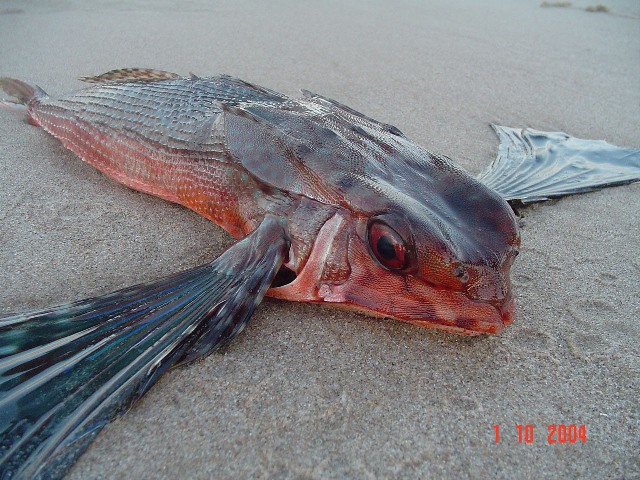
The coastal area in dispute includes, first of all, the Playa de Algarrobico and extends to the pebbly shore known as the Piedra de Roncaores. The roncaor, or “snorer” fish (“roncador” in more formal Spanish, “croaker” in English) seems like a good symbol for Carboneras in its present plight. It’s about a foot long with a bulldog-like face and lateral fins like wings that, when attacked, it thrusts out to make it look much bigger than it is, while it makes an angry (snoring?) noise with its jaws. Like Carboneras (pop. about 7,000) with its “general strike” and angry speeches against the Minister of the Environment last Friday. But all that fin-thrusting and snoring doesn’t always keep the roncaor from getting caught and eaten by bigger, human predators.

(The roncaor pictured above had washed ashore in Valencia, just up the coast from Carboneras. For sketches and further data on this peculiar beast, check out Mare Nostrum. Because of its "wings," the roncaor is also known as the pez golondrina.)

2005/11/21

The Old South in Black and White

Jones, Edward P. 2003. The Known World. New York: Amistad (HarperCollins).

This powerful novel, like a Brueghel painting, is a crowd scene of individual portraits where each character is engaged in some intense, private activity. The collective ritual in this case is slavery in the ante-bellum South of the U.S., and the characters include black slaves, black freemen and women some of whom are themselves slave owners, whites of various social statuses and backgrounds, and an Indian of ambiguous status – not quite enslavable, but not quite a white. Some of these characters, black and white, attempt to behave honorably without always succeeding; some do cruel things thoughtlessly or selfishly. All are trapped in a system that rewards whites for cruelty even when they want to be just, and servility from blacks no matter how hard they struggle to attain and retain dignity. The women – especially the black women -- are as vivid as the men. Though most of the action gets started in one county in Virginia in the 1840s, Jones wants to know what became of his creatures after they left the county, some as far as Philadelphia, New York, and Washington, and shows us the lives of the surviving blacks many decades later, after the Civil War and emancipation. Some of them do achieve dignity.

2005/11/09

The view from Carboneras

In this small town on the Mediterranean coast of Spain, the people who have been here a while are always looking for an opportunity to turn a stranger into a vecino, that is, into a known quantity that can be integrated into the community. This is why newcomers are so often surprised by unsought conversations in a shop, a bar, or on the street, even when the language barrier is high.

Community is woven of many threads of information, some of them as light and fragile as a person’s sigh or tic, others– remembrances of ancestors and of living family, or knowledge of one another’s political or religious preferences –tightly wound into stronger cords. The denser the weave, that is, the more the threads that cross through it, the more firmly attached are the members to each other. A vecino is not necessarily an amigo – among families that have dealt with one another for generations, threads of ancient conflicts pull against other, newer ties. But for the same reason, the multiplicity of ties, a vecino can never be entirely an enemy. And a newcomer is always a potential amigo, someone you know well enough to know what might please and what might hurt, and care enough about to avoid the latter.

People here are friendly and open not just to one another, but even to unmonied immigrants from Africa, black and brown, Eastern Europe, and China, to foreign retirees of means – mostly English or other European –and even gypsies. And here in Carboneras, as Susana & I happily allow ourselves be woven ever more tightly into this community, we watch – on TV and in the papers – how different things are in other parts of the world.

Right now the most dramatic contrast is with France, where youth of all colors, but especially those whose parents came from Africa or Asia, are hurling firebombs in protest against their exclusion from the community. And yet France has far fewer immigrants from those areas than Spain, which in 2004 received 610,000, more than any other country in the world except the U.S. (“Un milagro español,” by Andrés Ortega, El País, 7 Nov. 2005). Not all parts of Spain are as welcoming and harmonious as Carboneras, but this country has made far more successful efforts than France at bringing immigrants into the community. The reasons are complex, but surely the policies of inclusion of Spain’s socialist government, in sharp contrast to the punitive policies of Chirac and Sarkozy, are part of the explanation.