2006/06/04

Army of Shadows

We were deeply impressed -- as was everybody in the audience at Film Forum last night -- by Jean-Pierre Melville's 1969 docu-thriller Army of Shadows ("L'armée des ombres"), about the French Résistance in its most difficult years, 1942-43. It is gripping for many reasons: the tense, controlled acting; the inherent drama of the story itself, based on Résistance memoirs by the pilot, Résistance fighter and author Joseph Kessel; and most especially for the mastery of tension by director Melville, himself a Résistance veteran who has added details from his own memories (and cinematographic cunning) to Kessel's story.

The movie is fiction, in that it compresses many real episodes and their protagonists into a few memorable characters. (For how he did it, and what proportion is fictional and how much absolutely authentic, see the 1971 interview of Melville by Rui Nogueira.) The central figure, 44-year old civil engineer and ranking Résistance commander Philippe Gerbier, played by Lino Ventura (a former champion wrestler, Ventura had previously been cast by Melville as a bad guy), is a composite of (according to Melville) 7 or 8 real people who really did those amazingly daring things. I don't know who the Simone Signoret character, Mathilde, is based on, but she's wonderfully brave, determined and tragic. But the figure who impressed me most deeply was Luc Jardie (Paul Meurisse), who is based in very large part on the historical Jean Moulin, put in charge of the Résistance by De Gaulle himself and charged with uniting its various factions. But Melville seems to have had someone else in mind also when he constructed the character. The real Moulin was a rather handsome professional politician, once France's youngest prefect. The fictional "Jardie" is a small, balding, and unhandsome intellectual (we see his several books on theoretical mathematics), supremely brainy as well as supremely cool and courageous, acting with moral clarity in some very complex dilemmas.

It is a kind of heroism seldom celebrated in American action films. But in the director's better-known gangster movies you can find these same quiet, manly virtues, which he learned the hard way. Born Jean-Pierre Grumbach, "Melville" was his nom-de guerre in the résistance.

Jean-Pierre Melville filmography
Bio of Jean Moulin in English
Dossier : "De Gaulle et Jean Moulin" Biographie par Christine Levisse-Touzé (in French). This has more complete information plus photos of Moulin.
NYT review of "Army of Shadows"

2006/05/28

Double-dealing deity

I was surprised to read in the NYT yesterday that all the land of Palestine is waqf, given by God exclusively to the Muslim Arabs in perpetuity. No doubt the Hamas legal team has convincing scriptural evidence of this deed. But Jewish settlers have equally convincing evidence that God gave all that land to them, exclusively and in perpetuity.

This is not the first sign of the deity's duplicitousness. Jack Miles in God: A Biography (New York: Vintage Books,1995), points out how contradictory & unpredictable he is in the Tanakh (Hebrew Old Testament), undoubtedly because he is a synthesis of many earlier Mesopotamian gods & goddesses. He can be benevolent, cruel, petty, deceptive (he lies to Eve and Adam, saying they will immediately die if they eat the forbidden fruit of the tree of knowledge); he can be bargained with (e.g., by Abraham); then at the end of the Tanakh (which, unlike the Christian version, puts the prophets before "the writings," Psalms through Chronicles) he falls silent.

What fools they be who say "In God we trust." Eve not only survived, she multiplied (boy, did she multiply!). And the fruit of the tree of knowledge is all that can save us. We should all take another bite.

2006/05/27

Something there is that doesn't love a wall

On Thursday, as the U.S. Senate was about to vote on its new immigration bill, scholars and political experts at New York University were busy "Rethinking Global Migration: New Realities, New Opportunities, New Challenges." (Click here for conference program and webcast.) The main conclusion (for anybody who was paying close attention) was how ridiculous and inadequate are the Senate's gestures. The only thing that can be said for the Senate bill is that it is not as punitive as the bill in the House, but none of these measures addresses the real problems in a realistic way. To wit:
• The Senate proposal would permit 200,000 "temporary workers" per year (the House bill would permit none), but we've got 500,000 crossingly illegally each month, according to Cristina Rodríguez (NYU). So the numbers are totally inadequate both for the emigration pressure from Mexico and for the labor demand on the U.S. side of the border, which is immense.

• The Senate's bill does not envision any reciprocal process in Mexico, such as "We will admit x number of workers legally if you (Mexico) commit to reducing illegal emigration from Mexico by that amount" -- an idea broached by Jorge Santibáñez (President, El Colegio de la Frontera Norte, Mexico).

• People will keep coming, even at the risk of their lives, as long as survival opportunities in the U.S. are so much greater than in their own countries, no matter how high or long or thick the fence. Most of those who come illegally don't even cross by land anyway, according to several the speakers.

• U.S. labor demands, for example for highly trained nurses from the Philippines and elsewhere, are making conditions even worse in the sending countries -- by diminishing services -- and thus stimulating emigration. That's not going to stop with the proposed legislation, but there could be negotiated ways of relieving pressure on the sending countries.

• The biggest issue -- implicit in the others -- is one emphasized by Saskia Sassen, enriched by her comparative studies of European immigration policies: No immigration policy will be tenable unless it is worked out in negotiation among both sending and receiving countries.
In short, we can't "secure our borders" on only one side. Nor would it be enough to enter a treaty with Mexico. The northward flow of migrants is regional, with great numbers from Central America and South America illegally entering Mexico just to cross it and get to the U.S. border.

This is just a start for my thoughts on the question. We still haven't talked about "assimilation" of immigrants, whether and how fast they will learn English and adapt to the "American way of life." One thing is obvious, though: a "guest worker" program just inhibits assimilation, by telling people they can never become U.S. citizens anyway. And of course letting 11 million or so people remain "illegal" isolates them, from services, police, and schools, making their assimilation almost impossible.

When in "Mending Wall" Robert Frost quoted another farmer saying, "Good fences make good neighbors," it was because he found the statement ridiculous. He went on to reflect,
Spring is the mischief in me, and I wonder
If I could put a notion in his head:
"Why do they make good neighbors?...
Before I built a wall I'd ask to know
What I was walling in or walling out,
And to whom I was like to give offense.
Something there is that doesn't love a wall,
That wants it down." ...
In the 21st century, that "something" is globalization, the unstoppability of information, money goods and -- though at greater risk and cost -- people, regardless of borders. They only way to regularize the flows for the greatest benefit and least harm to all parties is through frank, honest and serious negotiations. A good place to start would be with Mexico and the countries to its south.

Good neighbors can make good fences.

2006/05/23

Immigration: preparing to enter the debate

I know, I know. My participation is long overdue. After all, I did write a book about it, and more recently (2003), an op-ed on a the growing census numbers. The huge demos last March caught me by surprise -- I was in Spain and, frankly, had not been closely following the politics of what I had called the Hispanic Nation. I don't want to just give an opinion; this question is too important for pundits. Rather, I want to come up with some hypotheses, and maybe even a proposal, that will help us understand and deal with all the conflicting issues. Big job. A job for a sociologist.

Here are some things I've been reading to get back up on it, in rough order of interest:
• Nina Bernstein,100 Years in the Back Door, Out the Front, NYT Week in Review; also, click on Bernstein's link to see her other articles on the issue -- serious reporting.
• E. J. Dionne Jr., Divisive In Any Language (washingtonpost.com)
• Alicia A. Caldwell, Security plan worries N.M. town officials (AP, boston.com)
• Shikha Dalmia, No Free Ride (Knight Ridder, Tom Paine)
• Sandi Burtseva, Yes, We Know They're Illegal (Tom Paine)

To know the truth-- you have to try!

Check out the National Coalition Against Censorship, or subscribe to their printed newsletter (address on the site).

2006/05/22

The truth must not be told

Borjesson, Kristina. 2004. Into the Buzzsaw: Leading Journalists expose the Myth of a Free Press. Pp. 453 + index. Amherst NY: Prometheus Books.
"The government has the legal authority to prosecute journalists for publishing classified information, Attorney General Alberto R. Gonzales said yesterday," reports Adam Liptak deep inside today's NYT (p. 14). The article goes on to say that Gonzales repects the right of the press under the First Amendment, "But it can't be the case that that right trumps over the right that Americans would like to see, the ability of the federal government to go after criminal activity."
And if it is the government that is committing the crimes? That's just the case in many of the stories told in Into the Buzzsaw, a collection of first-hand accounts of suppression of important news stories and attempts to silence the journalists who reveal them. Among the suppressed stories: CIA involvement in drug trafficking (chapters by Michael Levine & Gary Webb) and murder (J. Robert Port); excesses and even atrocities by U.S. forces in Iraq (Ashleigh Banfield) and 50 years ago in Korea (J. Robert Port); evidence that TWA Flight 800 may have been brought down by U.S. Navy missile in 1996 (Was it? I don't know, but the crime is suppression instead of investigation of testimony that suggests it was), and much more.

The suppression of stories inconvenient to the rulers is the oldest suppressed story in the world, and much of the time it has probably worked -- how many of those clay tablets from ancient Sumer were deliberately smashed by the king's censors, and what did they say? When Atahualpa defeated his half-brother Huáscar to become the Sapa (or "Supreme") Inca, he ordered the destruction of all previous history, which in the Andes was recorded mainly in a complex system of knotted cords called khipus (or quipus), decipherable only by the khipu-experts or khipukamayuqs. The only reason we even know this is that Atahualpa was captured and slain by the Francisco Pizarro's Spaniards before he could consolidate his power and erase all memory of the event.
In a gathering convoked by viceroy Cristóbal Vaca de Castro (c. 1600), the ancianos “explained that prior to the arrival of the Spaniards, Atahualpa had attempted to revise Inca history by burning all the khipu he could find and killing the khipukamayuqs.” (Brokaw, Galen. 2003. "The Poetics of Khipu Historiography: Felipe Guaman Poma de Ayala's Nueva corónica and the Relación de los quipucamayos." Latin American Research Review 38:111-147.)
So regime change is one way we can find out about suppressed news. But what came next in the Andes was even worse. Subsequent to Atahualpa's overthrow, the conquerors introduced a new official story and a terrifying way of sustaining it: the Inquisition. So revolution or other regime change is no guarantee of freedom of information.

The only guarantee is some system where competing power-groups sponsor competing narratives, which is what has worked for the U.S. for the past two centuries -- unevenly, of course. The Alien and Sedition Acts were ultimately undone by Jefferson's Democratic Republicans, McCarthyism hit its major snag when the senator from Wisconsin took on the Army, Johnson's war in Vietnam ran up against not only massive street protests but eventually even the establishment press when the NYT decided to go with the Pentagon Papers. And that is the kind of competition that worries Gonzales and his boss in the White House. Whether they are right in every detail or not, the reporters in Buzzsaw help keep open a little more space for further competing narratives. And as Jefferson, Lincoln and other American heroes stated over and over again, that is the only way to forestall the new American Inquisition.

Drawing by Guamán Poma de Ayala of a khupucamayuq displaying his work. Click to enlarge.

2006/05/19

Don't just read this -- Do something!

Lindorff, Dave and Barbara Olshansky. 2006. The case for impeachment: the legal argument for removing President George W. Bush from office. New York: Thomas Dunne Books.

Last night, at a panel sponsored by the National Writers Union at the Coliseum Bookstore in New York, I heard Dave Lindorff (long-time investigative reporter) describe how he came to write this book with constitutional rights lawyer Olshansky, and what he discovered in the process. He got me excited enough to buy the book, which I just now finished reading.

Like me and probably like you, Dave was skeptical at first that impeachment, however justified, would be at all possible in the present political climate. But it is not so far-fetched at all. Especially if we can change the political climate, both by re-taking Congress in the coming elections and, especially, doing everything we can to turn the widespread disgust with this administration into a popular movement.

This book can help us do that. It has two great strengths: First, a clear, concise review of the history and legal issues -- the procedure and Constitutional bases -- that we will need to understand and to explain to others who want Constitutional authority restored. Second, an equally concise and clear summary of the many "high crimes and misdemeanors" -- political offenses, abuses of power, violations of the U.S. Constitution and betrayals of the people's trust. Lying about WMD, about a supposed Hussein-al Qaeda connection, failing to protect us prior to 9/11 in the face of many explicit warnings, disregard of the law of the land (including the Geneva Convention and other international treaties signed by the U.S.), stripping U.S.-born citizens (José Padilla and Yaser Hamdi) of their rights and declaring them "enemy aliens," kidnapping civilians in other lands and shipping them to countries where they will be tortured, and on and on. And then there's the spying on U.S. citizens, from requiring librarians to secretly report on your library habits to the massive phone snooping now in the headlines.

The matter is urgent. We have to use every power at our command to stop this Administration's destruction of constitutional values. And most urgent of all, prevent them from launching yet another war, this time on a country -- Iran -- with greater power of retaliation, just so they can win or steal another election.

More info on the book.

See related articles by Lewis Lapham, John Dean, or just do a Google search for Case for Impeachment. It's amazing how many legal thinkers are already on our side!

And if you're a writer, check out the National Writers Union.

2006/05/18

Swinging from the family tree

Your grandma married a chimp! And mine too. Well, not exactly our grandmas, but our great- great- great ... great- grandmas. And the ceremony probably wasn't as formal as what we today call marriage. But they were getting it on! And as recently as 5.4 million years ago. This is what the new analysis of the human genome suggests. I find it really exciting (as it no doubt was for them) to think of these early couplings. I love the way the New York Times puts it: "Hybridization [of humans and chimps] could have speeded adapation to this challenging new environment [the drier woodlands opening up between the forests]... But the males in hybrid populations are often sterile. So the females may have had to mate with males in the chimpanzee lineage in order to produce viable descendants." Here, more accessible if you don't have a NYT account, is the BBC report on the findings.

Portrait of Freud, a great-great-great...great grandpa look-alike, courtesy of the Jane Goodall Institute.

2006/05/15

Mothers & sons

Turgenev didn't write this, so somebody has to. Actually somebody did, Sophocles for one. And Freud, of course. And Tennessee Williams and quite a few others. But the legend of the purity of maternal love (cf. the Virgin Mary) is so pervasive in our culture that most fear to state the obvious: Tensions between mothers and sons are terribly intense and become moreso as the son approaches maturity; unless they are carefully managed -- or unless the son succumbs -- they become unbearable, and the son must break out or do other damage. Maybe by signing on to a tramp steamer, or going to war. Or running off to a foreign continent.

Just a little reminder on Mother's Day. For much more on the subject, see the list of books here. Some day I may add another work to this list, but it will have to be fiction so that I can tell the truth.

Photo: Monica Peters in the role of Iocasta. Click to enlarge.

2006/05/12

Back in port


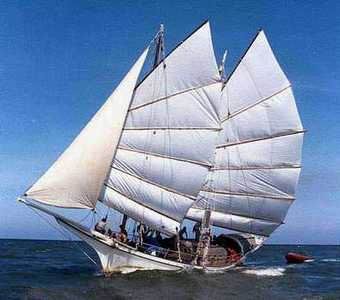
Monday night I got back from Spain, where my significant other and I have been living for the past six months. On the British Air flight from Heathrow to JFK, I got to see the tiny-screen version of "King Kong". Hilariously ridiculous. What I liked best, and what stirred something deep inside me, was the tramp steamer "Surabaya Venture." Wonderful name! It summoned recent memories of the harbor in Java crowded with colorful pinisi, overlaying earlier memories of Brecht's Surabaya Johnny. But most of all, the scenes awakened a deeper memory of adolescent romance. Perhaps it was in Heart of Darkness -- which the boy on board is reading in the movie -- where I first discovered such a magical vessel, or perhaps it was some other novel. I read many sea novels of sail, steam and even oars, eager to climb aboard again in my imagination. In at least one of those novels the point-of-view character was a boy like me, maybe 13 o 14 years old, except that he had shipped out as an "oiler." This meant he spent most of his time down in the dark, hot, smelly and noisy engine room, watching and learning from the older men sweating beside him. Oh glory! The smells of the sea and the oil and that sweat, the noise of the engines and of the boat itself creaking in the waves, the incessant movement toward -- toward nothing, really, because every port was merely an interruption in the perpetual rocking on the briny deep. That was the life for me, when I was reading. The rest of the time I was stuck on dry land in a suburb of Chicago.

Now I've crossed the sea by air. I'll probably have to wait until my return to Spain to experience in real life the sweat and motion and smell and noise of a working vessel -- "El Cuco," owner and captain of the María y Gabriela based in Carboneras, a diesel-powered fishing boat that normally carries a crew of 8 to 10, has promised to take me out on one of his expeditions, maybe to the Baleares in the Mediterranean, or maybe off the coast of Africa, near Madeira.

Internet connection was a bit of a hassle for us in Spain, which is one reason I haven't posted for a long time on this blog. The few chances I got (when I could get to the public library and when the library's ADSL connection was working) I put into my other blog, the one in Spanish. (If you read Spanish, you may want to look at my recent book synopses there.) But this is my announcement that I'm back in New York, with ADSL in my very own home office, and I hope to be posting here much more frequently. Coming up: My take on Spain's social and political evolution and how the country is dealing with its terribly violent history; some urbanizing lessons (what not to do) from Spain; and, once I've done the necessary research to say something new, more on Latin America and on Latinos in the U.S.

Photo: "A typical Cardiff tramp steamer - the SS Pontwen, built in 1914." From website Wales Past.