La grève des ovalistes. Lyon, juin-juillet 1869 by Claire Auzias and Annik Houel
My rating: 3 of 5 stars
The strike involving at least 2,000 and possibly 8,000 women silk workers in Lyon in 1869 has achieved mythical status in radical labor history for two reasons: it was the first sustained, large-scale and (partially) successful women's labor protest in France, and it resulted in formation of the first women's section of the International Workingmen's Association, the "First International". But who were those women, and how did they manage such an effort? This book attempts to discover that mostly hidden history.
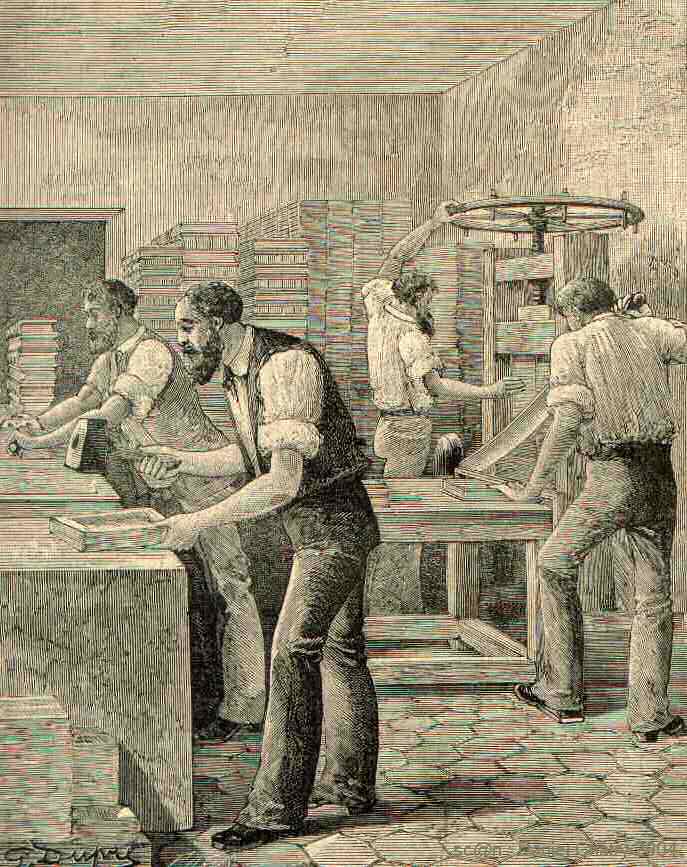
The ovalistes worked six days a week from 5 a.m. to 7 p.m., for 1 franc 40 centimes a day, standing (sitting was forbidden) inside the oval base of a steam-driven mill that wound filaments of raw silk into a yarn sturdy enough for weaving and dyeing.* The few men employed at this job earned twice as much — which of course is why the employers preferred to hire young women. Most were very young (median age 27, some only 15 or 16), illiterate or barely literate, and had been recruited from rural villages of the Rhône valley or northern Italy, and thus presumably brought up to be docile and obedient. Being far from home, and earning too little for an independent life, almost all of them slept and cooked their meals in the workshops where they were under the watchful eye of the employer, who provided bed and cooking fuel while he protected (by his lights) their morality.
In early June a group of ovalistes in one of the larger shops sent first one letter, then another, with politely phrased but insistent demands for more money and shorter hours, warning that if there was no improvement they would have to strike on June 25; they also addressed letters explaining their grievances to a senator and prefect. All were drafted by a man they knew as a professional letter writer, since few of the workers could even sign their names. Their president, sometimes called Rosalie and sometimes Philomène Rozan, signed with an X.
The newspapers found such girlish protest amusing, and the mill owners did not even bother to respond. Stonewalling turned out to be a misguided strategy, however: that first group rushed to other mills to get their support, and soon whole groups — "bands" or raucous harridans, according to the scandalized press — used their free Sundays to get acquainted and argue strategy, with the support of a male café owner who provided meeting space and the encouragement of other male neighbors; Republican (i.e., ant-imperial) sentiment was already strong in working-class Lyon. And on the 25th, as announced, some 2,000 ovalistes and their supporters gathered at the Rotonde, and determined to walk out of their jobs.
How did they survive for over a month with no pay, forced to abandon their beds in the workshops, subjected to arrest for "interfering with the right to work" (by demanding that other ovalistes join them)? Some of them didn't — some kept working or went back to work under the old conditions, some went home to their villages — but enough of them kept up the struggle long enough to make a serious impact on Lyon's main industry. Without milling of the thread, there could be no weaving and no marketing of silk.
The strikers were aided by mostly male sympathizers in Lyon, and then came an offer of strike support of 1 franc per day from the International — on condition that they join. The strikers don't seem to have had any enthusiasm for the IWA, but the offer was too good to refuse.
Finally some employers, and eventually all of them, accepted the demand for a two-hour reduction in the work day, but at the same rate of pay, less than half what men were then earning. The strike most seriously damaged the smaller millers, many of whom went out of business, and so — as interpreted by the authors of this study — furthered the consolidation of the industry into the hands of the bigger industrialists. Still, the least that can be said in favor of this strike is that it was a powerful assertion of dignity by one of the most oppressed sectors of the population, and contributed to uniting women and men workers in a common struggle. It was thus an important forerunner of and preparation for the revolution that was to break out in Lyon, Paris and other cities that declared their "communes" in the spring of 1871.
Auzias and Houel have apparently sifted through all the available documentation (police reports, newspaper articles, private correspondence) on a group of workers who left almost no descriptions of their own. These reports make for confusing and often difficult reading, and not all the data presented is equally relevant and the various concerns of the authors sometimes take us far from the main story — the lament of the non-encounter between these women strikers and the very active French feminists of the period is tantalizing but hardly satisfying. But even in the glimpses Auzias and Houel have gleaned from mostly hostile sources, and the few recorded scenes and remarks of the strikers, it is clear that the struggle, while very hard at times, was also an exhilarating and at times even festive experience, as these women discovered one another and their own power to shape their destiny.
View all my reviews
––––––––––––––––––––––––––––––––
* The ovalistes were what were called in the English silk trade "throwsters," producing "thrown silk," defined as follows in Rayner, Hollins. Silk Throwing and Waste Silk Spinning, 1903.
- Thrown silk.—A yarn composed of fibres of silk, each fibre or filament being the longest length possible to obtain from a cocoon, and such fibres of reeled silk having been "thrown," meaning wound together and twist put on the thread in a silk-throwing establishment. (Glossary, p. xv)