Showing posts with label revolution. Show all posts

2014/12/18

The Paris Commune, and them and us

Fighting Over the Paris Commune | The New Yorker 

Raoul Rigault
Right on my subject. All the contradictions that Adam Gopnik mentions are themes of my novel in progress. I'd quibble with some of his characterizations — Raoul Rigault and others were no angels, communeux or communards (they themselves generally used the first term) were far less inclined to annihilate their enemies than were the Versaillais commanders, “well-dressed ladies” really did do some of those horrible things after the massacre (we have ample newspaper accounts, by foreign and presumably objective reporters). And and then there's this remark,
There are many instances in Merriman’s account of people being saved by accident or by the act of a charitable and decent individual. But there is scarcely an incident of a principled humanity, where one side or the other refused to massacre captured civilian prisoners or hostages on the ground that it was the wrong thing to do, rather than impolitic at that moment.
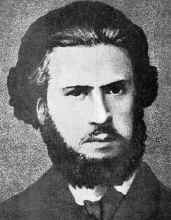
Yes, there were such instances, not only but mostly by "communards" — the most vivid testimony is in Vuillaume's "Red Notebooks"(also the best source on the crazed self-importance of Vuillaume's one-time friend Rigault). But in the last days and hours, the desperation of the Commune's defenders led to uncontrollable, mad rage on the last remaining, eastern streets of Paris. Eugène Varlin, draped in his official Commune sash, tried mightily but failed to save a group of hostages on the rue Haxo (image right).

A bloody mess, and it's true that the "Communards" were hardly united, except in their anticlericalism, and had they "won" or at least held out for a longer time, it's not at all clear that the progressive, democratic and humanitarian leaders among them would have ruled. Well, all this is rich material for my novel "The Bookbinder" (working title), which will be not only about the Paris Commune of 1871 but about us and our world today.

2014/10/22

An earthquake of a book about an earthquake event

Ten Days that Shook the WorldTen Days that Shook the World by John Reed
My rating: 5 of 5 stars

This vivid first-hand reportage of the first ten days of Bolshevik power, from the seizure of the Winter Palace in Petrograd, 25 October 1917 (by the Julian or Old Style calendar, which corresponds to 7 November 1917 in the Gregorian or New Style calendar) to its consolidation in Moscow and gathering force in the rest of Russia, is strongly partisan, pro-Lenin and the Bolsheviks, but also scrupulously documented and honestly, frankly observed. Reed describes the appearance, voices and quirks of the protagonists, including anonymous soldiers, sailors, Red Guards and workers, making apparent the chaotic, improvised character of most of the events, and the quick-witted decision-making and sometimes pitiless actions, especially those of the austere and uncompromising Lenin and the far more colorful, dramatic, and sarcastic Trotsky that repeatedly saved the Bolshevik insurrection from impending disaster. Reed does not hesitate to describe flaws, doubts and internal disputes, showing how precarious was their adventure and how close to failure. He collected leaflets, newspapers and bulletins from all parties, many of them reproduced in the book, and learned enough Russian not only to translate these but also to conduct interviews of Kerensky, Trotsky, Lenin and many other actors in this drama. Events in Petrograd and, later, Moscow are acutely observed, making this an indispensable account of the violent, chaotic, suspenseful first days of the seizure of power by masses of workers and soldiers with no administrative experience and, for all but the few intellectual leaders of the various parties, scant literacy or general knowledge of culture or history.
Those first ten days did indeed shake the world: they determined Russia's withdrawal from the Great European War, shaking diplomacy and strategy for all the other powers involved (Germany, Austria, England, France, the US especially), and created the beginnings of the hastily assembled Red Army which would eventually to triumph over the many fronts in the civil war in the world's largest nation, which was also one of Europe's least developed. The book itself continues to shake readers loose from more simplistic interpretations of this terribly complex series of events that redrew the lines of world power for the rest of the 20th century.
This 1922 edition is the first to appear with a foreword by Vladimir Lenin, encouraging all to read it. Reed was surprised and delighted to learn that Lenin had actually read it, and apparently was not offended by the very frank reporting that did not glorify the Bolsheviks, even though it supported them. Recognized even by the fiercest opponents of Communism as splendid and indispensable reportage, reader demand has not diminished and the book continues to be reissued by any number of publishers and in virtually all languages. Even if you have no particular interest in the Russian revolution (unlikely, but who knows?), you will find this book a model of vivid, scrupulous journalism — as Reed had already demonstrated in an earlier book, "Insurgent Mexico" but was unable to repeat after "10 Days," because he died in 1920 of typhus, in Russia. He was 33. He is buried alongside other revolutionary heroes just outside Lenin's mausoleum in Red Square.

View all my reviews

2014/09/18

From the center of the maelstrom of the Paris Commune

Mes cahiers rouges: souvenirs de la communeMes cahiers rouges: souvenirs de la commune by Maxime Vuillaume
My rating: 5 of 5 stars

Maxime Vuillaume’s “red notebooks” (cahiers rouges) contain some of the most vivid first hand testimony of all the writings on the Paris Commune. Vuillaume knew almost all the major players, some of them very well, and was himself an important actor, as a founder and editor of one of the most popular newspapers of the Commune, Le Père Duchêne.

Only 26 when he barely escaped execution in the bloody final week of the Commune (May 20-28, 1871), Vuillaume wrote the first post-commune reports in clandestine documents from his exile in Switzerland, before the amnesty (1880) permitted him to return to France. For years, he was reluctant to publish his notes, for fear of injuring people still living or being sued by their descendants. But finally, some 30 years after the annihilation of the commune, a younger journalist, Lucien Descaves, persuaded him to put them into shape and publish them, and Vuillaume then also began to compose and publish additional "cahiers", sometimes correcting things in the earlier ones or adding detail, and sometimes taking on aspects of the Commune that he had not personally experienced but researched through documents and interviews. All of these, the earliest and most personal and the later researched reports, have been gathered together in this edition of the “red notebooks.”

Vuillaume's Père Duchêne was a foul-mouthed, rabble-rousing, over-the-top scandal sheet, in imitation of the original Père Duchesne of Jacques-René Hébert that rallied the sans-culottes from 1790 until Hébert was guillotined in 1794. As in the original version, the "Old Man" or "Père" of the title was the fictional voice of a man of the "people", i.e., the unprivileged, lambasting the rich, the clergy, and anybody else seen as an oppressor. Its readers probably knew the paper was not to be trusted — reporting events that may or may not have occurred — but they bought it anyway, so many of them that the paper made more money than expected. They must have delighted in the invective against the “jeanfoutres” and “bougres” (gross insults, common in speech but rarely seen in print in those days), meaning all those opposed to the Commune, including Catholic clergy, local bourgeois and the government in Versailles.

The more mature Vuillaume, traumatized by the horrific bloodshed and prolonged repression of the end of the commune, became a much more serious, careful and responsible reporter, but without losing his capacity for vivid and impassioned description. Thus all these reports or “notebooks” are well worth reading, even those that go over material also covered by his journalist contemporaries Prosper-Olivier Lissagaray and Jules Vallès (both of whom Vuillaume knew well). But by far the liveliest cahiers are those on the experiences closest to him: Cahier I, “Une journée à la cour martiale de Luxembourg,” describes the army's systematic killing of suspected communards after their final defeat and Vuillaume’s own very narrow escape from execution; III, “Quand nous faisions Le Père Duchêne,” about all that he and his equally young partners, Eugène Vermersch and Alphonse Humbert, had to go through to get the capital together, write and distribute a daily paper in that period of intense debate, street agitation and combats, and IV, “Quelques-uns de la Commune”, intimate portraits of communards including Raoul Rigault, who in his last days was the commune’s chief prosecutor. Samples from some of those sharp-tongued articles are included in this book, but for the most part, the mature Vuillaume writes a more temperate prose, but still with passion for the lost cause of the Commune.

See also my reviews of Jules Vallès' fictionalized account, L'Insurgé,  and Lissagaray's Histoire de la Commune de 1871

View all my reviews
2014/08/19

Revolutionary thought, from Michelet to Lenin

Edmund Wilson's TO THE FINLAND STATION: A Study in the Writing and Acting of HistoryTO THE FINLAND STATION: A Study in the Writing and Acting of History by Edmund Wilson

My rating: 5 of 5 stars

Yesterday I devoted a pair of hours to a review of Edmund Wilson’s To the Finland Station, composing directly on the Goodreads review screen as was my habit. But when I was finally satisfied with it and pressed the button to “Publish,” the review vanished! Replaced by the sign-in screen for Goodreads. I won’t do that again. From now on, I’ll compose my reviews in Word, then post them — so if the link fails, I’ll still have my draft.

I won’t try to reconstruct my review. Instead, I refer you to the very good, thorough critique of this book by Louis Menand, in The New Yorker, March 24, 2003, The Historical Romance: Edmund Wilson’s adventure with Communism.

Menand will tell you how Wilson got the idea for the book and his many problems in writing it, including his changing attitudes toward the Soviet Union. Wilson, beginning this huge project in the 1930s, had got himself committed to an overly rosy picture of the Soviet Union, one that no longer convinced even him by the time he published the book in 1940. In his new introduction written in 1971 (a year before his death), Wilson tries to correct that rosy view, at least partially, quoting some very negative reminiscences by contemporaries of Lenin and making very explicit his disgust with Josef Stalin, who was barely mentioned in the original book.

 More important for contemporary readers, as Menand points out, is the success of this wide-ranging history of revolutionary thought in bringing together the ideas and the often tangled lives of those who developed them, from Jules Michelet to Vladimir Lenin. Wilson here is clearly emulating Michelet, whose histories of the French revolution he admires for making the past seem suspenseful and contemporary, viewing events (as much as possible) through the eyes of the people who were living them.

But the book is really historical journalism rather than philosophy, where Wilson was hopelessly incompetent — evident in his chapter on Marx and Engels’ concept of the dialectic. Menand writes,

“The dialectic was just the sort of high-theory concept that Wilson reflexively avoided. At the same time, he was not a man quick to concede his ignorance, and he devoted a chapter of his book to explaining that the dialectic is basically a religious myth (a characteristic exercise in journalistic debunking). Wilson had no idea what he was talking about. ”

Menand however does, and explains it in as good a two-paragraph exposition as you’re likely to find of this subtle and complex way of thinking. I recommend it. Here is Menand's summary:
The two-paragraph explanation [Wilson] gives of the term at the beginning of the chapter on “The Myth of the Dialectic”—the thesis-antithesis-synthesis model—is not the dialectic of Hegel. It is the dialectic of Fichte. And Marx and Engels did not name their method “dialectical materialism.” That was a term assigned to it by Georgi Plekhanov, the man who, after Marx’s death, introduced Marxism to Russia. Engels referred to the method as historical materialism.
Still, Hegel’s dialectic was part of Marx’s way of doing philosophy, and the use of the dialectic as a historical method is the strongest element in Marxist theory. In the broadest terms, it is a way of treating each aspect of a historical moment—its art, its industry, its politics—as being implicated in the whole, and of understanding that every dominant idea depends on, defines itself against, whatever it suppresses or excludes. Dialectical thinking is a brake on the tendency to assume that things will continue to be the way they are, only more so, because it reminds us that every paradigm contains the seed of its own undoing, the limit-case that, as it is approached, begins to unravel the whole construct. You don’t have to be an enemy of bourgeois capitalism, or believe in an iron law of history, to think this way. It’s just a fruitful method for historical criticism.

View all my reviews

2014/07/14

Too many ambitions

Banner of Spain adopted in 1981
You may have been expecting me to say something more about the political changes in Spain, which are moving rapidly through many currents, a confusing turbulence likely to bust this rigid, timid, antiquated and authoritarian system wide open. And that will no doubt have major repercussions throught the European Union. You surely know about Catalan nationalism, threatening to take Spain's richest region out of the country, but that is only a peripheral symptom of some much bigger shifts, most having to do with the issues I talked about in a previous post about "populism", the mass mobilizations that began in 2011, and "Podemos" and its ripples throughout the system. All this really requires cool-headed analysis, with lots of filling in for readers who have not been following.
Banner of the II Republic, 1931-39

BUT that will be a bigger job than I can take on right now. I've been trying to do too many things at once: write a novel about the Paris Commune, participate (even if marginally) in political movements in Spain, comprehend 21st century capitalism (Piketty), and now a trip to Russia. All I can say is, keep an eye on events here, and I'll try to give you a coherent account when I get back.

Right now I'm working as fast as I can to learn Russian well enough to get around in Moscow and St. Petersburgh. This is a new task I've assigned myself, but it's something I've wanted to do for many years, since I first took a Russian language course in college but was too undisciplined (it was my freshman year) to really learn it.

It may not look like it, but (for me) all these projects are parts of one bigger one: understanding the past attempts to change the world (Hobsbawm) in order to guide us to do it better.

That's why I am researching the Commune, to be able to tell part of its story in a novel, as it might have been experienced by a young revolutionary worker.

Flag of the Soviet Union, 1923-1991
And of course why I have long wanted to know more about Russia. Its 20th century past,


Russian Federation, since 1993 (white band on top)
 and its 21st century present.

(By the way, if you too are trying to learn Russian, I've had good experience with this on-line course: Russian Accelerator.)

2014/07/10

What we talk about when we talk about the Left

Left In Europe (World University Library)Left In Europe by David Caute
My rating: 3 of 5 stars

Reflecting on the confusion of aims and strategies of all the parties and movements calling themselves "Left" in Europe today, I turned again to this little book with its capsule histories and profuse illustrations (engravings, photos, posters) of revolutionary movements from the French Revolution of 1789 to the mid-1960s. Caute's intention was evidently to rescue the notion of the Left from many misunderstanding and confusions, but he does not manage to come up with a concise, convincing definition of his own. He critiques descriptions such as anti-racism, anti-clericalism, pacifism, and social reformism because conservatives and even reactionaries may adopt similar positions (Bismarck and Napoleon III were reformists, etc.). Nor are the movements he considers Left always anti-authoritarian (remember Lenin's vanguard party) or democratic, in the sense of always accepting what the greater number of voices demand; he suggests that "'popular sovereignty' is preferable to 'democracy' as a term descriptive of the central creed of the Left" [p. 32], but that hardly solves the problem.

I don't think there's any point in trying to define the Left, with clear delineations of what it includes or excludes; no definition — whether by Lenin, or Caute, or Hugo Chávez or anybody — will be accepted by everybody. The term originated from a vote in the assemblée nationale in Paris on September 11, 1789, where those opposed to a monarchical veto took seats to the left of the chairman; but those députés did not necessarily agree on anything else. Protest movements, then and now, are volatile and contradictory. What we can do, and what Caute's little book does in part, is describe some of them to find common characteristics and aspirations.

Over 50 years ago I was part of an informal seminar with the very young David Caute (I was 5 years younger), discussing some of these same ideas. The controversies live on.

View all my reviews

2014/04/29

When the revolution came of age

Paris Libre, 1871Paris Libre, 1871 by Jacques Rougerie
My rating: 5 of 5 stars

No one knows more about the Paris Commune than Jacques Rougerie, and no one has done more balanced and meditated research. This small book is an excellent synthesis and overview of his investigations of some of the most debated aspects: Was it the last flare-up of the sans-culottes, or the first socialist proletarian revolution? Or (as its enemies maintained) just an opportunity for wanton pillage by the "dangerous classes"? And what was it really about?

Rougerie's starting point was to ask, Who were the activists and what did they want? To find out, he pored through the records of the trials of suspected communeux in a pioneering statistical study, classifying them by age, sex, origin (many were born far from Paris), and — especially important for class analysis — occupation. This is not a fair sample of all those who fought for the Commune, both because so many had been killed and because the government accusers snatched up any suspect, often on no more evidence than a denunciation by a frightened or jealous neighbor. But it's a very long list, and the best sample we have. His conclusion: most were workers, though many were also employers and almost all in very small shops.

Who were their enemies? Here evidence comes not just from official declarations by the Commune, but also popular songs, the popular scandal sheet Père Duchène, and reports by observers of the political clubs. The main enemy by far was the Catholic church, including the clergy and the whole ecclesiastical establishment; next, the grocers, for hoarding and high prices; and finally, the landlords, demanding exorbitant rents. Big industrialists and financiers were not part of this list.

What did they want? Mostly, liberté, égalité, fraternité, with no clearer idea, but also cooperatives where workers would themselves make the rules and earn the full product of their labor. They would work with existing capitalist owners who were willing to cooperate, but if reluctantly they had to take possession themselves (reluctance due to the complexities of running an industry if you've never done it before), they had no doubt that they would compensate the owner for his fair share.

This analysis, the main part of the book, was originally published in 1971, but here he adds a preface written in 2004, critiquing certain points in the light of more recent research. These include greater emphasis on the active role of women and women's organizations, and a de-mythicizing of the military campaign. The communeux did not everywhere defend every barricade down to the last cartridge; neighborly relations and traditions determined the tenacity of their defense, fiercest in the "red belt" in the easternmost and southeastern arrondissements; the massacres by the invading Versaillais was not the work of crazed or fanatical soldiers uncontrolled by their commanders, but rather a deliberate strategy and the result of a wholesale remaking of the French army after its disastrous defeat in the war against Prussia and its ineffectiveness in the first days of the Commune.

Was it socialist? Rougerie thinks, yes, but socialism as understood in 1871 — which was not explicitly "anti-capitalist" but strongly for "Liberté, égalité, fraternité" in the new conditions of incipient industrialization. And it enjoyed a brief but glorious, even festive moment as a "free city", launching (but without time to complete them) advanced reforms in education, industry and local government that would later become standards for revolutionaries everywhere. Yes, he thinks, it was the last of a certain kind of mass urban uprising by people of various social classes united only by anger against poverty and injustice, but also a forerunner of more modern, class-oriented revolts.

View all my reviews

2014/02/07

Why a novel about the Paris Commune

Why write about events so long ago, specifically the late 19th century? Because it's terribly exciting, and because it can tell us a lot of how and why things got to be the way they are today. This was a period of very rapid changes, all of which contributed to and their effects magnified by the tumultuous 2-month life of the Paris Commune (18 March - 24 May 1871):
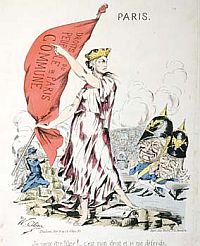
bonjourdefrance.com/images/paris-commune-3.jpg
:
  • the linking of distant places by the railways, facilitating not only commerce and diplomacy, but also labor organizing nationally and even internationally; 
  • the invention of mass journalism, spreading ideas and also creating a new class of intellectual workers — and stimulating (by reporting, diatribes, proposals) all of the other many changes;
  • mechanization of industries such as textile, mining, chemicals, printing and others, bringing with it the creation of an industrial proletariat and the marginalization of specialized crafts workers, all of them anxious to defend or improve their lot as the terrain shifted from under them;
  • revolutionary movements of many forms and ideals — utopian Fourerists, anarchists around Bakunin, and socialists and communists, some more or less influenced by Marx;
  • international wars — France and Prussia, most immediately — suddenly changed the relations of forces among countries, industries, and regions,
  • and great production and innovation in literature, painting and sculpture as artists, jolted by all these events, sought new ways to respond. 
I hope only to suggest some of this. It's keeping me busy.

2014/01/23

Blood stained humor

L'Insurge (French Edition)L'Insurgé by Jules Vallès
My rating: 4 of 5 stars

Jules Vallès was a central figure in the Paris Commune of March-May 1871: popular orator, creator and editor of the most-read newspaper, Le Cri du Peuple, elected deputy and even an elected battalion commander. He remained at the barricades throughout the "Week of Blood", la Semaine Sanglante of annihilation, but survived — through a combination of lucky breaks, discreet risk-taking friends, and clever improvisations — to tell the tale. In 1886, the year of his death, he told this part of it in this fictional autobiography, published posthumously and narrated by his alter-ego "Jacques Vingtras".
We can't know how much of it he fictionalized — very little, apparently, except that "Jacques Vingtras" focuses especially on the comic and self-deprecating details, careful not to attribute to himself anything like heroism, a notion he distrusts. Thus we see "Jacques" as a battalion commander with no military aptitude or tactical sense who issues contradictory and at times nonsensical orders, a loudmouth so brash he enrages people who should be allies, and so much in a hurry all the time that he can't get his official deputy's sash on straight. In the context of an immense tragedy he describes other moments not comical but so strange that I'm sure he didn't make them up: For example, when a handful of National Guards (the Commune's defenders) are running for their lives under a fierce cannonade, they pass an old, blind beggar still begging at his accustomed spot before a now-destroyed church, and — they stop to give him coins! The old urban habits of those men survived even under such enormous stress. It is the attention to such minute detail, in the context of broad involvement in all the politics of the Commune, that makes this book invaluable for feeling and reliving the immense drama. And because Vallès/Vingtras is so unpretentious, he's good company, even if his shorthand phrases and extensive use of slang sometimes make him hard to follow.

View all my reviews

2013/11/15

Hands, heads and revolution

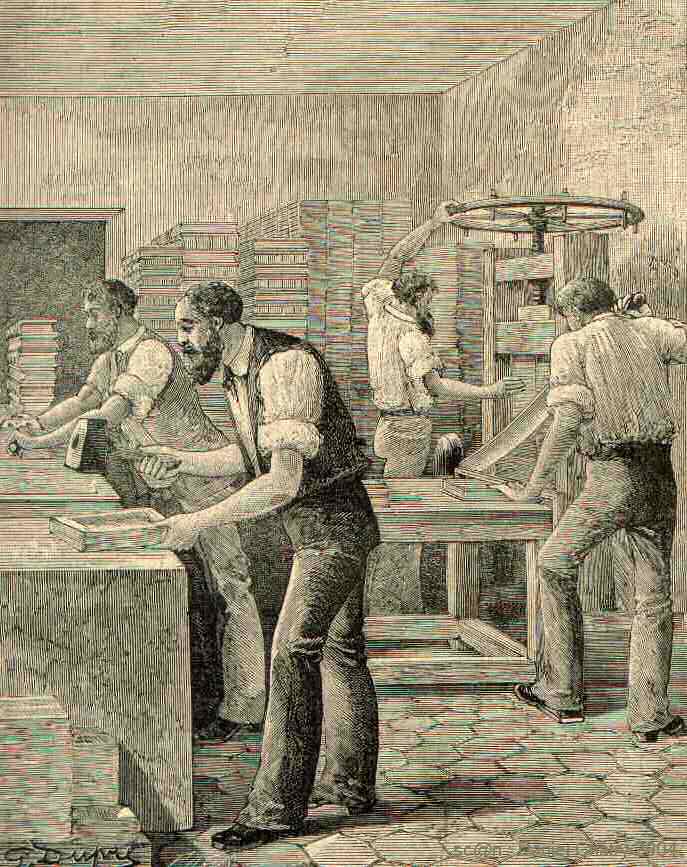
http://www.vieuxmetiers.org/gravure/imajpg/relieur.jpg
As readers of the blog already know, I am at work on a novel about the Paris Commune of 1871. This is not intended as escape literature, to take our minds off present crises, but rather as its opposite: as a way to rethink and interpret conflicts that are occurring around us now. It is also an opportunity to examine how our daily routines — the ways we work and communicate —shape our political and other views.

In the course of research, I discovered that the two most revolutionary groups of workers in Paris were the bronze workers and bookbinders, the latter organized by Eugène Varlin and, for the many women in that trade, Nathalie Le Mel. What a man or woman does with the hands, and the context of one's daily work routines, must explain much about how that person sees the world. So this is what I'm trying to learn now.
http://www.alaintruong.com/archives/2008/12/15/11764701.html

I have some idea of how the bronze workers worked in that period, and hope to learn more. These men (and they were all men) molded not only chandeliers, kitchen basins and cookware, bathroom fixtures and (for the bourgeois) ornaments, statuary and pretty clocks like the one at left; they were also the men who fashioned the cannons that defended Paris.

But the bookbinders (both men and women) are especially interesting, both because of the extraordinary personality of Varlin and because, by the very nature of their work, they had contact with the written word. I want to know what it would be like for, say, a young apprentice bookbinder with an 11-hour workday in an atelier of 20 or 30 laborers when a big order came in. What was the order of work, from the time the printed sheets came in to the final ornamentation of the cover? And how difficult was it to operate presses and clamps, knife, guillotine, sewing frames, gluing, etc.? What impressions — of literature, politics or philosophy — might the apprentice retain from glimpses of the pages he was required to bind? Besides consulting library and museum sources in Paris and Madrid, I hope to learn from people living today who are actually doing that sort of work.

This was the first great urban revolt in a modern metropolis (Paris 1871 as opposed to pre-industrial 1789), the first city-wide socialist reform movement ever put into practice (public education and health, labor rights, democratic procedure), and a demonstration of the capacity of ordinary workers with ingenuity and good will to run a city of over a million inhabitants. A close examination of the work lives and home lives of those ordinary workers should help us understand this enormous phenomenon.

The Commune and its defenders were annihilated in street-by-street fighting during the “week of blood” (May 21-28, 1871), demonstrating the precariousness of revolt and the ruthlessness and duplicity of threatened regimes everywhere. But despite that, because of its accomplishments and its declared though unfulfilled programs during its brief life (just over two months), the Commune has continued to serve as a model for aspirations of social justice in  revolutionary movements ever since.

For newcomers to this blog, my previous novel, A Gift for the Sultan, was about a much earlier great urban crisis, in Constantinople just 51 years before its capture by the Ottomans. That book has now also been translated and published in Turkish as Bir cihan, iki sultan (“One world, two sultans”).  I now think of that novel as practice for this one, about the Paris Commune of 1871.

2013/10/29

Waltzing to revolution

Eugène Varlin, chronique d'un espoir assassinéEugène Varlin, chronique d'un espoir assassiné by Michel Cordillot
My rating: 5 of 5 stars

Clearly written, extensively documented intimate biography of one of the most impressive leaders of the Paris Commune. We learn not only of the very serious side of Varlin, a country boy eager to learn, who became a master bookbinder (very proud of his trade), organizer first of the bookbinders union then of other unions, and a leader of the International Workingmen's Association (the "First International"). He also learned to sing in choral groups and to dance, becoming a tall, handsome idol to thousands of the low-paid women brocheuses, assigned to the menial folding and assembling of "brochures" (paper-covered books) in the book binderies. In London at the farewell party of a meeting of the International, he preferred to waltz with Marx's daughters to spending the evening debating economics with their father. A firm and fierce feminist (opposed to his Proudhonnien comrades' view that a woman's place was in the home and she therefore should not hold union office), he worked with Nathalie Le Mel, already a leader of women bookbinders, in numerous projects. Reading his story helps us understand how such a momentous upheaval as the Paris Commune could occur and why at that moment, and also how and why it collapsed before the massacre of the "week of blood" by troops from the extremely conservative government in Versailles. It will also help answering the third question, how it has shaped revolutionary movements up to our day, as the song says: "She [the Commune] is not dead" (Elle n'est pas morte).

View all my reviews

2013/10/19

A police thriller overwhelmed by real events

Le Cri du peupleLe Cri du peuple by Jean Vautrin
My rating: 3 of 5 stars

This is an immensely agitated, minutely detailed, ridiculously plotted police thriller, full of exaggerated characters, improbable coincidence and lots and lots of blood and sex, set in Paris during the 1871 Commune.

An emotionally disturbed cop and ex chain-gang convict (Charles Bassoucissé, a.k.a. Horace Grondin) obsessively pursues his murder suspect, who is now the gallant army captain Antoine Tarpagnan, and who we know almost from the beginning is quite innocent — like Inspector Javert on the heels of Jean Valjean in Les misérables, but Grondin is even crazier than Javert. These and other invented characters — other cops, crooks, prostitutes and various low-lifes — come into contact with historical figures, including Louise Michel and Gustave Courbet (very briefly) and especially Jules Vallès, whose newspaper Le Cri du Peuple provided Vautrin his title.

It is fast moving. I kept flicking the pages on my Kindle to find out what these crazy characters were going to do next, and one of the sex scenes, though a cliché, is quite lovely (a whore with a heart of gold tutors a timid youth in his first encounter). But the reason I read this instead of some other police thriller was to find out more about the Paris Commune, a far more dramatic story and with far more extraordinary personalities than the cop, the gallant and lovesick army captain he believes murdered his protégée, the troupe of loveable carnival freaks or even the gang of murderers with their grotesque symbol of brotherhood — glass eyes to be left in the hands of their victims.

The gruesome slashings of the "Glass Eye" gang, presented in bloody detail, pale into insignificance beside the more extreme and massive violence of the "week of blood" (la semaine sanglante) when government troops from Versailles virtually annihilated the communards, women and children included. Vautrin makes that suffering extremely vivid, and the (real, historical) violence is so massive that the (fictional) pursuit of Tarpagnan by Grondin seems of small importance. Vautrin is especially good at conveying the smells, most of them awful — of people, mildew, exhausted horses, bombs and rotting corpses. But the writing is so overwrought — people don't merely "say" something, they "snort" it or "grunt" it or even "whinny" it (I'm translating from Vautrin's over-abundant use of underworld argot) — that you know the story must have been conceived as a comic book, which it has now become, with illustrations by Jacques Tardi.

In short: You can learn some things about the commune, especially the minuscule details of how people lived and ate and traveled through the city, and a sense of the fear and smells and rage during the massacres of that last week. What you won't get clear is what it was all about and what it means to us.

That wasn't what Vautrin set out to do, so I'm not objecting. But it looks as though if I want to read the kind of novel I have in mind, I'll just have to write it. It's underway now.

View all my reviews

2013/09/28

A unique event, a common topic

A fellow author on LinkedIn has congratulated me on my choice of a unique event for my novel. Yes, of course he's right, the Paris Commune was unique, as the first (briefly) successful uprising in a modern, capitalist society. Urban revolt has been occurring almost since there have been cities, and there were immediate precedents in France: 1789, 1830, 1848. But the context had changed so much by the late 19th century (France was multi-continental imperial power, its major cities now included big industrial proletariats, communications had advanced enormously, and Paris itself had become "the capital of the 19th century" in Walter Benjamin's famous phrase), and running such a huge city had become so complex, that the communards had to invent everything as they went along.

What is not unique is my choice of subject matter. Like any powerful, dramatic event, the Commune has attracted scores of novelists and probably thousands of historians. I'm reading a recent novel now,  Le cri du peuple, by Jean Vautrin. It's a lot of fun, fast moving and thoroughly researched, but not like what I'm aiming to do. But I'll say more about that after I finish Vautrin's novel — it's slow going for me (despite the speed of the action), mainly because Vautrin inserts so much underworld argot that I'm clicking on the dictionary every couple of paragraphs. At least, I'm learning a lot of vocabulary. But it will be hard to work it into conversation, unless I want to insult my French friends.

Vautrin has collaborated with illustrator Jacques Tardi to produce this marvelous bande dessiné, for which the two authors studied (among many other sources) the collection at the Musée de Saint-Denis, where I also have spent emotion-filled hours. For a video on this collaboration (in French), see "Le Cri du peuple" de Tardi et Vautrin - Vidéo Ina.fr.

2013/09/27

Writing revolution

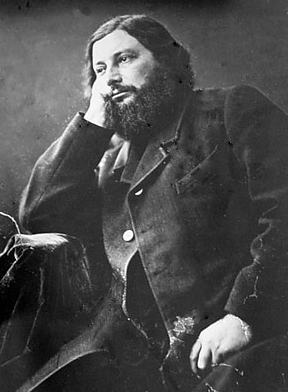
Gustave Courbet, pondering the art of revolution
As I've mentioned before, my next novel is about the Paris Commune of 1871. But not just about Paris or those 72 days of "people's power", but also about the possibilities, aspirations and contradictions in a revolutionary movement in a modern industrial capital and center of financial and military power. That is, it is also about us, today, whether in Cairo or New York or anywhere, and about the episode that has been a model for urban revolutions ever since.

So how's it going? I think I'm on track, but I'm not producing anything like 1,000 usable words of draft per day, which I think should be a reasonable quota. I hope to work up to that rhythm, though, once I work through my notes and tinkering with my outline. Meanwhile I'm still gathering more and more knowledge about Paris, French railroads, police, etc.

My novel starts with the lurch of my young protagonist, an apprentice bookbinder, from Lyon to Paris, by rail (his first trip anywhere), because he's decided to change his life — so I wanted to find out about the PLM (Paris-Lyon-Marseille or Méditerranée) line, tried but failed to get an 1870 timetable, did get an idea of how long it would take, am guessing about the fare (2 fr. 40 would be a day's wages for my guy) and the neighborhood where he would end up (3ême arrondissement, Gare de Lyon).

Why a bookbinder? Because that was one of the most politically engaged industries in the Commune. But why from Lyon? Because aside from Paris, Lyon was one of the most revolutionary cities in all France, especially in the silk industry, where women ovalistes had just formed the first feminine section of the International.

Another of my characters is a police official, and I've had to determine whether in the Sûreté (secret investigative police, staffed mainly by former criminals) or the Préfecture, and get some idea of how that was set up. For now, my character is a sous-préfet, meaning high-ranking but not at the top of the Préfecture. I already know (enough for my novel, probably) about the new police set-up under the Commune.

I'm delighted to be learning all this, but it doesn't make for rapid novel production. It does however enable me to understand the Commune in much greater complexity than we usually see.

To find out more about the Commune and to see some marvelous images, check out the blog of writer Yves Fey:

The Commune | YVES FEY

2013/07/18

Back to my novel in progress: Eugène Varlin

My new novel is about a crisis in a different city, in a different time. Not Constantinople in the 15th century, but Paris in the 19th, and very especially the Commune of 1871. And for this I had to read this book:


Pratique militante & écrits d'un ouvrier communardPratique militante & écrits d'un ouvrier communard by Eugène Varlin
My rating: 5 of 5 stars

The life and writings of one of the true working-class heroes of the Paris Commune of 1871, Eugène Varlin, bookbinder, labor organizer, promoter of women's equality in work and in the movement, and ultimately batallion commander and combatant slain in the final days of the Week of Blood, the "Semaine Sanglante" that crushed the Commune. Paule Lejeune, author of many books on feminism and French history, has pulled together letters of Varlin and other texts putting his life in context.

View all my reviews

I admire Varlin enormously, and was delighted to find this modest little book put together very conscientiously by a woman who has worked for years for good causes and on the recovery of obscured revolutionary history. (Check out her list of oeuvres on this Wiki site: Paule Lejeune.)

Among the reasons for my admiration of Eugène Varlin are that he was a superb labor organizer and one of the few elected members of the Commune to keep his head amidst all the frantic rhetoric and chaotic orders and counter-orders after the Versaillais finally broke through the Commune's defenses. He was also a surprisingly articulate and clear, largely-self taught radical journalist and thinker, as the articles and letters assembled by Lejeune will make clear. And very practical: it was his idea, for which he recruited Nathalie Lemel and other workers, to set up the low-cost working-class restaurants known collectively as La Marmite, which became popular centers not only for simple, cheap nutrition but also for developing social relations among workers in different métiers and of both genders.

He could have escaped, in those last desperate hours, as did many others — shaving his beard would have been a good start for a disguise. But he was almost the last commander standing — he had been elected a battallion commandant — and would not desert the barricade. When all ammunition was exhausted, he was seized and slaughtered. He was 32.

Varlin was also a founding member of the Paris section of l'Association Internationale des Travailleurs (A.I.T.), what we know today as the First International.

2013/07/12

Medicine & Citizenship in Venezuela | Dissertation Reviews

For those of us deeply attached to Venezuela, this University of Chicago, 2012 dissertation by Amy Ellen Cooper is especially fascinating. But it will also be important for anyone seeking to change the world, on the relationship of social context and social conditions (including especially citizen participation) to physical health.

Medicine and Citizenship in Venezuela | Dissertation Reviews

From the review by Ana Servigna (Tulane):
Health practices are generally related to healing bodies, but Cooper explains that in Venezuela, those practices have become a “political experience of citizenship” (p. 73).…

Participation in the healthcare system is not limited to doctors and patients; it also includes an extraordinary number of community health volunteers. Complementing her previous chapters, Cooper analyzes the volunteers’ experiences of providing healthcare for others. One important feature that she highlights is that most volunteers are women, a phenomenon found in many other studies as well; however in her sample, these women are not only active participants but also local leaders engaged in the solution of local problems.
oooo

One of many popular images of the miraculous doctor.
And much more. I suspect that the desire for such participation was always, down deep, what the  cult of "el Doctor Milagroso", José Gregorio Hernández,  has always represented. He was a real Venezuelan physician, d. 1919, to whom many Venezuelans attribute magical curing powers and is now in the process of beatification. Statuettes and images of him are seen all over the country, and a postage stamp with his portrait was issued on the centenary of his birth in 1864. Now citizens have other ways to work to change conditions for better health, in addition to, or instead of, seeking magical aid from the dead doctor.

2013/05/10

Lost in revolution

The Angels of ZimbabweThe Angels of Zimbabwe by Peter de Lissovoy
My rating: 4 of 5 stars

When Joe, a conspicuously tall young white American, hitchhikes into white-ruled Rhodesia in the early stages of the 1964-1979 "bush war" against supremacist Ian Smith's Rhodesian Front, his passion for liberty and his reckless crossing of color-lines gets him deeper into confusion and ultimately heartbreak. Hoping to help the black African liberation fighters create the free, black African nation they call Zimbabwe, Joe gets himself hired as a very junior journalist for the daily Clarion — whose editor tolerates his ironies because he's an amusing Yank — and using his position and the paper's resources, he gets to observe closely the routines of both blacks and whites in the small, rigidly segregated capital Salisbury (now Harare) — in the town center, the blacks-only bus station, the whites-only spaces but with black servants in stores and offices, the rundown black townships, police violence against black women protesters with their babies strapped to their backs, and a surprisingly multiracial garden party on a country estate. The portraits of ZANU youth activists, aspiring black journalist Shakespeare Forboni, his buddy the little auto mechanic Moses Chivera and the dour, bitter and determined revolutionary Frankie Mundie suggest the range of personality types struggling for a liberation that meant something different to each of them; among the whites, most memorable are the Clarion editor Mr. Wein, a cautious but canny "liberal," the absolutely apolitical but generally good guy sports journalist, and — most tellingly — an older, formerly influential settler who remembers pioneer days and still clings to the hope that whites like him can make a contribution in the future black republic. The ending is an undramatic fade-out with nothing resolved, either for Zimbabwe or for Joe personally, but in the meantime we have been presented a vivid panorama of that last white-racist holdout in Africa and its tensions in its last days, and some clear suggestions of the conflicts that would emerge in Robert Mugabe's Zimbabwe.

View all my reviews

2013/03/27

Two months that changed the world

Histoire de la commune de 1871Histoire de la commune de 1871 by Prosper-Olivier Lissagaray
My rating: 5 of 5 stars

This is the one essential book on two months that changed the course of European history and set new patterns for 20th century revolutionary struggle worldwide.

Lissagaray first gives us the political background of the 1870-71 crisis, when the Second Empire of Louis Napoleon, or "Napoleon III" destroyed itself in a disastrous war with Prussia, during which extreme conservatives created a new government elected mainly by rural constituencies. The revolt of Parisian ouvriers and petits bourgeois began as outrage against that disgraced government, successor of the emperor, that not only had failed to defend them against Prussian siege and bombardment but now expected them to pay (through rent increases and taxes) the huge indemnization demanded by the Prussians.

The insurrection broke out without plan or clear leadership when on 18 March 1871 that conservative government sent troops to seize the cannons of the Paris Garde nationale. Populace and Gardes quickly mobilized to prevent the seizure, and the government troops, bewildered and unprepared for such action, fraternized with them. Two generals, already notorious for earlier bloodletting, were murdered by the mob, and now Paris was in open revolt. The reactionary government, led by the aged Adolphe Thiers, then withdrew from the city and established its new capital in nearby Versailles. In the next weeks the citizens of Paris had to organize all urban services, while simultaneously defending themselves from infantry and bombardment of Versailles while the Prussian army hemmed them in on the north and east. Revolutionary reforms in education, work hours, women's rights and opportunities followed in quick succession — but despite spirited, though woefully disorganized, defense by Parisians and foreigners such as Dombrowski and Wroblewski, Versailles troops finally broke through and began the systematic destruction and massacres of la semaine sanglante, the "bloody week" of 21-28 May, 1871, followed by mass executions, rigged trials and deportations that very nearly wiped out the whole of Paris' working class — 30 or 40,000 killed, more thousands imprisoned and/or deported, others fled to exile in Belgium, Switzerland or England.

Lissagaray was a young radical journalist in 1871, not an elected official nor with any formal responsibility in the Commune, but committed to its cause and ultimately, in the last desperate days, a combattant and eye-witness of the semaine sanglante. He escaped, ultimately to London, and spent the next five years reading every available document, interviewing and corresponding with survivors, and writing his great history, which was published in Belgium in 1876. In 1886, the book appeared in English translation by Eleanor Marx Aveling (youngest daughter of Karl Marx and Lissagaray's one-time fiancée). In 1896, five years before his death, Lissagaray re-issued his history with a new postscript, where he predicts that the socialist goals of the Commune would be realized in Germany. Things didn't turn out that way, but the Commune's influence on the strategic thinking of Lenin, Trotsky and others would later be decisive for another country.

There have been many more studies since Lissagaray, and there are other contemporary accounts with important additional information — those by Louise Michel and Jules Vallès deserve special mention. Some of Lissagaray's value judgments may be challenged, and there are aspects he didn't know about that are important for understanding how this massive revolt emerged and developed, but this big, careful study (with numerous notes and appendices) is our most valuable single account. (I read the Kindle version of the 1896 edition.)

View all my reviews

2013/03/18

Constructing a novel

A good omen! Today, on precisely the 142d anniversary of the beginning of the Paris Commune, this book (ordered from amazon.fr) has arrived:
Varlin, Eugène, y Paule Lejeune. Pratique militante & écrits d’un ouvrier communard. Paris: Harmattan, 2002.
Eugène Varlin, October 5, 1839-May 28, 1871
Very likely you have never heard of Eugène Varlin. I first discovered him about a year ago, first in brief mentions as a member of both the Commune (that is, an elected member of its governing body) and the International Workingmen's Association (later known as the First International). The more I learn about his brief life — he was murdered in the final days of the semaine sanglante, 22-28 May 1871, when he was not yet 32 — the more deeply he impresses me. He is just one of many remarkable and admirable heroes and heroines of that glorious, disastrous social experiment, Paris in the spring — Le temps des cerises, as the song put it — of 18 March to 28 May, 1871.

But for my novel, Varlin — worker, theorist, promoter of women as equals in the struggle, and ultimately as a combattant — will be a key to the dynamics of that great uprising and improvised creation of a new social order.

The greater weight of my story will be borne by my fictional characters, but to construct for the reader they world they move in I need to use the real streets, the bricks, the cannons and figures including Varlin, and Louise Michel, Nathalie Lemel, Jaroslav Dombrowski, and many others who may be mentioned only fleetingly in the novel. But all are part of its real setting.

And today, 18 March, in the anniversary of the almost accidental, chaotic first revolt against an abusive authority — Thiers' failed attempt to remove the National Guard's cannons from Montmartre — that began the revolt that became the model for Lenin's State and Revolution and every modern urban uprising since.

2012/11/17

Generations of mothers of rebellion

A good friend and colleague has commented about the Agnès Poirier article I praised here recently, disputing her characterization of the Paris Commune of 1871 as "the mother of all rebellions." In his note he reminds me of many of the earlier ones, some much, much earlier, and of course the Révolution Française of 1789. I think we should give the journalist a little latitude — she needed a quick, economical phrase. But let's consider why and how the Commune mattered, and if it was a "mother," what have been its children?

The motherhood of revolution must go back to Eve, the original rebel. That is, if we mean "origin". But of course revolution has had many generations of mothers, each spawning offspring that had to adapt to its times.

What caught the attention of everybody in the late 19th century, revolutionary or counterrevolutionary, was that the Commune erupted in one of the principal cities of industrial capitalism. This could mean either that it was the last flare of the big one of 1789 or the harbinger of an ever more potent urban revolt. And that among the declarations of the communards were visions of a society that translated Liberté, Égalité, Fraternité into what were then modern, practical terms.

The Commune and all the earlier revolutions my friend mentions were many things at once, aiming in different directions, impelled by different and often contrary groups. I'm drawn to the communards because they are more of my time than Saint-Just, Robespierre, Danton et al., in language and proposals. Europe and the world had changed enormously since the revolution of 1789, in large part because of that revolution (and American independence, and Napoleon and his wars, and of course the steam engine, etc.).

To us today, pre-1789 is a much more foreign place than 1871. When I read about poor, brave Eugène Varlin, or about the women at the barricades (there were hardly any in 1789, but they were everywhere in 1871), they stir memories of our own days of rebellion, of 20th century Communists I've known, of debates I suffered and engaged in. Like all analogies, reading 1871 through, say, 1968 or the 1970s distorts both, I know that, but still, they stir me. And I want to get to know them better, by imagining their lives in my novel. They (the metalworkers, bookbinders and seamstresses, to name 3 of the main participating occupational groups) feel closer to me than the sans culottes, but if I live long enough, maybe one day I'll want to write about them too.

In any case, the Commune acknowledged its own "mothers" and "grandmothers" — especially 1789, 1830 and 1848 —  and its offspring have included Lenin's and Trotsky's concepts of revolution, much of the language and aims of the Spanish Second Republic (the one finally defeated by Franco), the many guerrilla movements in Asia, Africa and Latin America in the 1960s, '70s and '80s, and even in rebel discourse today.