My article on Podemos (CounterPunch, 13-15 February) has generated some thoughtful responses, including one from a French journalist friend who, remembering May 1968 in Paris, is worried that such "a social upheaval is not easily transformed into a viable political
power."
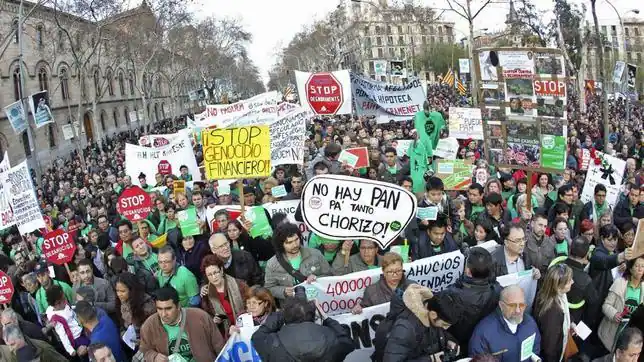
As I told him, I think we may have some interesting disagreements — interesting because they provoke further thought. Some (at least ) of the campaign proposals for the European elections were quite unrealistic, but they served not only to get all those voters (1.25 million!) but to put the goals of a decent, more egalitarian distribution on the agenda for all the parties. And Iglesias and the others have taken the critiques into account, and refashioned the proposals to make them much more reasonable. The structure of Podemos makes it extremely flexible and open to pragmatic adjustments of this sort — not turnabouts decided by a leader (like Zapatero's disastrous reversal on the Socialist Party program in 2010), but responses to demands and critiques from the base.
Podemos has adopted the formal trappings of a political party (statutes, officers, etc.) because that's what the law requires for elections, but it is more of a social movement than an organized party. It's unlike any other party for the openness of debate, the fluidity of leadership and (unheard of in Spanish politics) the scant respect for hierarchy — Iglesias and his closest allies are generally respected, but not always heeded. In the primaries for municipal elections, Andalucía and Aragón already have chosen rival slates to Iglesias'. Susana (my accomplice) and I are involved in our Podemos circle here in Carboneras (a coastal village of 8,000 in Almería, Andalucía) for the same reason as most of the supporters across Spain, to shake up established, self-satisfied local structures that are doing too little for the community.
My correspondent suggests (if I've understood him rightly) that movements like Podemos "challenge the two pillars of a decent European society : democracy and free market." First, I don't see how such an open, internally democratic movement as Podemos can be considered a challenge to democracy — but maybe there were such strains in the May 68 upheaval in Paris. And as for the "free market," I
personally have been very impressed by the analysis of another Frenchman, Thomas
Piketty. As Mohandas Gandhi said of European civilization, I think a
free market would be a very good idea. But to try it will require some major reforms of the one we've got, so skewed to preserving the wealth of the wealthiest.
Showing posts with label world politics. Show all posts
Showing posts with label world politics. Show all posts
2015/02/16


2015/02/13
Podemos: Threat or Promise? — CounterPunch: Tells the Facts, Names the Names

Podemos: Threat or Promise?
For background, you may also be interested in my earlier articles, on the movements in Spain that have now converged to create Podemos.
- Historic Reversal: Bombs and Bullets in Spain. Op-ed on the 2004 election of the socialist government in Spain in wake of terrorist bombing of Madrid's Atocha railway station. The Philadelphia Inquirer, Mar. 16, 2004
- Spain's "Indignados". On the political occupation of public spaces across Spain through the summer of 2011 ("15-M"). The Voorhis Voice (Claremont Democratic Club) , June 2012
- Spain's many currents of protest. Discussion of protests actions spurred by "15-M". Originally published in Norwegian translation on the website Radikal Portal, August 2013.
2015/01/27
The spectre of "real democracy"
A spectre is haunting Europe —and it's scaring the bejezus out of all the older parties. Lessee, what should we call it? Syriza? Podemos? Die Linke? Populism? Maybe we can call it "democracy", that is, rule by the common people. And "solidarity" where people join in groups and collectively try to help each other and take decisions for the whole commonwealth. Or maybe we should just call it "communism", because that's what the word still meant — rule by the common people and solidarity — back in 1848, when Karl Marx and Friedrich Engels popularized it in a manifesto.
But we have to be careful today with that word — the word "communism" has been sullied by the many horrid acts committed in its name. Gulags, purges, inquisitions, restrictions of all types. Like Christianity. Nowadays "populism" has become a popular insult. It's a fear word, with no precise meaning. It just represents that terrifying spectre, the end of the hegemony of "the markets" and the political parties that do their bidding.
Nobody who knows history expects Syriza to fulfill all the expectations of its supporters, or Podemos either. But each in its own way (obviously, conditions in Greece and Spain and the potential alliances in each are vastly different) is shaking to pieces the older Tweedledee and Tweedledum two-party systems. Which have more and more come to look like two faces of a single party, the one subservient to the big financial interests. And that has been a system that produces increasing inequality at such a rate that it is destroying itself, driving its own opposition.
How could a tiny coalition of leftist parties like Syriza triumph over the long-established Pasok and the newer, but well financed, New Democracy? How could Podemos rise from nothing to a real power contender in Spain in the course of just a few months? Not by the brilliance or charisma of its leaders, though those have helped, but by the mass support for change, structural change. What was called "Real democracy now!" (Democracia Real Ya, or DRY) in Spain's famous 15M movement, that began 15 May 2011 and took over public spaces in all the major cities. An impulse shared by masses of people in Turkey (Gezi Square), Egypt (Tahrir), Hong Kong, but which here in Europe may actually succeed. Or at least present a formidable challenge to the Bundesbank, the IMF and all their associated interests, and work to rebuild a society where inequalities are reduced and public wealth goes to public uses.
But we have to be careful today with that word — the word "communism" has been sullied by the many horrid acts committed in its name. Gulags, purges, inquisitions, restrictions of all types. Like Christianity. Nowadays "populism" has become a popular insult. It's a fear word, with no precise meaning. It just represents that terrifying spectre, the end of the hegemony of "the markets" and the political parties that do their bidding.
Nobody who knows history expects Syriza to fulfill all the expectations of its supporters, or Podemos either. But each in its own way (obviously, conditions in Greece and Spain and the potential alliances in each are vastly different) is shaking to pieces the older Tweedledee and Tweedledum two-party systems. Which have more and more come to look like two faces of a single party, the one subservient to the big financial interests. And that has been a system that produces increasing inequality at such a rate that it is destroying itself, driving its own opposition.
How could a tiny coalition of leftist parties like Syriza triumph over the long-established Pasok and the newer, but well financed, New Democracy? How could Podemos rise from nothing to a real power contender in Spain in the course of just a few months? Not by the brilliance or charisma of its leaders, though those have helped, but by the mass support for change, structural change. What was called "Real democracy now!" (Democracia Real Ya, or DRY) in Spain's famous 15M movement, that began 15 May 2011 and took over public spaces in all the major cities. An impulse shared by masses of people in Turkey (Gezi Square), Egypt (Tahrir), Hong Kong, but which here in Europe may actually succeed. Or at least present a formidable challenge to the Bundesbank, the IMF and all their associated interests, and work to rebuild a society where inequalities are reduced and public wealth goes to public uses.
2015/01/20
Toward a sociology of satire
 We've been reading a lot of serious stuff about humor since the assassinations of the "Charlie Hebdo" team and the related assault on the supermarket in Paris. It's really hard to joke about so much blood. But sometimes humor is the best, or even the only, way to deal emotionally with such trauma, without totally breaking down. And that's really what satire is about, coping with horror by laughing at it. That's what the latest cover of "Charlie" has tried to do. But millions of people don't get the joke, and can't be expected to, because the kinds of horror they're facing is something entirely different from "Charlie"'s audience.
Satire is an interplay of three terms: author, target, and audience, and they have to work in concert. The author is looking for a laugh at the expense of people or practices that make him and his intended audience uncomfortable. The laughter is supposed to be cathartic, a release (however brief) from that discomfort or fear.
For it to work, the audience has to recognize the target and share the author's discomfort.
And there's the problem. Or several problems. To wit,
- To be effective, it has to be deliberately offensive to its targets without alienating its intended audience. But with the Internet and television, its targets are a big part of its audience.
- In France, readers of Charlie Hebdo were and are uncomfortable with Sarkozy's frenetic impulses, Hollande's wavering, Valls' authoritarianism, the Catholic church hierarchy's moral pronouncements, Zionist nationalists and radical Islamists — among the more frequent targets. But even within France, from Paris center to the banlieues, in Marseille from the port district to the fancy shopping area next door, very different factors make people uncomfortable and fearful.
- Getting the laugh depends on irony, deliberate exaggeration which demands shared understanding of symbols and caricatures. All of us non French have probably been misreading a lot of the jokes in Charlie Hebdo, according to this persuasive discussion by Tekno. And the readings in Chechenia or Pakistan are also wildly opposite the satirists' presumed intention.
- Satire also requires a shared culture of discourse, i.e., what is permitted and what is not permitted to say. What a satirist can get away with in France can get you lashed to death in Saudi Arabia, jailed in Egypt, run off the airwaves in Venezuela.
- And you can't really get away with all that much in France, either — as Dieudonné M'bala M'bala, a very funny man but with very different targets, long ago discovered.
2015/01/04
Petition Vietnam Peace Commemoration Committee

Petition Vietnam Peace Commemoration CommitteeIf you too were active, here's your chance to sign and describe some of what you did. Together, we finally made it impossible for them to continue — making it clear first to LBJ, and then to Nixon, that they couldn't keep the peace at home if they continued the war abroad.
Here you can find my statement, along with those of all the other signers, describing a little bit of how we were involved in those actions.
Viet Nam Today: Annotated Signers
2014/10/07
Anti-boycott petition
This just come to my in-box from a scholar at Tel Aviv University. I agree (broadly) with the argument that an academic boycott is not the way to encourage dialogue, and dialogue is what we most need in the age of extremisms. Boycotts of many products may be effective, for example, a boycott of the Israeli weapons industry might be a very good thing — and might even make the Israel government respond. But boycotts of academic or any other intellectual interchange — "I refuse even to listen to you" sort of boycotts — will not only be utterly ineffective to change Israeli (or anybody's) policy, but will simply hamper much needed communication.
They are seeking signature from academics, but I am not affiliated to any academic institution, so rather than sign I'm expressing my support here. Follow the link to read the petition, though I think Professor Dreyfus' presentation of the case is especially clear.
Friends,
May I suggest that you consider signing this petition against academic boycotts, specifically academic boycotts of Israel’s academic institutions, scholars and students. The petition originated in the USA but is intended to be signed by scholars in all
countries.Personally, I oppose much of our present government’s policies with respect to Palestinians and a Palestinian state. So do many of my colleagues. However, I oppose an academic boycott in principle (see Zvi Ziegler’s arguments below) and in practice: A boycott is likely to weaken voices against government policy and strengthen the right wing in Israel.
Tommy DreyfusBest wishes,Tommy
Zvi Ziegler is head of the committee gathering signatures. He writes,
Our approach is that academic boycotts are harmful to the progress of mankind , and that science should be pursued without discriminating against people on account of their race, gender, nationality, politics, etc. This approach is identical to the one expressed by several national academies of science, including the USA one.
2014/08/19
Revolutionary thought, from Michelet to Lenin
 TO THE FINLAND STATION: A Study in the Writing and Acting of History by Edmund Wilson
My rating: 5 of 5 stars
Yesterday I devoted a pair of hours to a review of Edmund Wilson’s To the Finland Station, composing directly on the Goodreads review screen as was my habit. But when I was finally satisfied with it and pressed the button to “Publish,” the review vanished! Replaced by the sign-in screen for Goodreads. I won’t do that again. From now on, I’ll compose my reviews in Word, then post them — so if the link fails, I’ll still have my draft.
I won’t try to reconstruct my review.
Instead, I refer you to the very good, thorough critique of this book by Louis
Menand, in The New Yorker, March 24, 2003, The
Historical Romance: Edmund Wilson’s adventure with Communism.
Menand will tell you how Wilson got the
idea for the book and his many problems in writing it, including his changing
attitudes toward the Soviet Union. Wilson, beginning this huge project in the
1930s, had got himself committed to an overly rosy picture of the Soviet Union,
one that no longer convinced even him by the time he published the book in
1940. In his new introduction written in 1971 (a year before his death), Wilson
tries to correct that rosy view, at least partially, quoting some very negative
reminiscences by contemporaries of Lenin and making very explicit his disgust
with Josef Stalin, who was barely mentioned in the original book.
More important for contemporary readers, as Menand points
out, is the success of this wide-ranging history of revolutionary thought in
bringing together the ideas and the often tangled lives of those who developed
them, from Jules Michelet to Vladimir Lenin. Wilson here is clearly emulating
Michelet, whose histories of the French revolution he admires for making the past
seem suspenseful and contemporary, viewing events (as much as possible) through
the eyes of the people who were living them.
But the book is really historical
journalism rather than philosophy, where Wilson was hopelessly incompetent —
evident in his chapter on Marx and Engels’ concept of the dialectic. Menand
writes,
“The dialectic was just the sort
of high-theory concept that Wilson reflexively avoided. At the same time, he
was not a man quick to concede his ignorance, and he devoted a chapter of his
book to explaining that the dialectic is basically a religious myth (a
characteristic exercise in journalistic debunking). Wilson had no idea what he
was talking about. ”
Menand however does, and explains it in as
good a two-paragraph exposition as you’re likely to find of this subtle and
complex way of thinking. I recommend it. Here is Menand's summary:
The two-paragraph explanation [Wilson] gives of the term at the beginning of the chapter on “The Myth of the Dialectic”—the thesis-antithesis-synthesis model—is not the dialectic of Hegel. It is the dialectic of Fichte. And Marx and Engels did not name their method “dialectical materialism.” That was a term assigned to it by Georgi Plekhanov, the man who, after Marx’s death, introduced Marxism to Russia. Engels referred to the method as historical materialism.
Still, Hegel’s dialectic was part of Marx’s way of doing philosophy, and the use of the dialectic as a historical method is the strongest element in Marxist theory. In the broadest terms, it is a way of treating each aspect of a historical moment—its art, its industry, its politics—as being implicated in the whole, and of understanding that every dominant idea depends on, defines itself against, whatever it suppresses or excludes. Dialectical thinking is a brake on the tendency to assume that things will continue to be the way they are, only more so, because it reminds us that every paradigm contains the seed of its own undoing, the limit-case that, as it is approached, begins to unravel the whole construct. You don’t have to be an enemy of bourgeois capitalism, or believe in an iron law of history, to think this way. It’s just a fruitful method for historical criticism.
View all my reviews
2014/07/28
Fallen Monuments
 |
| "USSR - Bulwark of Peace" - photo Folkestone Jack
This for me is the most impressive piece in the Park of the Fallen Monuments, because it is not merely the image of a man that has fallen but a once noble and inspiring ideal.
Park of the Fallen Monuments
Acccording to the Guía Roja de Moscú, "This shield was in the southeastern sector of Moscow, at the intersection of Avenue Lenin and Kravchenko Street, placed there in the 1970s, the work in aluminum of S. Shchekotikhin. The shield and slogan were dismanteled at the beginning of the 90s and ended up in the Muzeon" (of Fallen Monuments) next to the new Tryetyakov Galereya. |
2014/07/27
Moscow, days 3-4: Partizani, Putin-mania & konstruktivizma
.jpg)
And then there were all the Putin images in coffee mugs: posing shirtless and flexing, or grimacing or snarling while saying things like "Crimea is ours!" And Russia's English-language TV station that night was equally belligerent, denouncing what they said (in perfect American accents) were absurd US propaganda slurs implying that Russia had something to do with the downing of the Malaysian jet liner while minimizing Ukrainian government terrorism. We weren't convinced by this view, but apparently many Russians are.
At Crash Scene of Malaysia Airlines Flight 17, Rebels Blame Ukraine
None of this tension has been observable on the streets of Moscow this weekend, where Gorky Park and the whole south bank of the Moskva river was in festival mood. And this in great heat, well over 30º. Most memorable today: the Costakis collection of Russian avant-garde art, or at least part of it, in the Tretryakov Gallery annex (fortunately air-conditioned). The story of how this very perceptive collector managed to save so many marvelous works — besides Malevich, pieces by Tatlin, Rodchenko, Popova and many others — from oblivion and almost certain destruction is told in a film.
More later. It's been a fatiguing day.
2013/12/16
Poor sailing for Spain
 |
| Fritz (Ricardo Olivera) |
- Catalonia, with almost 1/6 of the population and the highest GDP in Spain, is threatening to secede;
- Nationwide, unemployment is surpassed in the Eurozone only by Greece;
- Social services including health, education, and aid to caregivers of dependent relatives are being slashed, generating enormous "tides" of protest almost every day;
- Thousands of families are homeless due to evictions for nonpayment of mortgages while the banks are stuck with millions of empty new homes:
- The bankers that set up those unpayable mortgages and drove their banks to ruin claim and usually get multimillion euro bonuses;
- Corruption scandals among the political elite are multiplying, but few are punished and nobody ever resigns;
- The government is not only refusing to investigate Franco era crimes (despite UN and World Court demands), it is also reviving Franco era repressive legislation;
- The Catholic Church continues to use its state subsidies to return Spain to the middle ages.
The most divisive issues in Spain were not really resolved in the 1978 Constitution, but simply covered over in deliberately ambiguous language to achieve the broadest consensus. These divisive issues were mainly:
- Representative government —If the people were to be sovereign, who were "the people" and how direct could be their participation in government? Powerful forces wanted to maintain the institutions set up by Franco, including the supremacy of the military hierarchy and of the recently restored monarchy. With so many rival political parties — including Franco's arch enemies, the Communist Party and newly reorganized and re-invigorated Socialist Party, plus all the new regional parties that were springing up, all facing the die-hard Franco-heirs in Alianza Popular — how could the government remain stable and avoid a resumption of civil war, perhaps by other means? The expedient decided upon was an electoral system skewing votes so that one or another party's electoral advantage would be multiplied to give it enough parliamentary seats that it could not easily be overturned.
- Territorial and ethnic divisions —Large regions remained attached to languages and traditions that had been suppressed by Franco, the largest being the Galicians (gallegos or galegos), the Basques and Catalan-speakers (including not only those of Catalonia but those speaking related dialects in Valencia and Baleares). Was Spain one nation, or a union of nations with distinct laws, though gathered under a federal state? The pseudo-solution was regional "autonomy," understood differently by the different parties and subject to future determination by the courts.
- Monarchy or Republic? The ad-hoc solution (after much fierce debate) was a sort of republican monarchy, where the king reigns but does not rule. This was a major symbolic concession by the Left, standard-bearer of the Spanish Republic, but considered acceptable because of the apparently peaceable and pro-democratic posture of Juan Carlos — who owed his investiture to Franco.
- Church and State: Franco had defined his government and the country as "National Catholic" meaning that, for him, Fascism and Catholicism were two faces of the same reality, and a "Concordat" with the Vatican assured state funding of the Church. The Left representatives wanted to cut that funding entirely. The compromise was that "all" creeds would be recognized, the country was declared officially laic (id est, with no official religion), but the state continued to exempt the Catholic Church from taxes (even on commercial property) and to pay the salaries of teachers of religion in the public schools and of priests in military.
The ambiguity on the second point allowed pressure from the centralizing, conservative Partido Popular, through its influence on the courts, to overturn a reform of Catalonia's governing statutes (involving the relative emphasis on the national language, castellano — what we call "Spanish" — and Catalan and other issues of self-determination), taken in Catalonia as unpardonable meddling (intromisión), especially since a very similar statute was approved in neighboring Valencia (which also speaks a variety of Catalan, but was governed by the conservatives whereas Catalonia had at the time a coalition leftist government).
The other problems listed above stem mainly from the rigidity and inconclusiveness on the territorial and democratic procedure issues. There are too many courts (Audiencia Nacional, Tribunal Supremo, Tribunal Constitutional all top-ranked in the justice system, and all the regional courts) with different criteria and stacked with judges placed there by political pressure or, in some notorious cases, removed when they take justice issues too seriously: Baltasar Garzón is the best known, but there have been others. This makes it very difficult to prosecute corruption cases against politicians who have their party's support. And has for similar reasons made it almost impossible to control the banks and financial markets — since the people supposed to do the controlling are part of the problem.
As for the Church — well, we'll save that for later. (Though I've already discussed the issue in earlier notes, for example Claiming the soul of Spain (2008/02/10). If you're curious about other thoughts I've had on these themes, just click the link "Spain" below and the blog notes will pop up.
| . |
2013/10/29
Waltzing to revolution
 Eugène Varlin, chronique d'un espoir assassiné by Michel Cordillot
My rating: 5 of 5 stars
Clearly written, extensively documented intimate biography of one of the most impressive leaders of the Paris Commune. We learn not only of the very serious side of Varlin, a country boy eager to learn, who became a master bookbinder (very proud of his trade), organizer first of the bookbinders union then of other unions, and a leader of the International Workingmen's Association (the "First International"). He also learned to sing in choral groups and to dance, becoming a tall, handsome idol to thousands of the low-paid women brocheuses, assigned to the menial folding and assembling of "brochures" (paper-covered books) in the book binderies. In London at the farewell party of a meeting of the International, he preferred to waltz with Marx's daughters to spending the evening debating economics with their father. A firm and fierce feminist (opposed to his Proudhonnien comrades' view that a woman's place was in the home and she therefore should not hold union office), he worked with Nathalie Le Mel, already a leader of women bookbinders, in numerous projects. Reading his story helps us understand how such a momentous upheaval as the Paris Commune could occur and why at that moment, and also how and why it collapsed before the massacre of the "week of blood" by troops from the extremely conservative government in Versailles. It will also help answering the third question, how it has shaped revolutionary movements up to our day, as the song says: "She [the Commune] is not dead" (Elle n'est pas morte).
View all my reviews
2013/10/27
If War is Peace, Ignorance is Strength
 Nineteen Eighty-Four by George Orwell
My rating: 4 of 5 stars
Re-reading this book today, as so many people are doing, reminds us of how gloomy the world looked in 1949. And especially how gloomy it looked to Orwell, who had spent his entire life and lost his health in struggles for what he imagined as a more decent society — one where people care about and care for one another. The book is a biting satire of what he thought of as the muddle-headed reformism of the British Labour Party, heading toward a totally controlled society called "Ingsoc", Newspeak for "English Socialism", but the permanent anxiety-inducement, psychological manipulation through the distortion of language, and crude but effective torture were inspired more by Nazi Germany and, especially, Stalin's Soviet Union. The technology of surveillance by "Big Brother" seems laughably primitive today, in the face of Edward Snowden's revelations about the working of the NSA, but Orwell's vision of pseudo-friendships among individuals too frightened to really connect seems almost to foreshadow those on Facebook and Twitter.
Orwell's great strength was as a moral essayist, a writer with a very definite view of how things ought to be and a critique of all that fell short of that. And it is as a moral essay that this book continues to matter, not as an effort of belles lettres. It is not pleasing to read, the flow of the language is jarring, the characters unlovable and barely understandable as people — and that is surely just what Orwell intended. But those unlikeable characters all serve his two purposes: to point out the dangers of an all-controlling state and to remind us once again of how language can be corrupted in ways not to advance and express thought, but to impede it. And also perhaps to express one faint hope: Winston Smith, by resisting as long as he does, even though he finally succumbs, demonstrates that the system's control can never be absolutely complete.
View all my reviews
2013/08/29
In Syria: Stupid power move | Common Dreams
Recently, I commented on Elmore Leonard's novel Ryan's Rules, which he later retitled as Swag. It's about the catastrophe a crook named Ryan brings onto himself by disobeying his own sensible rules, like, don't trust other crooks.
Crooks aren't the only ones who need to abide by sensible rules. One of the first rules for rulers should be: If you can't make it better, don't jump in. I think there's something like that in Clausewitz, or maybe Machiavelli, both of whom drew up sensible rules for rulers.
I agree with Jon Queally (link below): a U.S. attack on Syria is not going to make things there better, not for Syrian civilians of whatever politics hit by the cruise missiles, not for the fragmented "opposition" and certainly not for democracy, and not even for U.S. interests (economic, political or military) in the region.
But of course, if rulers acted sensibly, there would have been no World War I — to take just one example of blundering into disaster. Rulers act more often out of pride than pragmatism, pressure from their closest confidants rather than the larger interests of the states they rule, or (probably the case of George W. in Iraq) blind adherence to an ideological vision unchecked by evidence. There's probably a little bit of all three influences on the U.S. plan to attack Syria. So, disaster, here we come!
In Syria, Obama's Calculations Reveal Stupidity of US Imperialism | Common Dreams
Also, see this video of an interview of Phyllis Bennis of the Institute for Policy Studies: As Strikes on Syria Loom, U.S. Ignores Diplomatic Track | Common Dreams
Crooks aren't the only ones who need to abide by sensible rules. One of the first rules for rulers should be: If you can't make it better, don't jump in. I think there's something like that in Clausewitz, or maybe Machiavelli, both of whom drew up sensible rules for rulers.
I agree with Jon Queally (link below): a U.S. attack on Syria is not going to make things there better, not for Syrian civilians of whatever politics hit by the cruise missiles, not for the fragmented "opposition" and certainly not for democracy, and not even for U.S. interests (economic, political or military) in the region.
But of course, if rulers acted sensibly, there would have been no World War I — to take just one example of blundering into disaster. Rulers act more often out of pride than pragmatism, pressure from their closest confidants rather than the larger interests of the states they rule, or (probably the case of George W. in Iraq) blind adherence to an ideological vision unchecked by evidence. There's probably a little bit of all three influences on the U.S. plan to attack Syria. So, disaster, here we come!
In Syria, Obama's Calculations Reveal Stupidity of US Imperialism | Common Dreams
Also, see this video of an interview of Phyllis Bennis of the Institute for Policy Studies: As Strikes on Syria Loom, U.S. Ignores Diplomatic Track | Common Dreams
2013/05/08
Spanias kreative protestb�lge | Radikal Portal
The Norwegian news and opinion website Radikal Portal has invited me to become a regular contributor. Here is my first article, on protest movements in Spain — translated into Norwegian.
Spanias kreative protestb�lge | Radikal Portal
 Since it's just possible that you don't read Norwegian, here is my English original in Scribd: Spain's many currents of protest
There have been developments since I wrote that piece, the most important being the gutting of the citizens' legislative initiative by the Popular Party to pass a much weaker version. The main argument, however, still stands: that protests surging outside of the traditional channels of parties and trade unions are shaking the whole institutional system in Spain and may be harbingers of serious change.
My next article for this site will be on Venezuela.
Spanias kreative protestb�lge | Radikal Portal
There have been developments since I wrote that piece, the most important being the gutting of the citizens' legislative initiative by the Popular Party to pass a much weaker version. The main argument, however, still stands: that protests surging outside of the traditional channels of parties and trade unions are shaking the whole institutional system in Spain and may be harbingers of serious change.
My next article for this site will be on Venezuela.
2012/11/10
Understanding the society that produced the Commune
 Paris Babylon: the Story of the Paris Commune by Rupert Christiansen
My rating: 5 of 5 stars
Wittily told and extensively researched, this brief account of the Second Empire, the Franco-Prussian War and the Commune has two special merits. First, it is more sociological than ideological: Christiansen aims neither to condemn nor exalt the revolutionary Communards or the Versaillais who tried (and ultimately succeeded) to destroy them, but rather to understand all sides. He is of course appalled by the atrocities, a few by the communards (much exaggerated by Versailles propaganda, but there were some) and far more by the Versailles government troops, especially during the semaine sanglante and following, but such horrors by one side do not necessarily justify the decisions and confusions by the other. The book's second great virtue is its descriptions of curious aspects of Paris and Louis Napoleon's II Empire on the eve of the series of disasters that destroyed it: war with Prussia, then the siege of Paris and finally the Commune. There is a brief account of Baron Haussmann's transformation of the city's space, and its unintended social and economic consequences. And the chapter, "The Spermal Economy," on French medical opinion and prejudices about sex (how much to indulge and how, and how upper-class men used the Opéra as their exclusive brothel) is very amusing, though of doubtful relevance to the Commune, whose proletarian defenders' sexual behavior surely had little to do with such official notions. The account of the war is too brief to understand it, and the intense debates among Blanquistes, Prudhonniens and Marxistes, Républicains, and monarchists and other conservatives, are merely alluded to.
For readers new to the subject, this book provides a lively and fair overview of events, with bibliographic notes for those who want to understand more. And for anyone, its anecdotes and portraits, e.g. of the Empress Eugénie and of the pathetic and mysteriously uncommunicative Emperor, or Haussmann and even of the young and insolent Rimbaud (who may or may not have got to Paris during the Commune — we don't really know) make it a lively and suggestive addition to the bibliography.
For me, as I continue developing my new novel around this dramatic episode, it will be more helpful for portraying the bourgeois, in the middle between the great revolutionary and reactionary forces.
View all my reviews
2012/10/14
Sad Europe, sad globe
A friend wrote to "congratulate" me on the Nobel Peace Prize to the European Union— I suppose, because I live in a corner of Europe. I thought she was joking, but no, it's true. The Nobel Peace Prize
seems like a sad joke, but maybe it's meant as a consolation prize. I had intended to write something about Europe's slow-motion disaster,
as
one after another of the hard-won social conquests crumbles, but the
forces of disintegration have been speeding up. How
Europe got into this pickle is pretty clear — I just reviewed a book (Indecentes
in my Spanish-language blog) that sums it up blow by blow, the bungling
miscalculations since Bear Stearns and then Lehman Bros., followed by
the more-or-less covert campaign by Trichet and his successors (and
allies in the Bundesbank) to shift the blame to the "middle classes" and
the workers, and (the special focus of Indecentes) the totally ineffective and even counterproductive actions by the Spanish government under its man of inaction, Mariano Rajoy.
Anyway, there's no mystery about how we got this close to the impending crash that IMF head Christine Lagarde foresees. And there is no reason to expect the financial powers to change the no-growth, severe austerity policies that they are ideologically committed to and that, short term anyway, appear to benefit German capital while impoverishing everybody else. So what we need to focus on is how to force a change in those policies (while there is still some democratic room to maneuver, in demos, elections, etc.), and most importantly — longer term, for recovery after the foreseeable global collapse if we don't change direction — what kind of more egalitarian, more productive, more environmentally sensitive society we can construct. We can't foresee the future, we can only make it, by omission or commission.
I know there are lots of people working on this, and have been for generations. And though all those struggles — e.g., the Paris Commune, the Spanish 2d Republic, and later social revolutions — have failed their maximalist objectives, we can learn from all of them, to at least fail better. If you haven't already, check out the late Eric Hobsbawm's brilliant compendium of some of those efforts, How to Change the World.
Anyway, there's no mystery about how we got this close to the impending crash that IMF head Christine Lagarde foresees. And there is no reason to expect the financial powers to change the no-growth, severe austerity policies that they are ideologically committed to and that, short term anyway, appear to benefit German capital while impoverishing everybody else. So what we need to focus on is how to force a change in those policies (while there is still some democratic room to maneuver, in demos, elections, etc.), and most importantly — longer term, for recovery after the foreseeable global collapse if we don't change direction — what kind of more egalitarian, more productive, more environmentally sensitive society we can construct. We can't foresee the future, we can only make it, by omission or commission.
I know there are lots of people working on this, and have been for generations. And though all those struggles — e.g., the Paris Commune, the Spanish 2d Republic, and later social revolutions — have failed their maximalist objectives, we can learn from all of them, to at least fail better. If you haven't already, check out the late Eric Hobsbawm's brilliant compendium of some of those efforts, How to Change the World.
2012/09/17
Mobilizations everywhere
Everywhere lately we have been seeing big, sudden and sometimes terribly violent rallies of angry people — the worst, with the deadliest consequences, in Benghazi, Cairo and other parts of the Islamic world beginning September 11, but almost simultaneously in Barcelona (also September 11), Madrid and Lisbon (both with huge rallies on September 15), Moscow and across China. Very different movements, but the fact that they are all happening now reflects the conjunction of two global phenomena: The explosion of electronic media, making it vastly easier to convoke a crowd, and deteriorating economic conditions everwhere.
About those violent assaults on U.S. embassies in Muslim countries that began on September 11, I think Ross Douthat is right about the immediate cause: it was not about a movie that, as far as we know, doesn't even exist (nobody seems to have seen any more than a 14-minute trailer) — though the video was sure convenient for the assailants.
It’s Not About the Video - NYTimes.com
The question remains, though: Why did such large numbers of angry people respond? Focusing on the video has got us into a useless and damaging debate about whether we should limit "blasphemy," a concept that has no place in a free society. It also encourages the notion that Muslims are generally crazed fanatics easily aroused if you push their sacred buttons. Those of us who are a little older remember when the really big political movement in Egypt and from there to other parts of the Arab world was entirely secular — Nasser and with his call for pan-Arabism could muster enormous enthusiastic crowds, even without Twitter or SMS. Religious fanaticism is not genetic or eternal, but a circumstantial response to some very dramatic circumstances.
Here, since I claim no special expertise on the region, all I want to offer is two lines of investigation to identify the forces that are inducing people to look for radical solutions. We should first look at demographics, and then who those interplay with economics, and only then do the particular doctrines of preachers, ulemas and other agitators become relevant. In the Arab world, and in almost all other Islamic countries as well, population has been growing too fast to be absorbed in a rigid, and closed, opportunity system, and the economic crisis— including in parts of the Near East, a long-lasting drought that has driven more and more people to the overcrowded cities, creating greater density of desperate folks.
There are other possible answers to the economic crisis, and other ways to mobilize mass discontent. Limiting anybody's freedom of expression, as in the proposed legislation to outlaw "blasphemy" as in Tunis, is just going to delay finding such a solution. We need the freest debate possible to find those answers.
I hope to say something about those other mobilizations (Spain, Portugal, and Catalonia among them) in future notes — not because I know the answers, but at least to clarify our questions, what is really at stake and what can we do about the really serious world problems?
About those violent assaults on U.S. embassies in Muslim countries that began on September 11, I think Ross Douthat is right about the immediate cause: it was not about a movie that, as far as we know, doesn't even exist (nobody seems to have seen any more than a 14-minute trailer) — though the video was sure convenient for the assailants.
It’s Not About the Video - NYTimes.com
The question remains, though: Why did such large numbers of angry people respond? Focusing on the video has got us into a useless and damaging debate about whether we should limit "blasphemy," a concept that has no place in a free society. It also encourages the notion that Muslims are generally crazed fanatics easily aroused if you push their sacred buttons. Those of us who are a little older remember when the really big political movement in Egypt and from there to other parts of the Arab world was entirely secular — Nasser and with his call for pan-Arabism could muster enormous enthusiastic crowds, even without Twitter or SMS. Religious fanaticism is not genetic or eternal, but a circumstantial response to some very dramatic circumstances.
Here, since I claim no special expertise on the region, all I want to offer is two lines of investigation to identify the forces that are inducing people to look for radical solutions. We should first look at demographics, and then who those interplay with economics, and only then do the particular doctrines of preachers, ulemas and other agitators become relevant. In the Arab world, and in almost all other Islamic countries as well, population has been growing too fast to be absorbed in a rigid, and closed, opportunity system, and the economic crisis— including in parts of the Near East, a long-lasting drought that has driven more and more people to the overcrowded cities, creating greater density of desperate folks.
There are other possible answers to the economic crisis, and other ways to mobilize mass discontent. Limiting anybody's freedom of expression, as in the proposed legislation to outlaw "blasphemy" as in Tunis, is just going to delay finding such a solution. We need the freest debate possible to find those answers.
I hope to say something about those other mobilizations (Spain, Portugal, and Catalonia among them) in future notes — not because I know the answers, but at least to clarify our questions, what is really at stake and what can we do about the really serious world problems?
2012/06/18
Antidotes to economic/psychological depression
In response to my article about the "indignados" of Spain, friend and colleague Christopher Leo writes:
Swarming rallies convoked by SMS and Internet are a worldwide phenomenon now. Even if the protests were completely ineffective in changing policies, they at least serve as an antidote to severe psychological depression among the millions who are suffering sudden decline in economic possibilities. (See Increasingly in Europe, Suicides ‘by Economic Crisis’ - NYTimes.com.)
Thus the protest rallies are an example of what Gramsci liked to call "optimism of the will". There are other antidotes to depression available: Jihad, neo-Naziism (as in Greece today), religious mysticism, drugs, alcohol etc. Lots of opiates for the people are on the menu. Of all of these possibilities, the big, rapidly assembled protest rallies against perceived injustice, where people of diverse class and ethnic backgrounds discover a common cause, seem to me by far the most healthful, both for the individual and for the society.
Sustained anger and racist hatred are hard on one's health (see Anger Effects on Your Heart: Heart Disease, Atherosclerosis, and More), drugs destroy your physical and emotional defenses, and mystic ecstasy doesn't help much with practical problems. Political protest in an atmosphere of solidarity not only feels better, it may — just may — help bring about a more equitable system.
You and I have been through this movie before. The rotating protests are reminiscent of the late sixties, except that then there was one clear focus, the war in Vietnam. This time it's about many things, and no one thing in particular. Hard to guess where it's going to lead, if anywhere.
Swarming rallies convoked by SMS and Internet are a worldwide phenomenon now. Even if the protests were completely ineffective in changing policies, they at least serve as an antidote to severe psychological depression among the millions who are suffering sudden decline in economic possibilities. (See Increasingly in Europe, Suicides ‘by Economic Crisis’ - NYTimes.com.)
Thus the protest rallies are an example of what Gramsci liked to call "optimism of the will". There are other antidotes to depression available: Jihad, neo-Naziism (as in Greece today), religious mysticism, drugs, alcohol etc. Lots of opiates for the people are on the menu. Of all of these possibilities, the big, rapidly assembled protest rallies against perceived injustice, where people of diverse class and ethnic backgrounds discover a common cause, seem to me by far the most healthful, both for the individual and for the society.
Sustained anger and racist hatred are hard on one's health (see Anger Effects on Your Heart: Heart Disease, Atherosclerosis, and More), drugs destroy your physical and emotional defenses, and mystic ecstasy doesn't help much with practical problems. Political protest in an atmosphere of solidarity not only feels better, it may — just may — help bring about a more equitable system.
2012/06/06
Civil protest in Spain: Optimism of the will
The dismantling of the once-excellent public health, education and other benefits and destruction of labor rights, with no prospect of economic recovery from our deep recession, threaten to overwhelm Spaniards with "pessimism of the intellect". The rising of the indignados, known here as "15-M", is a thrilling example of the only antidote, "optimism of the will" —the determination to change the course of events, as Antonio Gramsci (following Romain Roland) liked to remind himself and others .
The following article has just appeared in the June issue of
THE VOORHIS VOICE
Thanks to Ivan for his invitation to develop this analysis.
Spain’s Indignados
By Geoffrey Fox
Last year’s mass movement of indignados in Spain, initiated May 15
(“15-M”), and evolving into protest occupations of the central plazas and
marches, astonished government authorities and even participants. Inspired by
protests in Tunis and Cairo, and encouraged by those in Greece and Portugal,
the Spanish mobilization demonstrated further possibilities of democratic
action in the Internet age, setting an example for movements as far away as Chile
(the huge student protests) or the U.S. (Occupy Wall Street). But “15-M” was
also a response to specifically Spanish political conditions.
This was the biggest in a series of
volcanic eruptions against the legacy of the Franco dictatorship (1939-75) that
began even before the election of the first Socialist party government, in
1983. Franco-ists and their allies have been entrenched in the judiciary,
business sectors, and the Catholic Church, which still enjoys extraordinary
legal and financial privileges. Democratic demands had erupted in mass
mobilizations repeatedly in recent years, for example against military
intervention in Iraq, the mishandling of a huge coastal oil spill, and attempts
to use the 2004 terrorist bombing at Atocha for electoral advantage. Additional
background included a series of corruption scandals, and the removal from
office of judge Batasar Garzón, for investigating the current scandals and exhuming the crimes of the Franco
dictatorship. This was Spain’s
political drama even as ordinary people endured an economic “crisis” that they
blamed on those very corrupt officials and antidemocratic legacies.
Police estimated 20,000 at the initial
demos May 15 in Madrid’s Puerta del Sol, and 130,000 nationwide, with the
biggest gatherings in Barcelona, Murcia, Granada, Seville, Malaga, Alicante and
Valencia. One reason for the big initial turnout was the date, exactly one week
before nationwide elections for regional and municipal authorities; another was the demo’s independence of any
party or trade union sponsorship. The heated campaign of mutual blame for the
economic crisis by the two principal parties had disgusted many voters with
both. The governing Socialists had disappointed their supporters by bowing to
pressure from Brussels and Berlin to freeze pensions and cut other benefits;
and the right’s Popular Party, closely aligned with big capital and banking,
offered no credible alternative. One of the popular slogans of 15-M was “Don’t
vote for them!” and the initiating coordinating committee called itself “Real
democracy now!” (¡Democracia Real Ya!).
The original protesters included
experienced veterans of social action groups but they were joined by many
younger “indignados” frustrated by their lack of employment or educational
opportunities. In Madrid’s spacious Puerta del Sol after the speeches, hundreds
of the youth decided spontaneously to stay the night. Their rousting by the
police before dawn was the second main cause of the protest’s huge success:
press and Internet coverage of the rough handling resulted in far larger crowds
the next night, and spontaneous
encampments in other cities.
The veteran social activists and younger,
unemployed “indignados” were
quickly joined by a broader cross-section of the electorate, including students
and unemployed adults, fully-employed but worried workers and professionals,
housewives, and retirees. They were articulate, informed and determined.
Participants set up orderly camps, declaring that they would not leave until
satisfied that they had accomplished something.
Mobilized by Internet social networks,
e-mail, and SMS, not by a parties or unions, the coalition sprouted no
leadership that could be pacified with minor concessions. The press sought out
the cyber activists, who called themselves “¡Democracia
Real Ya!” — “Real Democracy Now!”
— but cyber activists could not and did not seek to control over a mass
consensual movement of indignant
people, the “indignados.”
The right-wing Popular Party at first
imagined that the demonstrations could benefit them electorally, reasoning that
indignados who boycotted the election
would otherwise vote for the left. The right did win big, not just on May 22,
2011 but even more significantly in the parliamentary and presidential
elections November 20. However, their political victory has deepened
dissatisfaction with the political right and the whole political structure. The
Socialist Party sought the protesters’ support, expressing sympathy with their
grievances, but with little apparent success. The 15-M crowds had already
decided that major parties and the trade unions were too bureaucratized were
too embedded in the system to respond to their demands.
But how to create real democracy? The
absence of an executive committee or even a “majority rules” consensus
prevented the emergence of a unitary of demands; however, there
did emerge a broad consensus on what people did
not want: huge bailouts of the banks, huge cuts in health and education
budgets, more bureaucratic, non-representative rule. The term “indignados” came from a book written in
French by Stéphane Hessel, a Résistance veteran. The book’s title, Indignez Vous! might be translated
literally as “Get indignant!,”
but “Don’t put up with it
anymore!” would be a truer fit.
Indignation is essential as a starting point for protest, but for real,
lasting change, as Hessel himself emphasized, indignados have to agree on and work for clearly defined goals. To
define these goals, one of the many committees that popped up in the Puerta del
Sol set up suggestion boxes for proposals, and gathered nearly 14,700. When finally analyzed months later, the
demands ranged from “open lists” of candidates, to harsher punishments of
corrupt politicians, to nationalization of the banks and even abolition of the
monarchy. Here was enough material for several political initiatives, requiring
different kinds of actions.
The camp-ins amounted to intense political
self-education, including the practical experience of working with diverse
people to meet the needs of such an improvised settlement. The camp alumni have
taken those experiences back to their neighborhoods and created local action
groups to act locally while continuing their debates to develop larger
strategies for acting in the whole society. Many of the 15-M veterans again thronged the plazas of
Madrid, Barcelona, Valencia and other cities on the anniversary, on May 12, 2012. The crowds in the plazas were somewhat
smaller, and though there were a few late night skirmishes with police, they
mostly respected the police order against setting up tents or sleeping bags.
This has led some reporters to speak of exhaustion but that prospect is
unlikely because the rallies are only the most visible part of a movement that
has grown deeper and wider in 2012.
Meanwhile, the larger situation of Spain in
Europe and of all of Europe in the world are getting worse, and activists
realize that it will take more than mobilizations and neighborhood actions to
create employment, restore social services, and realize their many other demands. But, roused from their
torpor, the two big union federations and the parties of the left (Partido
Socialista Obrero Español, Izquierda Unida, and regional left
parties) are now finding common ground rather than spending all their
energy competing for the same constituents as in the past. Together they are
making broader demands, and introducing more internal democracy .
Demonstrations have become almost weekly events, with 15-M and unions joining
forces, including in the broad labor-community general strike last march
against the rightwing “labor reform”
that simplified the process of firing workers, and nullifying labor
contracts while reducing economic equality. The indignados have not made a revolution, but should it come, they
will be better prepared thanks to all their collective work since 15 May 2011.
Geoffrey
Fox is an American author who resides in Almeria, Spain. He is the author of
A Gift for
the Sultan and other books. His blogs: Literature & Society
and also Lecturas y lectores.
2012/03/23
"Authoritarian leftism" support for despots
Remember Lenin's 1920 essay, Leftwing Communism: An Infantile Disorder? Nicholas Kozloff describes a similar disorder: What he calls the "authoritarian left" is so convinced that the enemy of my enemy is my friend — the "enemy" being western capitalism — that writers like Alex Cockburn and Robert Dreyfuss find nice things to say about Muammar Gadaffi and Bachar Al-Asad, and even Noam Chomsky refrains from critical analysis of the crazed Bolivarian Hugo Chávez. That means they're having trouble distinguishing "left" from "right."
The authoritarian left goes awry: From the Arab Spring to Latin America - Opinion - Al Jazeera English
The authoritarian left goes awry: From the Arab Spring to Latin America - Opinion - Al Jazeera English
Subscribe to:
Posts (Atom)