Showing posts with label Moscow. Show all posts

2014/09/05

Visit to Russia — Susana's travelogue

Here is my accomplice Susana Torre's account of our recent trip to Moscow and Saint Petersburg. For more writing and other work by Susana, see her website, Susana Torre.

SUSANA AND GEOFF’S TRIP TO MOSCOW AND SAINT PETERSBURG, JULY-AUGUST 2014 

SHHHHHHH!!! The young guards were, very loudly, making sure we didn’t make any noise going down the steps of Lenin’s Mausoleum in almost complete darkness. It’s impossible to tell if the figure lying in state with face and hands precisely lit is the real mummy, or a wax representation. All the same, we wanted to say goodbye in our last day in Moscow to the symbol of the momentous social changes brought about by the October 1917 revolution. Goodbye, Vladimir Ilych. Goodbye, John Reed and Alexei Shchusev buried with many others along the Kremlin wall.
Red Square. From left: GUM, St. Basil's, Lenin's tomb (click for larger view)
We made this trip intending to make the picture in our heads, formed by our readings by historians, theoreticians, protagonists and inspirers of the revolution, more nuanced and complete. Not exactly a nostalgic trip for lost ideals, but to see first hand whatever remained of the material evidence of those ideals, and to see what had become of them today in Moscow and Saint Petersburg (called “Peter” by the Russians). First Moscow, and then a trip on the fast “Sapsan” — “Hawk” — train to “Peter”, through flat farmland, villages and densely packed residential high-rise suburbs. Geoff had resumed his college Russian language studies, and managed to communicate and read all the Cyrillic signs, indispensable to travel by public transportation – especially the subway, as efficient, clean, advertisement-free, frequent and fast as touted in the tourist guides, including the lavish use of marble surfaces and alabaster fixtures.

Considering an alternative to the Moscow subway
On our first day in Moscow we visited Krasnaya Ploshchad, Red, or Beautiful, Square (“krasnaya” has both meanings in Russian), the vast open space, formerly a market, just outside the walls of the Kremlin. The brightly colored multiple onion-domes of St. Basil’s Cathedral dominate one end, and the more somber, red-brick State Historical Museum the other, over 2,000 feet away. Stretching along part of the wall is Lenin’s classical-cum-constructivist mausoleum, and facing it across the square, 230 feet away, sits the huge GUM, the largest covered arcade in the world. Built in 1890 to impress Europeans and create an enclosed place for the nobility to consume the latest Parisian fashions, today it is a private shopping mall known to locals as “the exhibition hall of prices”. From the restaurant terrace in front of GUM, we watched the people ambling across the great space, at a much more leisurely pace than the purposeful walk of people in Western capital cities. Maybe this is because the square is a destination unto itself, not a passing-through place. It is from here that the avenues structuring the city radiate, intersected by multi-lane, high-speed ring roads that pedestrians may cross only by underground passages. To my surprise, the interior of St. Basil’s Cathedral (a Museum since 1929) was not a large nave, but a collection of eight chapels around a ninth, central one less than 700 square feet in area. We had to search through the narrow connecting corridors to find one with especially great acoustics, resonating with the voices of a four-man vocal group.

Even the Cathedrals within the Kremlin walls followed a similar pattern, churches meant for a privileged few and with no ambition to include the unwashed masses. We were more impressed with the model of Catherine the Great’s insanely ambitious Grand Kremlin Palace, now in the Architecture Museum than with the existing Kremlin itself. Had it been built, monumental Neo-Classical double colonnades would have surmounted the entire Kremlin Wall facing Red Square.

Everywhere we saw the signs of historical continuity between Tsarist, Soviet, and post-Perestroika Russia: cathedrals turned into museums; streets in Moscow’s center lined with mansions of the aristocracy now put to public uses or turned into homes for the “oligarchs”, including the Art Nouveau gem of a house the last Tsar had built for a lover — now a museum — with the balcony from which Lenin harangued the partisans after he had taken over the house for Bolshevik
Christ the Savior and Tsereteli sculpture
headquarters. One discontinuity, Moscow’s Cathedral of Christ the Savior, demolished by Stalin to make room for a Palace of the Soviets that was never built, was rebuilt in the 1990s. Here, Pussy Riot staged the 4-minute concert that landed two of their members in jail for almost two years. The cathedral faces the river and a pedestrian bridge that brings Moscow’s youth into the fashionable Strelka café, and the nearby, exceedingly ugly 15-story high statue by the apparatchik architect/sculptor Zurab Tsereteli. The sculpture was a gift representing Columbus, intended for the US but rejected, and here displayed with a new head, that of Peter the Great. (Patrick Murfin blog, photographer uncredited)


Another continuity is the ubiquitous orange and black striped ribbon of St. George, symbolizing fire and gunpowder, that is everywhere attached to car handles and rear-view mirrors, to Putin’s lapel and the lapels of bodyguards in black suits in 90-degree weather. The ribbon is a component of military decorations awarded by imperial, Soviet and current Russia governments, now used to show support for pro-Russians in the disputed regions of Ukraine. Many coffee mugs in the souvenir section of the gigantic Izmailovo flea market had the map of Crimea next to the legend: “It’s OURS!” The popular mood seems to be with Putin, and the Russian TV channel in English kept reporting on the lies of the Western media about Russia’s military involvement in the Donbass.

Among the dozens of house museums where artists and writers lived, the one I wanted to see most was that of Anatoly Lunacharsky, Lenin’s Commissar of Enlightenment, a great intellectual and promoter of the artistic avant-garde; he staged a happening avant la lettre, a trial against God for crimes against humanity, in which the deity was condemned to death and “executed” by a firing squad shooting machine guns into the sky. When we could gолигарх, i.e., “oligarch”.
et no answer on the phone for an appointment, we simply showed up at the address and rang the bell. A burly man— evidently the caretaker — came down to inform us, by gesture and the few words we could understand, that the apartment was now privately occupied; with a semi-apologetic grin, he explained in one word:

In both Moscow and St. Petersburg we visited art and political history museums. In Moscow’s Tretyakov Gallery annex, we were able to see the 50% of George Costakis’ extraordinary art collection that he was obliged to leave behind when he moved to Greece, including Malevich’s Black Square and some of the best pieces of Natalia Goncharova, which establish her role as the inspiring founder of new movements. It was enlightening to see them for the first time in the context of earlier and later works by Russian artists not well known in the West. The focus of the contemporary art world is Moscow’s “Garage”, a would-be museum currently housed in a temporary, unremarkable structure designed by Shigeru Ban, awaiting its permanent location in a Soviet era pavilion being remodeled by Rem Koolhas, in a clear effort to become an international destination. Although we are not entirely up-to-date with Russian contemporary art, we had liked the rambunctious energy of songspiel videos by the art collective Chto Delat? (What is to be done?) http://vimeo.com/12130035 -- but the exhibition at Garage, with work by artists in the periphery of the Russian Federation about the dislocation produced by the end of the Soviet Union, seemed trite and superficial.

Construction in Moscow’s center, especially in its main radial avenue, Tverskaya Ulitsa, seems to have stopped after Stalin built the Seven Sisters skyscrapers in the late 1940s and early 50s. The foundations for an eighth “Sister” bordering Red Square were used after Stalin’s death for the modern, monstrously big Rossiya Hotel (21-storeys, 3,200 rooms, police station, etc.), the biggest in Europe, which was finally demolished in 2006. It has become a contested site, with public pressure to use it for a park instead of a new entertainment center designed by Norman Foster. But a new International Business Center, boasting Europe’s tallest building, is nearly finished on a site beyond the third ring road. We saw its gleaming towers at a distance during our tour of Constructivist buildings – the workers’ clubs, communal housing and other emblematic projects built during the 1920s that embody the revolutionary social change made into architecture during the Bolshevik government’s first years.

We continued our search for places and buildings of that fateful period when we arrived in picture book Neo-Classical “Peter”. Such buildings can be found mostly in Narvskaya Zastava, the center of the workers’ movement during the events of 1917, still a proletarian neighborhood full of factories and streets with names like “Tractor” or “Barricade”. Two impressive relics are the Kirovsky District Soviet building, municipal offices still used for the original purpose, and the former humongous industrial kitchen supplying hot lunches to factory workers in the area, now a shabby shopping mall. Lenin’s statue and the hammer and sickle on the façade of the Soviet building have not been removed to a “Fallen Monuments” park like the one we visited in Moscow, and his statue with the raised arm still shows the way on the square in front of the Finland Station (we had been re-reading Edmund Wilson’s book.) The temporary exhibition of extravagantly lavish costumes worn by the army of palace servants we saw at the Hermitage was another reminder of why the revolution had to happen. Sustaining it through the decades; a world war; centralized power; and a lack of understanding about the transformation of a proletarian consciousness was quite another matter.
Vladimir Ilyich & comrade, in the Park of Fallen Monuments

2014/07/31

Moscow: dead Lenin

It is a quasi religious experience, after standing in line in the hot July sun and finally passing the security checkpoint, to  file past the red granite tombstones of Communist heroes — John Reed among them (no women, as far as I could see, though I didn't actually manage to read all the names) — and then enter the dark descending staircase. Uniformed honor guards signaled vigorously for me to take off my cap and hushed everybody. Then, after another turn in the dark passageway, you file past the waxy figure, dressed as though to chair a meeting or give a speech. The guards keep everybody moving so soon we are back in the bright sun, walking past still more tombstones and plaques with names of dead Communists. 

Today's Russians must view Lenin much the way Americans are supposed to think of George Washington, as the founder (or "father") of the modern state, meriting the same kind of respect as Peter the Great, the motor force of an earlier great modernization. Their respective ideologies, like Washington's supposed "deism", are little more than historical curiosities — very few Russians today call themselves "communists". But Lenin's thinking may still offer us some good guidelines, both regarding political strategy (his ideas about how to gain and extend power were most effective) and
larger economic questions (imperialism, for example). He may not have been a pleasant man to deal with (I'm remembering Struve's and Valentinov's memoirs, quoted by Edmund Wilson in his 1972 introduction to To the Finland Station). But he was a brilliant and audacious one. And Russia could not have become the power it is today without the consolidation of the centralized, modernizing state, difficult to imagine under the Mensheviks or any of the other contenders of 1917-1920.

 Olga Boiko has posted  historical photos of the mausoleum, together with interesting commentary

2014/07/29

Moscow: seeing what's left of constructivist architecture

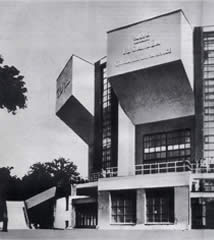
Rusakov Workers Club by Melnikov
Yesterday (in Moscow's continuing exceptional heat) we saw about as much as still can be seen of the  city's constructivist architecture designed and built in the 1920s and beginning of the '30s. The architects and engineers' aims were to create spaces for the education and expressive development of the workers (with libraries, theaters and sports and recreation areas), announce by their strikingly new design the society's entry into a new communist era, and to do all this quickly and cheaply with available scarce materials. (In addition to the Wikipedia article, see New World Encyclopedia, source of photo at the right.)

As with the constructivist art that I mentioned yesterday (and which in some cases was produced by the same people who designed the most impressive architecture), that creative, open and experimental period did not last. The art was mostly destroyed or hidden with the bureaucratization of the Soviet state and the imposition of "correct" tastes. The architecture was neglected or altered, sometimes drastically, for uses for which it was never intended. But some of it is still standing, and some has even been conscientiously restored. 

It would have been impossible for us to get to so many widely separated sites on our own in one day, or for us to negotiate in Russian with the doorkeepers so we could see the interiors of some of these places. Fortunately, we had hired Arthur Lookyanov to get us to all these places, and Arthur is a very persistent and organized guide — with very good English, an air-conditioned car with GPS, and photographic skill and equipment. Susana had sent him in advance the list of sites, and he had worked out the most efficient itinerary; he was very dogged in trying to get us into places, some of which were in reconstruction or were in top security sectors — a power plant, for example, or the famous Shukov radio tower.

He took much better pictures than we would have managed. I'll share them with you once he sends them. If you're planning a tour of Moscow, he would be a good guide: Moscow Driver is his website.

2014/07/28

Fallen Monuments

"USSR  - Bulwark of Peace" - photo Folkestone Jack

This for me is the most impressive piece in the Park of the Fallen Monuments, because it is not merely the image of a man that has fallen but a once noble and inspiring ideal. 

Park of the Fallen Monuments

Acccording to the Guía Roja de Moscú, "This shield was in the southeastern sector of Moscow,  at the intersection of Avenue Lenin  and Kravchenko Street, placed there in the 1970s, the work in aluminum of S. Shchekotikhin.  The shield and slogan were dismanteled at the beginning of the 90s and ended up in the Muzeon" (of Fallen Monuments) next to the new Tryetyakov Galereya. 

2014/07/27

Moscow, days 3-4: Partizani, Putin-mania & konstruktivizma

Yesterday, we joined the crowd at the flea-market "vernissage" in Ismailovskaya park, near the Partizanskaya Metro station. Like the station, the flea market was full of "Great Patriotic War" memorabilia, and much more : matryoshka dolls, bad art, Soviet-era books, maps and documents,ancient post cards, goofy sculptures, and even some surprisingly clever handicrafts. Vladimir  Poprotzkin, for example, offers matryoshkas of works by famous artists; Susana bought his Malevich doll, one tiny reproduction nested in another nested in another of the famous suprematist paintings.  We were also impressed by the detailed lighthouse models by Andrei Savarov.

And then there were all the Putin images in coffee mugs: posing shirtless and flexing, or grimacing or snarling while saying things like "Crimea is ours!" And Russia's English-language TV station that night was equally belligerent, denouncing what they said (in perfect American accents) were absurd US propaganda slurs implying that Russia had something to do with the downing of the Malaysian jet liner while minimizing Ukrainian government terrorism. We weren't convinced by this view, but apparently many Russians are.
At Crash Scene of Malaysia Airlines Flight 17, Rebels Blame Ukraine

None of this tension has been observable on the streets of Moscow this weekend, where Gorky Park and the whole south bank of the Moskva river was in festival mood. And this in great heat, well over 30º.  Most memorable today: the Costakis collection of Russian avant-garde art, or at least part of it, in the Tretryakov Gallery annex (fortunately air-conditioned). The story of how this very perceptive collector managed to save so many marvelous works — besides Malevich, pieces by Tatlin, Rodchenko, Popova and many others — from oblivion and almost certain destruction  is told in a film.

More later. It's been a fatiguing day.

2014/07/26

Moscow: day 2

On Friday we toured the churches and gardens inside the red walls of the Kremlin, full of tombs and images of saints and tsars, and then took a great leap into another time and mind set with the exhibition in the State Historical Museum, "The myth of the beloved leader." For this small but densely packed show, the curators brought out of hiding objects, posters, videos and other images related to the creation and elaboration of the myth that was supposed to substitute for the suppressed myth represented by those churches: the enlightened heroism and steadfastness of Lenin, and the continuation of his spirit in Iosif Vissarionovich Stalin ( Russian : Иосиф Виссарионович Сталин).

Stalin's version of the myth required distorting or obliterating much of the turbulent story of the creation of the Soviet Union and of the Comintern, which is why so much of the material in this exhibition had been hidden after Stalin consolidated his power in 1927. Many of the heroes of those earlier phases had been declared enemies by Iosif Vissarionovich — Trotsky being the best known, but there were scores of others who had worked closely with Lenin but now were to be expunged from the record and, when possible, killed. But all those bright, enthusiastic faces have been brought back to view, in photos, documents and the vivid sketches by Isaak Brodsky and, most impressively, in his huge painting (1920-1924) of the Second Congress of the Communist International.

In the full-size original, with the help of an electronic screen provided by the museum, you can pick out Lenin (presiding), Stalin (far to the right of the picture, a few rows in front of the column), Trotsky (behind and to the left of Lenin, leaning over a rail and talking to another comrade), Karl Radek (a special hero of mine— I think he's the man sitting in the same row as Lenin, to his left), Zinoviev, Kamenev, John Reed (the only American I found), plus scores of men and women delegates from Germany, France, Hungary, Bulgaria...

If those early Bolsheviks had only tried to demythologize Christianity as intelligently and respectfully as the museum curators seek to reveal the construction of Stalin's myth of his own continuation of a heroic Lenin, maybe we would not see today so many frightened people pleading for salvation by the saints. But it seems that most people need powerful imaginary companions to get through all our troubles, and for decades, a mythified Stalin-Lenin duo did the job for millions of Russians and others. Now they're gone, and the saints have come marching back.

2014/07/24

Moscow: day 1

We've taken our first day in Moscow slowly, to orient ourselves. Besides getting acquainted with the subways and strolling the length of Varvarka Street (Moscow's oldest), we spent most of the day on and around Red Square, where we plan to return tomorrow for an exhibition that was closed today: "The Myth of the Beloved Leader" at the State Historical Museum. Today we visited the Cathedral of St. Basil the Blessed (a complex of ten churches under as many domes, where we stopped to hear a 4-man vocal group who made a chapel and its labyrinthine corridors vibrate to old Russian paeans to God), GUM and the other part of the historical museum (open today) for pre-20th century Russia.

Vast and overwhelming. So much history, so complex, and all the labels in Russian — which may be why we were the only foreigners we saw in the place. Fortunately Susana had found on the Internet and printed out case-by-case descriptions of things in all the 18th and 19th century halls, but when we got into earlier times — Mongol invasions, medieval salt production (I think that's what a big wooden machine was doing), cruel and primitive weapons, all the way back to the mammoths and giant rhinoceros that were there before the humans — we could call upon only our memories of past readings and my searches through my Russian-English dictionary to interpret what we saw.

Still, it was worthwhile. Viewing clothing, tools, housing and artifacts linked with images we had retained from Tolstoi and every other Russian author who had passed through our consciousness, each of these experiences (reading and seeing) strengthening the other. So we are beginning to feel Russia, which is important to understand it.

And that of course is the main reason I've been studying the language. I've made small but significant progress: people understand me when I ask directions. The next big step will be to understand their answers, but so far, Russians on the street or the subway platform have been very helpful and very patient, and we've been able to find our way.