Showing posts with label art. Show all posts

2015/04/18

Staying awake in the city that never sleeps

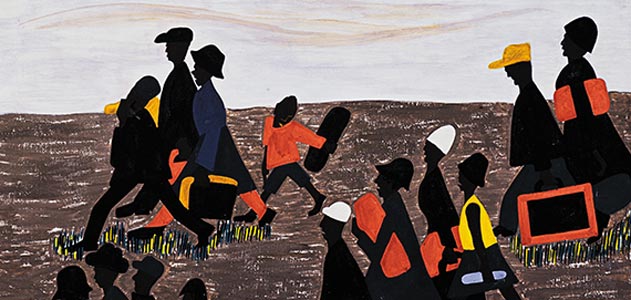
From Jacob Lawrence's migration series, 1941
We used to say that New York was the city that never sleeps. More than that, it is a city that wants to keep you alert. However, the flashing signage, noise and bustling-hustling crowds in Times Square, the agitated foot and skateboard and motor traffic, the rattling subway and the hurried pace and startling changes may produce the opposite effect, stupefying you with conflicting demands on your attention and shutting down most of your brain, leaving the remaining working part so focused on whatever you're trying to do that you mindlessly become another vector in the general agitation, avoiding obstacles but otherwise oblivious to other people and your surroundings.

All that is true, but New York also offers sites and events that invite quiet reflection, that permit you to integrate some of all those stimuli into a coherent narrative. The New York Public Library, with all its branches, has always bee such a site, and I hope it will remain so — though we heard disturbing news of plans to sell off the branches (more valuable as real estate) and ship the books out to an out-of-city warehouse. Good people are fighting to save the libraries, and good people in New York have been able to accomplish many things, so maybe it'll all be all right.

Other great sites for reflection on where we are and what it all means include the great museums, the galleries and the theaters. We returned to Madrid yesterday after another week in New York, a city we know well — we lived there for over 30 years — and still recognize, though it is ever changing. And we took the opportunity to take in some shows at a couple of museums, several galleries and a theater: the Music Box, for the revival of Wendy Wasserstein's 1989 hit, "The Heidi Chronicles". Great production, terrific actors, in a very dated story that reminded us how far we have not yet come in women's struggle for recognition and equal opportunity.

In MoMA, we spent a lot of time at the exhibit Latin America in Construction: Architecture 1955-1980 — mainly because we've been working on a book that includes that period. Not, in our view, a totally successful presentation of such a complicated history — as Ronald Reagan famously noted, there are a lot of different countries "down there", and unless you already knew a lot about what you were looking at, you might not be sure whether a particular project or building was in São Paulo or Mexico, or 1952 or 1972, and some enormously important events (e.g., the coups in Chile and Argentina) were scarcely mentioned. But, if you did have some idea what you were looking at, you could find many fascinating, more obscure works that you hadn't seen before. Susana will be writing a more detailed review, so I'll leave my comments at that.

A totally successful exhibit (in my view) was the marvelous One-Way Ticket: Jacob Lawrence’s Migration Series and Other Visions of the Great Movement North. Seeing the entire series of Lawrence's 60 paintings, re-united for the first time in many years and set out on the four walls of a large gallery in the order he intended, was marvelous in many ways. First, the beauty of the pieces, in Lawrence's dramatic, flattened images in just four colors, emphasizing the stark reality of the great black migration from the southern to northern states of the U.S. in the years just before Lawrence was born (in 1917). And then, of course, that dramatic story, which the young Lawrence (he was only 23 when he painted the series) had thorough documented, by his readings in the  collection on black history amassed by Puerto Rican-born scholar and bibliophile, Arturo Alfonso Schomburg, (now the Schomburg Center for Research in Black Culture, part of the wonderful resources of the New York Public Library,) and from his many conversations with his parents and other older neighbors in Harlem. The exhibit is further enriched by works by other artists, including the poet Langston Hughes (a friend of Lawrence, who illustrated Hughes's collection of poems with the same title as his series picture series, "One-Way Ticket"), a video of Marian Anderson singing at the Lincoln Memorial, another of Betty Holiday performing "Strange Fruit," and many other black musicians and graphic artists.

This I saw as a hopeful, optimistic picture of triumph, of people who and maintained and efended their dignity against the tremendous odds of color discrimination. 

But then, for a much more pessimistic view of ethnic relations in the U.S., the sad show at the Metropolitan Museum, The Plains Indians: Artists of Earth and Sky. The peoples of the American plains seized on new materials (glass, metals), images (clothing styles and others), and the great possibilities offered by the horse — all these imported by Europeans, with extensive contact beginning around 1700 — to create beautiful new forms and to increase their hunting and manufacturing prowess. Their ancestors had already been producing many beautiful objects before the European contact, but with more limited materials; the new things and ideas inspired a great growth and exploration of new styles and images. That demonstrates once again how creative people can be when given the chance. But this flourishing culture was brief, and its end disastrous: more and more Europeans came, killed off the buffalo that the plains people had come to rely on, massacred enormous numbers of "Indians" and then herded the survivors into camps and prisons and reservations, prohibiting their languages and many of their customs.

Some of their descendants have not given up or given in, and it's good to know that there are still rebels among them, defending their dignity and expressing themselves in new ways. But overall, the story told by the Met's exhibit is very sad one.

2014/07/27

Moscow, days 3-4: Partizani, Putin-mania & konstruktivizma

Yesterday, we joined the crowd at the flea-market "vernissage" in Ismailovskaya park, near the Partizanskaya Metro station. Like the station, the flea market was full of "Great Patriotic War" memorabilia, and much more : matryoshka dolls, bad art, Soviet-era books, maps and documents,ancient post cards, goofy sculptures, and even some surprisingly clever handicrafts. Vladimir  Poprotzkin, for example, offers matryoshkas of works by famous artists; Susana bought his Malevich doll, one tiny reproduction nested in another nested in another of the famous suprematist paintings.  We were also impressed by the detailed lighthouse models by Andrei Savarov.

And then there were all the Putin images in coffee mugs: posing shirtless and flexing, or grimacing or snarling while saying things like "Crimea is ours!" And Russia's English-language TV station that night was equally belligerent, denouncing what they said (in perfect American accents) were absurd US propaganda slurs implying that Russia had something to do with the downing of the Malaysian jet liner while minimizing Ukrainian government terrorism. We weren't convinced by this view, but apparently many Russians are.
At Crash Scene of Malaysia Airlines Flight 17, Rebels Blame Ukraine

None of this tension has been observable on the streets of Moscow this weekend, where Gorky Park and the whole south bank of the Moskva river was in festival mood. And this in great heat, well over 30º.  Most memorable today: the Costakis collection of Russian avant-garde art, or at least part of it, in the Tretryakov Gallery annex (fortunately air-conditioned). The story of how this very perceptive collector managed to save so many marvelous works — besides Malevich, pieces by Tatlin, Rodchenko, Popova and many others — from oblivion and almost certain destruction  is told in a film.

More later. It's been a fatiguing day.

2013/09/27

Writing revolution

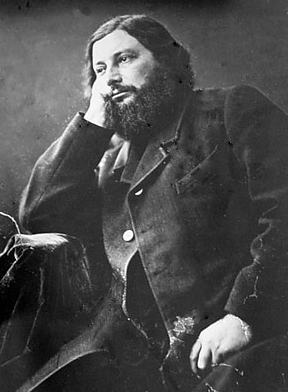
Gustave Courbet, pondering the art of revolution
As I've mentioned before, my next novel is about the Paris Commune of 1871. But not just about Paris or those 72 days of "people's power", but also about the possibilities, aspirations and contradictions in a revolutionary movement in a modern industrial capital and center of financial and military power. That is, it is also about us, today, whether in Cairo or New York or anywhere, and about the episode that has been a model for urban revolutions ever since.

So how's it going? I think I'm on track, but I'm not producing anything like 1,000 usable words of draft per day, which I think should be a reasonable quota. I hope to work up to that rhythm, though, once I work through my notes and tinkering with my outline. Meanwhile I'm still gathering more and more knowledge about Paris, French railroads, police, etc.

My novel starts with the lurch of my young protagonist, an apprentice bookbinder, from Lyon to Paris, by rail (his first trip anywhere), because he's decided to change his life — so I wanted to find out about the PLM (Paris-Lyon-Marseille or Méditerranée) line, tried but failed to get an 1870 timetable, did get an idea of how long it would take, am guessing about the fare (2 fr. 40 would be a day's wages for my guy) and the neighborhood where he would end up (3ême arrondissement, Gare de Lyon).

Why a bookbinder? Because that was one of the most politically engaged industries in the Commune. But why from Lyon? Because aside from Paris, Lyon was one of the most revolutionary cities in all France, especially in the silk industry, where women ovalistes had just formed the first feminine section of the International.

Another of my characters is a police official, and I've had to determine whether in the Sûreté (secret investigative police, staffed mainly by former criminals) or the Préfecture, and get some idea of how that was set up. For now, my character is a sous-préfet, meaning high-ranking but not at the top of the Préfecture. I already know (enough for my novel, probably) about the new police set-up under the Commune.

I'm delighted to be learning all this, but it doesn't make for rapid novel production. It does however enable me to understand the Commune in much greater complexity than we usually see.

To find out more about the Commune and to see some marvelous images, check out the blog of writer Yves Fey:

The Commune | YVES FEY

2009/08/16

Our friends, the Freudian little people

We're in D.C., at the Dumbarton Oaks guest house, where the Dumbarton Oaks Museum has included a piece we own (pyramid in the photo) in their exhibit of Charles Simonds' sculptures, drawings and videos. They've put Charles' fantastical dwellings for tiny people and other sculptures in appropriate spots among the pre-Columbian (Mayan, Inca, etc.) pieces that partly inspired them. It's a lot of fun. His parents were both Freudian psychiatrists, and you'll see a lot of Freudian references -- or jokes -- among the works. We love to visit the Dumbarton Oaks museum on any pretext, anyway. There is a pre-Inca woven tunic of such fine weft that Susana has to keep returning to believe it. And I also get very involved in the other collection, of Byzantine mosaics and artifacts.

Susana acquired this marvelous pyramid from Charles more than 30 years ago, when he was just starting out. I should have taken a picture when we were in the gallery yesterday, to show you the setting in the show, but I didn't. This blog El estante del fondo includes excellent photos of this and other Simonds pieces, along with intelligent commentary (in Spanish).

2009/05/06

Regeneration

Dirk (see his icon in the "Followers" box) just sent me this uplifting curiosity: The Phallological Museum. Amusing, but frankly I've always preferred this image: Gustave Courbet's L'origine du monde.

I love this painting, but I'm also fascinated by Courbet for other reasons, so much so that I wrote a short story (in the form of a screenplay), imagining his encounter with another icon of the Paris Commune. Courbet and the Red Virgin was published online by the Copperfield Review in 2001, but since it seems impossible to find old stories in their archives, I've posted it on my website. Maybe you'll enjoy it.

2006/07/12

Madness seen from within

Bond, Alma H. Camille Claudel: A Novel. Baltimore: PublishAmerica, 2006.


"In my humble opinion, a woman who hasn't been made love to by a sculptor hasn't been made love to at all." (p. 119)

Camille Claudel (1864-1943) is remembered for her exquisite and emotionally disturbing sculptures, for her passionate 10-year love affair and complex professional relationship with Auguste Rodin, and the utter insanity of her last three decades, when she was persuaded that Rodin was out to destroy her and steal her work and ideas. This treatment of her intense, tortured life is very effectively written from her own, increasingly paranoid point of view. She is supposedly writing this account herself, in the last months of her life, on scraps of paper supplied her by a sympathetic nurse in the Montdevergues Asylum for the insane. The reader must accept the impossible premise that someone who has been so mad for so long could write so coherently, but will probably do so willingly; this is a literary device for understanding a brilliant, paranoid woman's world as she herself sees it. She is a classically unreliable narrator, but her paranoia did have some basis in fact. She clearly was a victim of stultifying anti-erotic and antifeminist attitudes, including those of her provincial mother and her super-Catholic reactionary brother, the writer Paul Claudel. And Rodin no doubt did steal some of her ideas, though on the whole he seems to have treated her better than most of the men she dealt with. Alma Bond's experience as a psychoanalyst and her deep familiarity with the Parisian artistic milieu of the period make the fantastic premise a tool for uncovering what feels like psychological truth. And it's very sexy, as was la petite Claudel.

For examples of her work, see Some Beautiful (If Tortured) Works
of Camille Claudel
and these shots of L'age mûr (The Age of Maturity)

For more biographical details and chronology (with photos) in French, see Biographie de Camille Claudel. There you will find images of Oeuvres graphiques (sketches), Sculptures, Liens (links) and much else. There is also a musical about her.

Readers may also enjoy my story about another artist in Paris, exactly 10 years before the 17-year old Camille got there: Courbet and the Red Virgin.

At top: Photo of Camille as a young woman; her bust of Rodin