Showing posts with label race. Show all posts

2015/04/18

Staying awake in the city that never sleeps

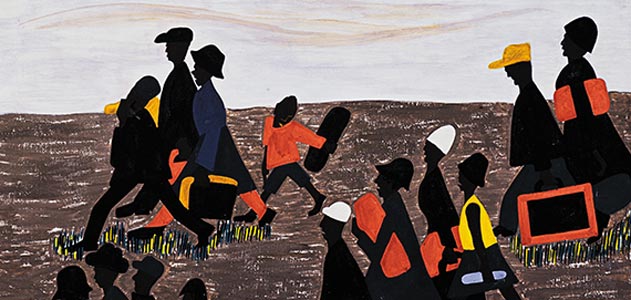
From Jacob Lawrence's migration series, 1941
We used to say that New York was the city that never sleeps. More than that, it is a city that wants to keep you alert. However, the flashing signage, noise and bustling-hustling crowds in Times Square, the agitated foot and skateboard and motor traffic, the rattling subway and the hurried pace and startling changes may produce the opposite effect, stupefying you with conflicting demands on your attention and shutting down most of your brain, leaving the remaining working part so focused on whatever you're trying to do that you mindlessly become another vector in the general agitation, avoiding obstacles but otherwise oblivious to other people and your surroundings.

All that is true, but New York also offers sites and events that invite quiet reflection, that permit you to integrate some of all those stimuli into a coherent narrative. The New York Public Library, with all its branches, has always bee such a site, and I hope it will remain so — though we heard disturbing news of plans to sell off the branches (more valuable as real estate) and ship the books out to an out-of-city warehouse. Good people are fighting to save the libraries, and good people in New York have been able to accomplish many things, so maybe it'll all be all right.

Other great sites for reflection on where we are and what it all means include the great museums, the galleries and the theaters. We returned to Madrid yesterday after another week in New York, a city we know well — we lived there for over 30 years — and still recognize, though it is ever changing. And we took the opportunity to take in some shows at a couple of museums, several galleries and a theater: the Music Box, for the revival of Wendy Wasserstein's 1989 hit, "The Heidi Chronicles". Great production, terrific actors, in a very dated story that reminded us how far we have not yet come in women's struggle for recognition and equal opportunity.

In MoMA, we spent a lot of time at the exhibit Latin America in Construction: Architecture 1955-1980 — mainly because we've been working on a book that includes that period. Not, in our view, a totally successful presentation of such a complicated history — as Ronald Reagan famously noted, there are a lot of different countries "down there", and unless you already knew a lot about what you were looking at, you might not be sure whether a particular project or building was in São Paulo or Mexico, or 1952 or 1972, and some enormously important events (e.g., the coups in Chile and Argentina) were scarcely mentioned. But, if you did have some idea what you were looking at, you could find many fascinating, more obscure works that you hadn't seen before. Susana will be writing a more detailed review, so I'll leave my comments at that.

A totally successful exhibit (in my view) was the marvelous One-Way Ticket: Jacob Lawrence’s Migration Series and Other Visions of the Great Movement North. Seeing the entire series of Lawrence's 60 paintings, re-united for the first time in many years and set out on the four walls of a large gallery in the order he intended, was marvelous in many ways. First, the beauty of the pieces, in Lawrence's dramatic, flattened images in just four colors, emphasizing the stark reality of the great black migration from the southern to northern states of the U.S. in the years just before Lawrence was born (in 1917). And then, of course, that dramatic story, which the young Lawrence (he was only 23 when he painted the series) had thorough documented, by his readings in the  collection on black history amassed by Puerto Rican-born scholar and bibliophile, Arturo Alfonso Schomburg, (now the Schomburg Center for Research in Black Culture, part of the wonderful resources of the New York Public Library,) and from his many conversations with his parents and other older neighbors in Harlem. The exhibit is further enriched by works by other artists, including the poet Langston Hughes (a friend of Lawrence, who illustrated Hughes's collection of poems with the same title as his series picture series, "One-Way Ticket"), a video of Marian Anderson singing at the Lincoln Memorial, another of Betty Holiday performing "Strange Fruit," and many other black musicians and graphic artists.

This I saw as a hopeful, optimistic picture of triumph, of people who and maintained and efended their dignity against the tremendous odds of color discrimination. 

But then, for a much more pessimistic view of ethnic relations in the U.S., the sad show at the Metropolitan Museum, The Plains Indians: Artists of Earth and Sky. The peoples of the American plains seized on new materials (glass, metals), images (clothing styles and others), and the great possibilities offered by the horse — all these imported by Europeans, with extensive contact beginning around 1700 — to create beautiful new forms and to increase their hunting and manufacturing prowess. Their ancestors had already been producing many beautiful objects before the European contact, but with more limited materials; the new things and ideas inspired a great growth and exploration of new styles and images. That demonstrates once again how creative people can be when given the chance. But this flourishing culture was brief, and its end disastrous: more and more Europeans came, killed off the buffalo that the plains people had come to rely on, massacred enormous numbers of "Indians" and then herded the survivors into camps and prisons and reservations, prohibiting their languages and many of their customs.

Some of their descendants have not given up or given in, and it's good to know that there are still rebels among them, defending their dignity and expressing themselves in new ways. But overall, the story told by the Met's exhibit is very sad one.

2014/03/15

Return to the ´60s

If at all possible, you must see this exhibition at the Brooklyn Museum: Witness: Art and Civil Rights in the Sixties
 Or if you can't get to Brooklyn, at least check out the website and the catalogue. But it's not the same as seeing the vibrant, sometimes chilling, often enraged, and at times oddly distant — a protective distance, the artist's self-shielding from painful emotion — of that terrible, sometimes joyous, often heart-breaking period of struggles for simple human dignity. Among the highlights: Romare Bearden's collages, a video of Nina Simone singing with full emotion "Mississippi Godam", a collage-construction by artist Jack Whitten called simply Birmingham : a newspaper photo from the bombing of the black Sixteenth Street Baptist Church in Birmingham, Alabama,  in September 1963, which killed four girls, at the center of an explosion of aluminum foil, stocking mesh, plywood and paint.
We revisited that era yesterday at the Museum, with the added joy of performance and talk by Sonia Sanchez, Bernice Reagon, and Bernice's musician daughter Toshi. They reminded us of the hope that survived, and the victories — never complete, but still significant — in those years of nonviolent struggle. Nonviolent on one side, that is.

2013/11/26

Mockingbird

To Kill a MockingbirdTo Kill a Mockingbird by Harper Lee
My rating: 4 of 5 stars

The voice of the perky, inquisitive, acutely observant Scout Finch from age 6 to 9 captures the reader so strongly as to hold together a whole string of disparate episodes — originally conceived by the author as separate short stories. Mainly, we get to know various characters of a poor little Alabama town during the Depression, their peculiar rituals and class and racial prejudices, and their sometimes redeeming acts of generosity. In this, it is more like Mark Twain's Adventures of Tom Sawyer, another child's-eye view of a southern small town told as a series of anecdotes, than like Twain's later and more tightly structured Adventures of Huckleberry Finn.

Scout's most piquant observations of hypocrisy, neurosis, arrogance, or cowardice are of the white folks she knows best. But she also reports with fascination the courage and kindness of a few individuals, including especially her father Atticus Finch, a neighbor woman, Maudie, and the Finches' black maid Calpurnia. A particularly beautiful moment is Scout's visit with Calpurnia to her First Purchase AME Church, a revelation to this protected white girl of black devotion and dignity and a whole community close by but separate from the little white hamlet.

The book is best remembered for one episode that is expanded to extend over several chapters and which is a pleasing, though historically misleading fable: the trial of a black laborer accused of rape of a poor white woman, and his defense by Scout's father Atticus. Sadly, nothing like the judicial fairness of the Maycomb judge, the opportunity of the defendant to legal defense and serious cross-examination of the plaintiff ever happened or could happen in Alabama in the 1930s in a black-on-white rape case. What Harper Lee evidently had in mind when she wrote it was the famous Scottsboro Boys trial in 1933, where no such judicial niceties occurred. But there were defense attorneys — mostly northerners — who, a bit like Atticus Finch in the novel, made the effort, often at the risk of their own lives.

But it is the voice that saves this and all the stories in the book. You have to love this tomboy when she tells you in a hurt voice that, when she tried to hold her big brother back from some dangerous adventure, "Jem told me I was being a girl…" Or when she observes, back in her white church, "the Impurity of Women doctrine that seemed to preoccupy all clergymen."

On the Scottsboro boys, see the NYT November 21, 2013, article,  
Alabama Pardons 3 ‘Scottsboro Boys’ After 80 Years


View all my reviews

2011/08/14

Understanding London's civil violence

Civil violence: three steps to understanding the ‘mindless criminal’ | MICROCON

You may find Jaideep Gupte's "three steps" helpful, but for me the most interesting part of his posting were these background data:
 … here are some basic statistics to help you make up your own mind: unemployment in the UK for 16-24 years olds is up from 17.90% in the early 1990s to 19.70% in 2010, while London continues to have the highest unemployment rate for this cohort at 22%.[6] Currently, 22% of 19 year old boys in England do not have a basic education, while this figure drops to 15% for girls.[7] Black young adults (16-24 years) are four times as likely to be in prison under sentence, than White young adults, and almost eight times as likely as Asian young adults.[8] Nevertheless, the number of burglaries and violent incidents with injuries have dropped significantly since the 1990s – from 1.8 million burglaries in 1995 to 0.7 million this year, and from 2.4 million incidents to 1.2 million over the same time period. 50% of adults surveyed in 2000 believed that the crime rate was increasing, this figure has dropped to 28% now. And while 24% of adults reported being very worried about being the victim of violent crime in 2000, this year the figure has dropped to 13%.[9]

2011/08/04

Race in America - The Christian Science Monitor - CSMonitor.com

This photo-sequence is a good follow-up to Peter de Lissovoy's novel-memoir about civil rights struggles in the South in the '60s. (See review below, posted 16 July.)

Race in America - The Christian Science Monitor - CSMonitor.com

2011/07/28

Growing up out of place

Feelgood: a trip in time and outFeelgood: a trip in time and out by Peter de Lissovoy

My rating: 4 of 5 stars


Semi-autobiographical novel about a sweet-natured, dope-dealing, white middle-class youth from a northern suburb who drops out of Harvard in 1962 and heads south to join the Student Nonviolent Coordinating Committee (SNCC), the premier civil rights activist organization, in violently racist rural Georgia. In the next year and a half he also drops out of the movement but learns much about life, trouble and sex from the blacks of southwest Georgia, and about the capacity for brutality and violence, not excluding murder, by whites who see their hegemony threatened — until he comes to fear death himself as a "nigger lover" and knows it's time to leave. The book is notable for the honesty and frankness about the narrator's often confused feelings, the sensuous descriptions of places and people, and especially the sensitive and detailed portrayals of a wide range of personalities black and white, especially the blacks— a deacon and his wife, a rebel ill-disposed to nonviolence, a too-clever thief and conman, winos and various hustlers, a couple of women happy to love him but not so dumb as to trust him, and finally the gentle, wise old marijuana-expert and healer he knows as Dr. Feelgood. De Lissovoy by his own account was not of much service to the civil rights movement— too easily distracted, too ready to follow another's lead — but he was a superb witness and narrator.

This is not really autobiography, but a novel about somebody (the unnamed narrator) a lot like Peter de Lissovoy but not entirely. The real Pete de Lissovoy had already been a correspondent in Africa while still a student at Harvard, and when I knew him, he may have been getting stoned more frequently than most of us (mostly because he seemed to have better contacts) but was still a functioning and articulate intellectual. And while most of what he tells us in the book probably resembles things that really happened, some of the turns in the story  (the fate of Yellow, for example, or the unexpected but very narratively-neat reappearance of Knight) make the kind of sense that's only possible in good fiction. (See the remarks Mark Twain made on the subject, especially “Truth is stranger than fiction, but it is because Fiction is obliged to stick to possibilities. Truth isn't.”- Following the Equator, Pudd'nhead Wilson's New Calendar.)

So there's some, maybe even a lot, of invention here. De Lissovoy is a writer, after all. But the basic story of the complex humanity of southern blacks, and the fear and rage of many of the whites, is absolutely true and beautifully described.

View all my reviews

2011/07/16

Reporting on civil rights in the dangerous '60s

I just renewed contact with an old college buddy who dropped out to do stuff that was more important — fighting for racial justice in the deep south in the dangerous '60s. And to write about it, so the rest of us could get some idea of what it was all about. His short recap here of some of his experiences and people he worked with or encountered, from his earlier writings (in The Nation and elsewhere) is an important reminder of how intense, risky and, at the same time, joyful that struggle was.

Reporting Civil Rights: Perspectives on Reporting: Peter de Lissovoy - Returning to Georgia

He writes so vividly and was involved in such exciting, frightening, and sometimes hilarious events (check out "The Great Pool Jump") that I've just ordered his novel, Feelgood.

Peter and I are nearly the same age, both grew up near Chicago and went to Harvard, but then we took off in different directions — me, to South America, he to Southwest Georgia. Except for one brief foray into the deep South, my involvement in civil rights was mostly northern and urban (in Evanston when I was a grad student at Northwestern U, later with the Black Panthers and Young Lords and others in Chicago). Southwest Georgia was like another planet.

Yes, he's right in his retrospective, we did manage to change the world a little bit for the better with all our serious, enthusiastic and sometimes foolhardy acts. Southwest Georgia is not the same today (not nearly as unjust, though far from perfect) as it was before he and Randy and C. B. King and all the others worked their magic, in all their different ways. I'm glad to have found you again, Pete.

2009/10/13

Dreams of the absent father

This book would be fascinating even if its author were not now president of the United States. It's the voice of a very young Obama (he's still not very old, especially for a U.S. president), just out of Harvard Law School. Obama, Barack. Dreams from my father: a story of race and inheritance. Rev. ed. New York: Three Rivers Press, 2004. It's the work of a young man, learning how to write a book and using the richest material he had, his own experience. Especially resonant for me were his pages on his community organizing experience -- frustrations and small triumphs -- in black Chicago. I too was a community organizer in a Chicago community, a few years earlier and many blocks north, in the Division Street area, then (1964-66) mostly Puerto Rican. And I recognize those feelings of the young organizer -- "Anything is possible," "Yes, we can" -- and surprise and disappointment when the people we're counting on turn out to have much more complex motives than we had imagined. And that sometimes take a long time to discover, because people are embarrassed to admit something (e.g., illiteracy, or some relationship or past event) or because they disguise their true motives under a mask of bravado or, most commonly, because they don't well understand their own impulses and anxieties.

I'm glad the author became our president. I think he's the best man possible at this time. But he would have still been impressive if he'd merely made himself a professional writer. This is a beautiful memoir, generous to those people in Chicago, to his stepfather in Indonesia, to his mother and his Kansas grandparents in Hawaii, and especially to the absent but imaginatively very present father. And it will help all of us Americans who are not black to understand a little better how a black man experiences our society.

Photos of Barack Obama, Sr., from BarackObama-net.

2009/05/02

Ox-bow revisited: Acquittal in Fatal Beating - NYTimes.com

And we thought we were making progress in race relations in the U.S. This just shows we have a long, long way to go. National Briefing - Mid-Atlantic - Pennsylvania - Acquittal in Fatal Beating - NYTimes.com

In case you don't remember or never read this famous 1940 novel (and 1943 movie with Henry Fonda), you can check out my review of The Ox-Bow Incident by Walter Van Tilburg Clark. Another literary antecedent is O. Henry's invention, the Cisco Kid (NOT the one who appeared in the TV series), a maniac who murders Mexicans for the fun of it. Here's where you can download the pdf of "The Caballero's Way" by O. Henry, as frightening and beautiful as any by Cormac McCarthy.

2009/03/22

Civil rights days

We've spent this past week in New York City, too busy to blog, and will be going home to Andalucía (Andalusia) in a few hours. Besides seeing friends and picking up our Spanish permanent residency visa from the consulate here (which obliged us to return), we managed to see the production of Tracey Scott Wilson's The Good Negro. (See review at backstage.com. More reviews at Critic-O-Meter.)

Most of the audience were, like us, old enough to remember the early, dangerous days of the civil rights movement, how precarious every little victory seemed to be, the spying and false information spread by FBI men to disrupt the movement, the murders, the exaggerated and impossible expectations everybody had of those bold, scared men and women who dared to lead. The play simplifies the history, but wonderfully complicates the accepted myth -- that somehow Martin Luther King, Jr., Ralph Abernathy and the others in the Southern Christian Leadership Council were always virtuous, always sure of themselves, always focused only on the movement. It couldn't have been like that -- these were human beings, just like us, with all our common frailties. That's important to remember, because otherwise we will forget what June Jordan reminded us, that we are the ones we have been waiting for.

On a personal note, the play reminded me of an episode from my own past, which I've recounted here.

We were no heroes or demigods, but we dared, and in our bumbling and sometimes frightened ways, we did what had to be done. And even when victory looked most remote, we kept telling ourslves "Yes we can." And, finally, we could and did.