Showing posts with label theater. Show all posts

2015/04/18

Staying awake in the city that never sleeps

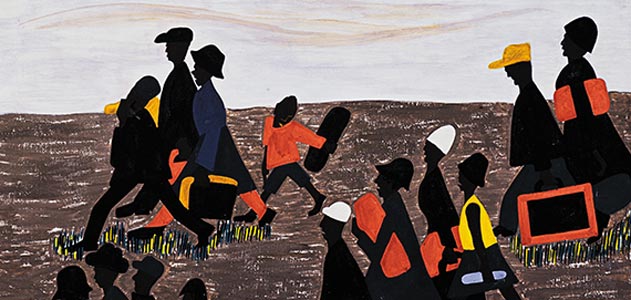
From Jacob Lawrence's migration series, 1941
We used to say that New York was the city that never sleeps. More than that, it is a city that wants to keep you alert. However, the flashing signage, noise and bustling-hustling crowds in Times Square, the agitated foot and skateboard and motor traffic, the rattling subway and the hurried pace and startling changes may produce the opposite effect, stupefying you with conflicting demands on your attention and shutting down most of your brain, leaving the remaining working part so focused on whatever you're trying to do that you mindlessly become another vector in the general agitation, avoiding obstacles but otherwise oblivious to other people and your surroundings.

All that is true, but New York also offers sites and events that invite quiet reflection, that permit you to integrate some of all those stimuli into a coherent narrative. The New York Public Library, with all its branches, has always bee such a site, and I hope it will remain so — though we heard disturbing news of plans to sell off the branches (more valuable as real estate) and ship the books out to an out-of-city warehouse. Good people are fighting to save the libraries, and good people in New York have been able to accomplish many things, so maybe it'll all be all right.

Other great sites for reflection on where we are and what it all means include the great museums, the galleries and the theaters. We returned to Madrid yesterday after another week in New York, a city we know well — we lived there for over 30 years — and still recognize, though it is ever changing. And we took the opportunity to take in some shows at a couple of museums, several galleries and a theater: the Music Box, for the revival of Wendy Wasserstein's 1989 hit, "The Heidi Chronicles". Great production, terrific actors, in a very dated story that reminded us how far we have not yet come in women's struggle for recognition and equal opportunity.

In MoMA, we spent a lot of time at the exhibit Latin America in Construction: Architecture 1955-1980 — mainly because we've been working on a book that includes that period. Not, in our view, a totally successful presentation of such a complicated history — as Ronald Reagan famously noted, there are a lot of different countries "down there", and unless you already knew a lot about what you were looking at, you might not be sure whether a particular project or building was in São Paulo or Mexico, or 1952 or 1972, and some enormously important events (e.g., the coups in Chile and Argentina) were scarcely mentioned. But, if you did have some idea what you were looking at, you could find many fascinating, more obscure works that you hadn't seen before. Susana will be writing a more detailed review, so I'll leave my comments at that.

A totally successful exhibit (in my view) was the marvelous One-Way Ticket: Jacob Lawrence’s Migration Series and Other Visions of the Great Movement North. Seeing the entire series of Lawrence's 60 paintings, re-united for the first time in many years and set out on the four walls of a large gallery in the order he intended, was marvelous in many ways. First, the beauty of the pieces, in Lawrence's dramatic, flattened images in just four colors, emphasizing the stark reality of the great black migration from the southern to northern states of the U.S. in the years just before Lawrence was born (in 1917). And then, of course, that dramatic story, which the young Lawrence (he was only 23 when he painted the series) had thorough documented, by his readings in the  collection on black history amassed by Puerto Rican-born scholar and bibliophile, Arturo Alfonso Schomburg, (now the Schomburg Center for Research in Black Culture, part of the wonderful resources of the New York Public Library,) and from his many conversations with his parents and other older neighbors in Harlem. The exhibit is further enriched by works by other artists, including the poet Langston Hughes (a friend of Lawrence, who illustrated Hughes's collection of poems with the same title as his series picture series, "One-Way Ticket"), a video of Marian Anderson singing at the Lincoln Memorial, another of Betty Holiday performing "Strange Fruit," and many other black musicians and graphic artists.

This I saw as a hopeful, optimistic picture of triumph, of people who and maintained and efended their dignity against the tremendous odds of color discrimination. 

But then, for a much more pessimistic view of ethnic relations in the U.S., the sad show at the Metropolitan Museum, The Plains Indians: Artists of Earth and Sky. The peoples of the American plains seized on new materials (glass, metals), images (clothing styles and others), and the great possibilities offered by the horse — all these imported by Europeans, with extensive contact beginning around 1700 — to create beautiful new forms and to increase their hunting and manufacturing prowess. Their ancestors had already been producing many beautiful objects before the European contact, but with more limited materials; the new things and ideas inspired a great growth and exploration of new styles and images. That demonstrates once again how creative people can be when given the chance. But this flourishing culture was brief, and its end disastrous: more and more Europeans came, killed off the buffalo that the plains people had come to rely on, massacred enormous numbers of "Indians" and then herded the survivors into camps and prisons and reservations, prohibiting their languages and many of their customs.

Some of their descendants have not given up or given in, and it's good to know that there are still rebels among them, defending their dignity and expressing themselves in new ways. But overall, the story told by the Met's exhibit is very sad one.

2009/05/16

Chulapos y chulapas

We're in Madrid this week, for the festival of San Isidro Labrador. Isidro was a 12th century farmer ("labrador") who probably never imagined himself as a saint, but he must have had the reputation of being a good man because, decades after his death, when what was supposed to be his corpse was discovered remarkably well-preserved, people began attributing miracles to him. To celebrate his day (15 May) people dress up not as 12th century farmers, but as early 20th century fancypants proletarians, the guys in black-and-white checked vests and caps, the gals in multiflounced red-and-white polkadot dresses, white scarves, and a big red flower in the hair.

And you're supposed to dance the schotis (also spelled chotis or even xotis), a couple dance falsely attributed to the Scots (hence the name, derived from the German Schottisch), probably because it involves a lot of jumping up and down like a jig.

For us, the big events have been all the free street theater, a performance by a whole series of folkloric dance groups in the park of Las Vistillas, a wonderful concert by Joan Manuel Serrat, and an adaptation by our friend Antonio Rodríguez of Eric Rohmer's "Trío en mi bemol" ("Trio en E-flat"). My alter ego Baltasar Lotroyo plans to post a review on his page

2008/05/27

For poetry lovers

Back to literary matters. Here is my updated page covering our two groups of literary performers in Carboneras, "Personas libro" (in Spanish) and "Book Persons" (for the English-speakers among us). See Poetry Readings (though not every text chosen is a poem). There you will find links to the selected texts, and maybe will find something you like well enough to learn.

There may be enough French speakers in town to form a third group, but that hasn't happened yet.

2003/04/01

Cultural notes

(1) I do not love Leonardo [da Vinci, that is]. As the show that just closed at the Met demonstrated, he was a superb draughtsman. However, there is nothing in those exquisite drawings to suggest he cared about people. There is no religious feeling in his drawings of saints and virgins, just meticulous studies of skin texture and anatomical proportions of pretty girls and muscular, usually contorted men. Grotesque faces also interested him, but just their external, nothing of their contexts, nothing to suggest what life might feel like for the persons within those faces. And Leonardo lavished equal attention on those war machines he kept inventing, the beauty of a mortiferous shower of missiles into a castle or a town, the striking and gouging power of ingenious bolt-hurlers, and so on. Not so much as a line or a shadow to suggest the effects of such machines on human beings. No, I do not love Leonardo, because he did not love me or thee. He loved only the power of his creations. Sort of like the guys who thought up "shock and awe" for Iraq.

(2) The other super-exhibition at the Metropolitan Museum of Art is a sharp contrast: Manet/Velázquez, on view until June 8. Velázquez, Murillo, Zurburán did feel for their subjects. They all seemed much more eager to portray the lives of their models than their anatomical peculiarities. We see the subjects' attitudes, moods and expectations. Then, 200 years later, comes Goya. This was another superb draughtsman, expert in portraying contorted bodies, most notably in the series "The Disasters of War" (scenes from the Spanish resistance to French occupation of Spain under Napoleon) and many others, but with a passion utterly different from Leonardo's. Manet, Degas, even Courbet reinterpreted those passions. And the Americans (Sargent, Whistler, et al.) commodified them. (If you can't get to the show, be sure at least to check out the website.)

(3)Midnight's Children: We caught the last performance at the Apollo Theater on Sunday. Terrific play, in the original sense -- that is, terrifying. We spotted Salman Rushdie himself in the audience, only a few seats away, but we didn't fight through the crowds afterwards to greet him. I don't know what I would have said, other than "I've loved your work." Satanic Verses I especially loved. I never got through the book Midnight's Children, I confess; it's long, and requires close attention to follow, and other things came up to take my attention away from it. Now that I know how it comes out, I want to go back to the book. You can perform a lot more magic on the page than on the stage.

(4)The side benefit of going to the play was that it took us to 125th Street, Harlem's main drag, where before the play we visited one of our favorite places, the Studio Museum in Harlem. The main show, open through June 6, is "Challenge of the Modern: African American Artists 1925-1945." Very, very impressive works by artists famous (van der Zee, Jacob Lawrence) and less famous. Oddly, they include the Cuban, Wifredo Lam (whose name they misspell as "Wilfredo"), but I was happy to see more of his exuberant paintings, whatever the pretext.