Showing posts with label consciousness. Show all posts

2015/07/11

Narrative thought

In his column today, David Brooks offers a thought-provoking (he's good at that) contrast of off-line as compared to on-line learning. Here's a key passage:
When people in this slower world [off-line] gather to try to understand connections and context, they gravitate toward a different set of questions. These questions are less about sensation than about meaning. They argue about how events unfold and how context influences behavior. They are more likely to make moral evaluations. They want to know where it is all headed and what are the ultimate ends.
We short-story and novel writers — well, most of us, anyway — live and work mostly in this slower world. Video game-writers, on-line interactive plotters offering multiple pathways, and E. L. James are challenging the model, obviously, creating experiences rather than narrative. Which is fine, I suppose, and inevitable, but has its cost if it occupies all our attention. Brooks goes on,
The online world is brand new, but it feels more fun, effortless and natural than the offline world of reading and discussion. It nurtures agility, but there is clear evidence by now that it encourages a fast mental rhythm that undermines the ability to explore narrative, and place people, ideas and events in wider contexts.
I'm still an old-fashioned, Second Millennium guy, wedded to narrative. Not just in my fiction, but in my thinking and writing about social, political and (occasionally) scientific matters. And so is David Brooks. I think the world will always need such thinking for us to have some idea of where we're headed and how we got here, instead of just jumping to each new experience that seems exciting. It's a minority view, but you on-liners are going to need us when your games crash.

2015/01/06

Historical fiction: impossible and necessary

Anyone who has seriously attempted it knows the impossibility of representing past events authentically, as they were lived and felt by the people involved. Michael Graves was surely aware of this impossibility when he impersonated a Roman noble of the 1st century A.D. in I, Claudius. John Fowles, in The French Lieutenant's Woman, interrupts his narrative to acknowledge the impossibility of truly understanding the thoughts of his character Smithson, who is, like Fowles, an Englishman and lived only a bit more than a century before Fowles' book. People then just didn't think the way we do. Even in our own families, in overlapping generations, grandchildren and grandparents are often bewildered by one another's reactions and behaviors.

There are authors unaware of this gap, and who present a Cleopatra or a soldier of Napoleon's Grande Armée as though they saw the world just like, say, a contemporary American teenager or a Green Beret. They put contemporary characters into past situations, changing little more than the wardrobe. But when you and I read historical fiction, we demand something more. We want to get into the minds of those very foreign people. People in the past just don't think and act the way we do. It's not just a question of how much they know or what tools or weapons they have available — all that is important — but, more mysteriously, the ways their brains are configured.

The biggest break between one kind of thinking and another comes, historically, with literacy. As Julian Jaynes, Walter Ong, and the pioneering work of Vygotsky and Luria in Uzbekistan and other neuroscientists and diverse scholars have made clear, the neural paths that connect and stimulate different parts of the brain change enormously with literacy. As Jaynes put it, preliteracy we used to hear voices that seemed to come from afar but were really memories stored in one hemisphere of the brain, whereas learning to read connects the two hemispheres so that one half of the brain is aware of what the other half is firing off in electrons.

But the changes don't end there. Even in a society where everyone is literate, new technologies — the telegraph, then the telephone, then TV, and on to Smartphones and Whatsapp — create new neurological connections. Our concepts of time have changed enormously, but also our sense of relationships in an era where one can suddenly acquire a zillion "friends" or even "followers" without leaving home.

In my case, in my novel in progress, I'm trying to understand and to present to readers the thinking of people who acted in — whether for or against or just trying to survive — the Paris Commune of 1871. They spoke a different language from the one I'm using, but more than that, they lived in a culture that was more oral than ours (not everybody knew how to read, and only a minority read anything at all complicated), where inner city mobility was either on foot or by horse-drawn vehicle or on horseback, and where relationships — men and women, or comrades of the same sex, or rivals — obeyed different traditions from ours. 

But we must try to reach them, if we are to understand anything about the Commune and thus to understand how the western revolutionary tradition emerged and how it has changed. We can come closer to understanding if we read carefully what they themselves said about it, and the testimony left by survivors of the bloody massacre of May 1871, together with court transcripts and newspaper reports and other documents, is abundant. We can come closer, but we cannot quite reach them. So my solution, like Fowles' in The French Lieutenant's Woman, is to acknowledge the gap, to let readers know that I am aware that those people are and ever will be different from us.

References:
Julian Jaynes, The Origin of Consciousness in the Breakdown of the Bicameral Mind
Walter Ong, Orality and Literacy 
On Lev Vygotsky and Aleksandr Luria:
Michael Graves, I, Claudius
My novel in progress: The Bookbinder 


2014/08/03

Russia, revolution and me

On the 4 1/2 hour train ride from Leningradsky Station in Moscow to Moskovskaya Station in Saint Petersburg last Thursday, I continued re-reading Edmund Wilson, To the Finland Station.
Lenin's train. From Canadian Military History
I've now got close to the end of this history of revolutionary thought from Michelet to the 1917 revolution, and the arrival of Lenin and other exiles at the Finland Station in Petrograd (as the city was then known), which we plan to see tomorrow. Meanwhile, while visiting museums (the Hermitage, Museum of Russian Art) and monuments and churches and walking all over the central city in this great heat, I've been reflecting on what this visit means for me and what I've defined as my life projects.

The most immediate of those projects is completing my novel about the Paris Commune. Wilson is little help there; his too-brief summary is not only mistaken in some details, but treats the whole adventure with detached bemusement. But Wilson and this Russia visit both help me understand better the larger and longer-lasting context of that adventure. More important, they have led me to understand this novel in larger terms. What I really aim to do is understand all of social change, the revolutionary impulse, how it gets mobilized, its splits and contradictions, and especially the conflicts ensuing upon initial victory. The Paris Commune of the spring of 1871 is but one essential chapter. It inspired Lenin and all the other Russian revolutionaries, which is one reason it is essential. The other is that it was a tightly condensed laboratory experience that suggests almost all that can, or has, happened, not only in Russia 1917-1920, but also Mexico 1910 and after, Cuba 1956 (landing of the Granma) and on, and so on. I don't know how much of all this I'll be able to complete before that great, final deadline, but the whole picture, however dimly, will be in my mind as I continue.

So I see these questions as parts of two life projects: 1, to write fiction that helps me and my readers enter these processes emotionally, and 2, to analyze them as the sociologist I was trained to be.
    
And finally there is a much smaller, less ambitious project: for over 50 years I've wanted to learn Russian, and now I'm doing it. I've begun working through the originals, with the help of the translations, in a bilingual edition of Osip Mandelstam's verse, and loving it. This trip has been the great stimulus.

2014/06/13

Voices from beyond (and within)

The Future of an Illusion The Future of an Illusion by Sigmund Freud

(This review was originally posted 2012/07/14, but posting got contaminated by distracting ads, requiring me to trash that version and re-post the original.)

My rating: 5 of 5 stars

Where does the belief in a god come from? And why does it persist even among educated adults, who have available to them much more convincing explanations of all that God is supposed to represent? And finally, will it ever be possible for a society to disabuse itself of this notion, and what would be the costs (psychological and social) and benefits? These are Freud's central questions in this 1927 essay, and they are just as urgent today, when even the Higgs boson can't shake the faith of true believers.

"An illusion is not the same as an error, nor is it necessarily an error. … For example, a middle-class girl may entertain the illusion that a prince will come to carry her off to his home. It is possible, cases of the sort have occurred. That the Messiah will come and establish a new golden age is far less likely; depending on the personal stance of the person assessing it, he will classify this belief as an illusion or as analogous to a delusion. … we refer to a belief as an illusion when wesh-fulfilminet plays a prominent part in its motivation, and in the process we disregard its relationship to reality, just as the illusion itself dispenses with accreditations."

The question then is why do humans so wish for God or gods to exist?

Freud has a pretty convincing hypothesis. "As for humanity as a whole, so too for the invividual human, life is hard to bear." In the face of events he can't control and often can't understand, "man's badly threatened self-esteem craves consolation, the world and life need to lose their terror, and at the same time humanity's thirst for knowledge, which is of course driven by the strongest practical interest, craves an answer." The invention of gods, attributing human personalities to the unseen and threatening forces, gives great relief; "a person may still be defenceless but he is not helpless any longer, he can at least react. In fact, he may not even be defenceless: he can deploy against those violent supermen out there the same resources as he uses in his society. He can try beseeching them, appeasing them, bribing them…"

At a later stage, many peoples compress all their gods into one, thus exposing "the paternal core that had always lain hidden behind every god figure… With God now a single being, relations towards him could recover the intimacy and intensity of the child's relationship with its father." It is this relationship with "God the Father" that people find so hard to give up, regardless of all the evident contradictions of the notion. We could, and a minority of us do, accept that we are small and impotent "in the face of the totality of the world" without taking that next step, imagining a protective God-Parent. That is, we accept responsibility for our own actions, confront setbacks as well as we can with our own resources and seek explanations of mysterious phenomena — the creation of the universe, for example — without recourse to magic.

The alternative is to remain in a child-like state, expecting Daddy to take care of us. And since Daddy knows all, we should stop asking embarrassing questions. "Think of the distressing contrast between the radiant intelligence of a healthy child and the intellectul feeblenes of the average adult. Is it not at least possible that in fact religious education is largely to blame for this relative atrophy?"

The worst part is that we (well, many people) think he is the Daddy of us all, and will punish us if we do not punish others who disobey him. He is also hypersensitive, despite being all powerful, and wants anybody who dares insult him to be burned at the stake, or stoned to death in the public square, or bombed to Hell. That makes life difficult in multicultural contacts, where people are listening to different Daddies with different rules, and some have left behind Daddy along with the Tooth Fairy, Santa Claus, and "the Invisible Hand".

Can any large number of humans free themselves from the illusion? Not by decree. "It is certainly a nonsensical plan to seek to abolish religion by force and at a stroke. Principally because there is no chance of its succeeding." Substituting some other "doctrinal system" (such as the CPSU's "dialectical materialism") "would assume, in its own defence, all the psychological characteristics of religion, the same sanctity, rigidity, intolerance, the same ban on thought."

But it is possible to win such freedom from the imaginary bully-cum-protector, at least for some people who are willing to heed their own doubts about the established religions. "[T]he voice of the intellect is a low one, yet it does not cease until it has gained a hearing. In the end, after countles rejections, it does so. This one of the few respects in which one may be optimistic for the future of the human race…" And, Freud writes later on in his argument, "ultimately, nothing withstand reason and experience, and the fact that religion contradicts both is all too tangible."

In Egypt, the masses have just elected as president an engineer educated at Cairo University and the University of Southern California, who is also a self-proclaimed Islamist and former head of the Muslim Brotherhood. In Spain, even socialist party activists participate in religious processions. And in the U.S., almost no politician, regardless of party or education, dares say he or she is an atheist. But the low voice of the intellect persists, though perhaps it needs more amplification.

View all my reviews

2013/06/28

Neurons in harmony

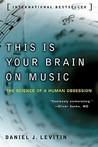
This Is Your Brain on Music: The Science of a Human ObsessionThis Is Your Brain on Music: The Science of a Human Obsession by Daniel J. Levitin
My rating: 4 of 5 stars

Hard to believe, but this book is as good as its blurbs. Levitin is both a musician and a neuroscientist, who got into the science to understand better the music he was playing or engineering for rock bands. He knows far more music than I do, drawing on all genres to illustrate what it does, how it does it and why it matters. "Musical activity involves nearly every region of the brain that we know about, and nearly every neural subsystem." (pp. 85-86) And, he argues (against Pinker and other skeptics), it is not a superfluous byproduct of evolution, but has been essential to our survival and most probably, as Darwin himself believed, is even older than language.

Just how do we remember songs, even when the pitch, rhythm and timbre are all altered? And just what are pitch, rhythm and timbre, and how do they affect our brains? And why do you like heavy metal (or whatever you like), while I … well, many other things? These are just some of the mysteries that scientists are beginning to solve.

And what must occur in the brain for a musician to achieve full physical skill (of voice, strings, horn, whatever) and sensibility? It takes at least 10,000 hours of practice, says Levitin, for the brain to achieve complete mastery of anything (auto mechanics, fiction writing, musical composition or performance, or anything else). "Although people differ in how long it takes them to consolidate information neurally, it remains true that increased practice leads to a greater number of neural traces, which can combine to create a stronger memory representation." (p. 197) Talent — a genetic predisposition, that difference in learning time he mentions — is a big help, but it's not enough without practice.

Levitin's style is lively, his examples well chosen (even though I didn't recognize all the music he expected me to know), and his openness to examining contrary hypotheses makes him a credible guide. I especially appreciated his comments on performance and how a musician learns new pieces, by "chunking" — that is, learning whole groups or sequences of chords, melodies, etc. rather than all the individual notes a beginning piano player struggles to memorize. And best of all, the sheer emotion of listening and playing. That's what I want to hold on to as I get back to practicing. And I now have a clearer idea of the "schema" to listen for in classic jazz (I sort of knew, but never had it explained before) and how to appreciate the clever transformation Mahler achieves in his Fifth, or what and how Joni Mitchell accomplishes with her alternative guitar tunings.

So why four and not five stars? My very personal reaction: the first couple of chapters were too cute and anecdotal, an unnecessary (for me) warm-up for the truly informative, analytical stuff to come. But if you've never thought much about notes or scales or timbre, maybe you'll need that.

View all my reviews

2012/09/01

Nothing lasts forever — not even eternity

The Fabric of the Cosmos: Space, Time, and the Texture of RealityThe Fabric of the Cosmos: Space, Time, and the Texture of Reality by Brian Greene
My rating: 5 of 5 stars

Nothing lasts forever — not even eternity, as we learned from Steven Hawking a few years ago. The recent discovery of what may be the Higgs boson made me aware again of how little I understand about the universe. Or even about the questions now being posed by cosmologists. Greene makes it all about as clear as it can possibly be to someone — like me — who can't follow the math. For those who can follow it, he offers many of the necessary equations in the endnotes, which also include numerous references for further reading. To substitute for the math, Greene uses metaphors, generally pretty silly ones — Bart Simpson on a supersonic skateboard, for example — that at least give us an idea of, for example, what Einstein meant about space-time in the general theory of relativity. And then beyond Einstein, to quantum mechanics, and why the world and the whole universe appear to us in only three space dimensions (forward and back, side to side, up and down) and one time dimension, when quantum theory, confirmed experimentally, demonstrates that there must be ten space dimensions (but still only one time dimension). Is our universe really a kind of hologram projected by forces outside it, that is, beyond the universe we are capable of perceiving directly? Could be; Greene considers that hypothesis as at least plausible. And how did it all, everything, begin? Or did it? Was the Big Bang, the initial expansion of matter and energy that set everything in motion, just a new configuration of energy that is always, and that therefore may have been dispersed in some other entropic system(s), and may again — if our universe ever reaches the limit of its continuing expansion — shrink to extreme density, preparatory to a new explosion ("Big Bang") some billions of years hence? It took me weeks to get through this book, not because it was unclear, but because the news about the universe seemed so strange, so oddly contrary to our ordinary experience, that I had to keep checking back to re-understand parts of earlier chapters necessary for following the later ones. I remain amazed, and inspired with new speculations about philosophy and existence and what we do and cannot know. Guess it's time for me to learn some math.

View all my reviews

2012/06/18

Antidotes to economic/psychological depression

In response to my article about the "indignados" of Spain, friend and colleague Christopher Leo writes:
You and I have been through this movie before. The rotating protests are reminiscent of the late sixties, except that then there was one clear focus, the war in Vietnam. This time it's about many things, and no one thing in particular. Hard to guess where it's going to lead, if anywhere. 

Swarming rallies convoked by SMS and Internet are a worldwide phenomenon now. Even if the protests were completely ineffective in changing policies, they at least serve as an antidote to severe psychological depression among the millions who are suffering sudden decline in economic possibilities. (See Increasingly in Europe, Suicides ‘by Economic Crisis’ - NYTimes.com.)

Thus the protest rallies are an example of what Gramsci liked to call "optimism of the will". There are other antidotes to depression available: Jihad, neo-Naziism (as in Greece today), religious mysticism, drugs, alcohol etc. Lots of opiates for the people are on the menu. Of all of these possibilities, the big, rapidly assembled protest rallies against perceived injustice, where people of diverse class and ethnic backgrounds discover a common cause, seem to me by far the most healthful, both for the individual  and for the society.

Sustained anger and racist hatred are hard on one's health (see Anger Effects on Your Heart: Heart Disease, Atherosclerosis, and More), drugs destroy your physical and emotional defenses, and mystic ecstasy doesn't help much with practical problems. Political protest in an atmosphere of solidarity not only feels better, it may — just may — help bring about a more equitable system.


2012/06/07

Deep in the caves, deep in our past

See Telegraph article cited below
We've been traveling, just got back to Madrid from Cantabria (region on the north coast of Spain). Our main interest was to see the caves where our ancestors made such amazing paintings 12, 20 and even 40 thousand years ago. We got into a major one called El Castillo, a small number of people with a guide — just stunning, to see the paintings of giant bisons, deer, horses and, in one remote spot, a little fox. The best paintings are deep in the interior, where no sunlight at all penetrates, and sometimes in spaces so small that only a fery few people could have entered; there are no remains of smoke around the figures, so paleontologists infer that they used smokeless tallow lamps (they've even found the remains of bowls that may have been for such lamps). Also stunning and amazing is the nearby Cueva de las Monedas, too small for clan habitation but a fantastic temple of stalactites and crystals, with a few exquisite paleolithic paintings tucked into remote crevices.

From The Ballroom Blog
One has to wonder what those works meant to their artists and to the rest of the clan. Were they summoning the spirits of those sacred animals? Except for the deer, most of the animals they painted were not part of their diet, so must have had some other importance to them.

The most famous cave of all, Altamira, has been closed to the public since the 1970s; the crowds were destroying it, not by vandalism but just by their presence, changing the temperature and humidity that had preserved those marvelous paintings. To compensate, the authorities have built a life-size "neocave" millimetric replica of the main chambers, reproducing every crack and bulge of the rock and ever handprint (both positives — paint smeared on the palm of the hand and pressed against the rock — and negatives — paint blown over the back of the hand pressed on the rock), every charcoal or iron oxide figure, every engraving etched with some sharp stone.  It was disappointing not to see the real thing, but still well worth the visit, because of the attached museum, with clear and vivid explanations of all the history and "prehistory", including the geological formation.  At some future date, they plan to again admit very small numbers of people for limited visits. The other caves inhabited tens of thousands of years ago remain accessible (there are many, besides the two we visited, in Cantabria and southern France). Now for the first time I feel a desire to read Jean Auel's The Clan of the Cave Bear, her famous re-imagination of the age when Neanderthals and Homo sapiens cohabited the planet.

For more, see Spain to reopen Altamira Caves despite risk of destroying prehistoric paintings - Telegraph

2012/05/22

Alzheimer's Patients Turn To Stories Instead Of Memories

Further evidence (as though any were needed) that our most fundamental psychological need, and the only way we can imagine that we understand anything, is to spin a story about it. "It" being the narrative string connecting sights, smells, memories, and everything else. It's what dreams are made of, and theology, and scientific theories, and all our human relationships.

Alzheimer's Patients Turn To Stories Instead Of Memories : Shots - Health Blog : NPR

Plus of course our novels, short stories and poems. Like the ones these patients are creating.

2011/11/21

Why the 1% Love "Anarchist Violence"

A good friend just sent me this article by Steve Weissman, which roused memories and emotions or not-so-long-ago.

Why the 1% Love "Anarchist Violence"

Astute analysis. It makes me think back on my own experience, which was different because my theater of operations then was the Chicago area.

There our movement started out on the campuses — I had founded an SDS chapter at Northwestern by bringing together three or four separate single-issue clubs already recognized —but reached out to link to community groups, especially (in Evanston IL and Chicago) black, mostly church-based organizations. They got us to contribute to demanding better housing and better schools by sit-ins, marches and heavy leafletting, and we helped them make their constituents more aware and more angry about the toll theirs sons were paying in the US's futile and odious Indochina war. Such days. We, or some of us, also made contact with young labor activists. These were workers and mostly union members from those other ethnic communities — Polish, Italian, Ukrainian, Czech, even some Irish — some of whom were discovering Marxism-Leninism through the small, short-lived W.E.B. DuBois Club, where I came into contact with them.

It was during the Democratic Party Convention of 1968 that for the first time in the most dramatic ways we did face the issue of provocateur violence. And especially the absurd plots that the police attributed to the Chicago Seven and the even more absurd (and much funnier) fantasies that the Yippies invented in reply.

We continued to draw on students from many Chicago-area campuses, but the twin issues of racial and ethnic discrimination and the Vietnam war brought us together with young labor activists and then, increasingly, other non-student youth from the several ethnic communities (Appalachian whites in the "Young Patriots", Puerto Ricans in the "Young Lords", Mexicans in a couple of separate "Raza" groups) systematically and intelligently politicized by the Black Panthers, under the very capable leadership of Fred Hampton.

The Panthers made a display of self-defense, but that was mostly a pose; the real violence always came from the police. They assassinated Fred in his bed shortly before Christmas 1969, but he had established a strong enough base that the movement survived and gathered new support — since the murder had been so blatant. (For much more on this, including video clips of Hampton showing why he was such an effective leader and thus such a threat to the likes of Atty. Gen. John Mitchell, FBI chief Herbert Hoover and Nixon, see this 2009 broadcast The Assassination of Fred Hampton on Democracy Now.) The day Fred's lieutenant Bobby Rush sought and received refuge in the church of Jesse Jackson, icon of ML King's non-violent movement, marked a major breakthrough for all of us, a joining of hands of dissheveled young radicals and well-groomed, church-attending family folk who just weren''t going to take it any more.

In sum, what I've taken from all those experiences is that nonviolence must be the preferred strategy — as it was for Fred Hampton — but not an unwavering principle. Not when, as Hampton put it, the enemy doesn't even know what "peace" means, when like the US's Cointelpro then or Bashar al-Assad's tanks and planes today they threaten to wipe out your whole community. But that is not (yet) the nature of conflict in Oakland. As long as possible, nonviolence has to be the preferred strategy because it is the most effective, because the victory sought is not a shift of rulers over the same system but a social transformation, making the blind defense of privilege impossible. But you knew that already.

2011/08/09

Seeing colors - more on our tricky brains

Here's a fascinating follow-up to our discussion of the language of color —here, what happens in our brains even before we give names to hues.

Beau Lotto: Optical illusions show how we see‬‏ - YouTube

Thanks to my ever-alert old friend LouBette Herrick for suggesting this link.

2011/08/02

Thought and language

Through the Language Glass: Why the World Looks Different in Other LanguagesThrough the Language Glass: Why the World Looks Different in Other Languages by Guy Deutscher

My rating: 3 of 5 stars


This digressive examination of whether and, if so, how a speaker's language structures his/her thoughts contains two interesting arguments bundled with amusing anecdotes about odd languages and linguists. Some of the descriptions of non-Western languages, and even of Western languages (English among them) at earlier stages of development, show truly surprising ways of putting together information, such as numbers of tenses, whether person and time of action are included in verb or noun or in separate words (as in modern English), and even the number of sounds available to speakers. Current consensus: No language is a prison of thought; the speaker of any language can find a way to express any idea, even if s/he has to invent or borrow new vocabulary for some of it. But some languages oblige the speaker to give information that is optional in other languages. The handiest example is the English pronouns; if I'm speaking of a person, I can't say "it" visited me, I have to let you know whether the person was "he" or "she". If we're speaking Turkish (or any of many other languages with unsexed pronouns), I can leave the sex of the person ambiguous if I choose — or add something if I want to let you know.

The first of the two interesting arguments is about the language of color. As William Gladstone discovered in his monumental study of Homer, there are no color references beyond "black" (meaning dark), "white" or light, and red in the Odyssey or Iliad. (I had had no idea that the politician Gladstone, before becoming PM, had been such an important scholar). The sea or sky are never described as blue, the word sometimes translated as "green" is really much vaguer (could be yellow, or could just mean "ripe"). Later research revealed that no ancient language, or modern language of preliterate simple societies, has a developed vocabulary for all the colors that you or I would see and name and that surround them in their environment. Gladstone and generations of later linguists assumed there was something wrong with primitive and ancient people's color vision. But no: Deutscher reports all the tests that have shown that even people who have no names for many color tones can see them perfectly well if they need to. They don't think of the sky as "blue" because it does not seem to them to be an object, just a vast emptiness, and as people become more aware of different colors blue is always (so far in all the studies) the last to be named, because it just doesn't appear much in their environment (except that empty sky). We today are far more sensitive to colors than our ancestors because of all the colored objects on the market and in our household and on our computer screens etc. For people a few centuries back, distinguishing between bright and dark and red (because of blood, symbolizing life) was quite enough.

The second argument is more amusing though less important: How assigning gender to inanimate objects affects, but only slightly, they way people perceive them. The German "die Brucke" is described as female, graceful, delicate, etc., the Spanish "el puente" as male, big, sturdy, the English "bridge" is simply a thing with no preconception about its delicacy or strength. But all three words refer to the same object. The sexual connotations of dish, spoon, sea, etc. are faint and of little consequence to most speakers in ordinary life, but can add flavor to the poetry in those languages that have not (like English) lost their genders.

View all my reviews

2011/04/06

Becoming an elder

Sunday I turned 70. That means that I am now one of the elders. I do not take this responsibility lightly. You and all the other members of our tribe — the entire human race — have a right to expect more of me now, and I shall try to satisfy your expectations.

I am probably not any smarter than I was when I was 20 or 30 or 40. Maybe even less smart, in the sense of grasping new information, like, say, all the technological changes that come so fast these days. But — unless we have been really dumb all these years and actively resisting knowledge — we elders are bound to be wiser than we were. That's just the way the brain works, accumulating experience, transferring new knowledge grasped by our quick left-brain to our more meditative right brain. Elkhonon Goldberg has explained how all this happens, the physical changes in our brains that make us maybe a little less quick to grasp new information, but nevertheless able to react more quickly and surely (without all that youthful Hamlet-like doubting) because almost anything we encounter is somehow like something we have seen before.

The job of youth is to change the world. Then — in our 30s, 40s, 50s — to understand it. And now, as elders, to accept it.

But accepting — I mean seeing reality as it is, without the screen of wishful thinking — is not enough. That could just be depressing if we didn't also remember our younger selves. Our job as elders is to share what we've learned so that all of us, young, mature and elders, can change things better.

That's been my story, and the story of others I have known and admired, including some who reached elderhood long before me. Those who were in their 20s back in the 1930s, for example. We Americans who were in our 20s back in the '60s did change the world, very substantially. We broke down some fierce racial barriers in the US, we changed the gender rules, we forced our government to accelerate the end of its war in Southeast Asia, we created new art forms in all the arts. Some of the changes came so fast that we who had been pushing for them were perplexed and confused, because the terrain was changing. And some of the changes were unexpected, and not all of them were good.

I began to get an inkling that things were more complicated than I had first assumed when I was still in my 20s. Work as a community organizer in what for me was a foreign culture, the poor barrios of Caracas, Venezuela, was a bath in a different pond. When I got back to the States I started grad school in sociology, still focused on changing the world but also recognizing that I needed to work harder to understand it. I thought I could do the two things simultaneously, coupling my sociological research and courses and readings with very active participation in the antiwar and civil rights movements, trying to bring those things together.

The shift into a new phase of consciousness didn't happen all at once, but suffered some big jolts when I was in my 30s. First, the coup in Chile (September 11, 1973, when I was 32) made it clearer than ever how hard the democratic struggle was going to be. And then the rapid deflation of the anti-war movement in 1975 drove a lot of us activists back to the books and into ferocious debates over political and revolutionary theory. And a lot of it turned out to be wishful thinking. The proletariat that we had imagined didn't even exist, the capitalism we were confronting was not the caricature that had been drawn for us, the people we thought we were liberating didn't always (if ever) behave the way we had expected. 

Which didn't mean that we shouldn't try to change the world, to make it more just, to open more opportunities to more people. Just that it was going to be harder than we thought, and maybe there would never be a final, total victory, but rather the unceasing struggle to widen justice and keep injustice from encroaching.

I've learned some things, I think. And now that I am one of the elders of our tribe, it will be my honor and especially my duty not just to share knowledge already acquired, but to use my new elder skills to seek out reasonable strategies in the face of all our several crises of war, contamination, and continued injustices of all kinds.

By the way, the birthday party on Sunday was a blast. Thanks to all my good friends who participated, and all the others who couldn't be present but sent their good wishes.

(Check out my earlier blog comment on Eros and Thanatos for more about Goldberg's thesis.)

2010/10/20

History, fiction and historical fiction

In my review agenda that I posted last month, I promised to write something about two closely related, big, important books on Brazil: Euclides Da Cunha, Backlands : the Canudos Campaign, trad. Elizabeth Lowe (New York: Penguin Books, 2010), and Mario Vargas Llosa, La guerra del fin del mundo (Madrid Spain: Punto de Lectura, 2008).  Vargas Llosa's recent and belated Nobel recognition may make readers especially interested in this and all of his fiction. 

But to my annoyance, my alter ego Baltasar Lotroyo has beaten me to the punch with his own blog entry: Lecturas y lectores: Ficción, historia, ficción histórica. As you see, if you read even a little Spanish, I've plagiarized his title. And for those who don't read Spanish easily, I'll sum up his main points.

Balta begins by quoting Vargas Llosa from a recent interview, “I have never written a historical novel.” And then goes on to mention three of Vargas Llosa's novels situated in and based on extensive investigation of historical events: his latest, El sueño del celta; his La fiesta del chivo, and the one that concerns us here, La guerra del fin del mundo.

This dense, long, and powerfully moving book (first published in 1981) is dedicated to Euclides da Cunha, “a tragic figure and one of the greatest of Latin American narrators,” known today almost exclusively for his great book Os sertões, which has been recently re-translated as Backlands: the Canudos campaign. (There is also an earlier translation, Rebellion in the backlands, 1957, by Samuel Putnam — but probably harder to find now.) So let's begin with Da Cunha and his story, considered by many Brazilians to be the greatest work of literature their country has produced.

In 1889, Brazilian military units backed by the urban elites of Rio de Janeiro and Salvador da Bahia, deposed the aging Emperor Dom Pedro II and declared the country a Republic, and the new republican rulers initiated a whole panoply of reforms meant to “modernize” the country, that is, to make it look more like the European countries they emulated. Just the year before, Dom Pedro had finally succeeded in pushing through the abolition of slavery, and for this and other reasons he was revered by many of the poor, non-urban, non-propertied, illiterate or barely literate majority of Brazilians. Nor did these poorer, non-elite groups understand or accept such changes as the introduction of the metric system, a census, increased taxes.

In the deep backwoods of the northeastern state of Bahia, with a mestizo population — whites, Amerindians, blacks and various combinations — and a primitive economy of hard-scrabble agriculture and cattle-raising, where the mounted police rarely entered the dense scrub, gulleys, canyons mountain peaks and bandits roamed at will, the people were especially suspicious. And when a tall, thin, ascetic preacher with penetrating gaze and a direct line to the will of the Good Jesus walked barefoot into their villages, telling them everything that was wrong with the republic and urging devotion to the Good Jesus and to the traditional ways, more and more of those villagers and wanderers followed him. His name was Antônio Vicente Mendes Maciel, but he was known as Antônio Conselheiro ("the Counselor").  And this was the unlikely, and to city folks from Rio or Salvador incredible, beginning of what grew into a massive and extremely bloody revolt against the new state.

(To be continued)

2010/09/14

Words that Change the World

Thanks to my son Joaquín for sending this marvelous "Radio Lab" audiofile (WNYC and NPR production) on language and how it works.

Words that Change the World

From the story of a deaf Mayan who only as an adult learned that there were words, through experiments showing how language allows us to connect discrete concepts of space, to Shakespeare's inventions from the throngs of words that clamored for entry into his brain. Listen, if you love and are perplexed by language. Columbia U.'s James Shapiro now has me reading "The Rape of Lucrece" — as a lesson in language and writing, besides all the emotions it directly talks about. He also has made me want to read his next-to-latest book, A Year in the Life of William Shakespeare.

For more stuff on language, click on — what else? — "language" in the labels beneath this post.

2010/03/18

Sects and violets

My mother was a lover of sects and violets. African violets gave her a pleasure whose source I never quite understood: whether their color, their fuzziness, or their function as reminders of some pleasant time.

I can't be blamed for the violets, but her interest in sects may have been mainly my fault. She probably would have remained content with a vague Protestantism as soft and fuzzy as her violets (especially in its vision of the afterlife). But she accompanied me -- that is, she observed and reflected upon my behavior -- as I searched for the One Great Truth somewhere in the nebula of hints and promises of Protestant Christianity. When I was 13 or 14 I thought that I had found it in Christian Science, that extreme expression of American positive thinking (evil, illness or misfortune are mere illusions). Before I even finished high school I had given up that attempt at faith in the Incredible, but my mother persisted, partly because the Scientific Statement of Being had the added attraction (for her) of having been written by a woman.

In college I read up on Hinduism, Buddhism, Islam, and my college roommates briefed me on Judaism. Some Baha'is took me to their splendid mosque-like temple in Boston (also, incidentally, home of the Mother Church of Christian Science). Baha'ism was appealing, with its claim of the ethical oneness of all religions -- that is, disregarding their peculiar dietary, sartorial and other ritual demands. But if all the gods are the same God, then what is God if not Us? The rules of behavior that the Baha'is claim to find in all the great religions (those that have survived for many generations and that appeal to the largest numbers of believers) are simply those that work best for the survival of our species: don't murder, don't steal, help one another out when someone is in trouble.

By this time I was also reading Marx. We make ourselves and our social orders, and every social order contains forces capable of destroying that order and creating a new one, and we are therefore free to make or destroy if only we understand that we have that power ("consciousness"). I liked that. And although today I would not call myself a "Marxist" (neither would Marx), many of his expressions and his whole approach to philosophical issues remain part of my thinking.

What I would call myself today is a "pragmatist." When I read Rorty, or Peirce or William James, I feel that I'm in a conversation with like-minded friends. Also, Jeremy Bentham (despite his unmusical prose), Benjamin Franklin or Voltaire (much better stylists), all of them (to my mind) pragmatists avant la lettre -- that is, before Peirce invented the term and James and Dewey and others popularized it. It is not an exclusively American philosophy (I've already mentioned Bentham and Voltaire), but it is especially typical of America, a country where anything is believed to be possible and it's up to us to realize those possibilities.

We have no choice but to make choices, though for many people the choice is to deny that we have any choice. That is, they choose to submit themselves to some higher authority (such as Allah, Jehova or karma). Pragmatism, or Marxism, in my reading of it, or any philosophical starting point that denies a higher authority and absolute moral judge, requires more courage than many people can muster. You have to be willing to assume responsibility for your own actions and your own decisions of right and wrong. And to face the music when things go wrong, making do with whatever you have at hand and not expecting some miracle to save you.

I enjoyed this essay by Stanley Fish, which says in more detail and a more complicated vocabulary pretty much what I had worked out for myself, with a lot of help from the authors I read. The problem now is how to survive as a pragmatist in a world full of fanatics. Sometimes the most pragmatic option is to pretend to believe.

Pragmatism’s Gift - Opinionator Blog - NYTimes.com

2010/01/31

Recent reading: On reading

Here's a fascinating book by a French brain scientist who is elegantly articulate in English. The language is important, because he uses the peculiarities of English spelling, and the consequent difficulties of inexperienced readers to interpret it, to demonstrate how many different areas of the brain must be activated to interpret something as simple as the sentence you have just read.

Stanislas Dehaene, Reading in the brain : the science and evolution of a human invention. (Viking, 2009)

When we begin to read a page of text, we don't take in the whole page or even a whole line, but visualize clearly only a very small section at a time, moving our eyes in rapid saccades. Reading requires rapid and successive interpretations of small sets of visual marks (in alphabetic writing, no more than 5-7 letters per saccade) by neurons from several regions of the brain, interrogating the symbols until the most likely hypothesis of their meaning is established. The very first operation in each saccade is to recognize the symbols as letters (rather than corporate logos, or numbers, or something else) and attribute possible sounds to them. If the symbols invariably represent a single sound (as in Italian or German), it is quickly recognized by the phonics neurons. If they may represent several possible sounds (e.g., the letters "ough" in English), other neurons from other parts of the brain must apply grammatical rules while others evaluate context (the symbols seen in previous saccades) to narrow the possible interpetations.

Recognition of symbols as letters (or phonemes or characters in nonalphabetic systems) occurs in all humans, regardless of culture or writing system, in approximately the same section of the left brain hemisphere (Dehaene calls it the "letter box"), but requires activation of other brain sections to interpret them. Recognition of simplified symbols, or "proto letters", evolved millions of years before the invention of writing, inspired by common forms seen in nature: L, Y, T etc. Even apes recognize such symbols. What humans have been able to do that apes cannot is to learn to give different interpretations to the symbols, that is, to invent writing.

"…over time, scribes developed increasingly efficient notations that fitted the organization of our brains. In brief, our cortex did not specifically evolve for writing. Rather, writing evolved to fit the cortex." Thus all writing systems in all cultures, even Chinese or the many Indian scripts, share common features: combinations of symbols of no more than 4 strokes, arranged in straight, regular lines. All (even Chinese) include some signal of sound. Those writing systems that correspond most closely to spoken sounds (e.g., Finnish, Italian, German) are the quickest for children to learn, English is the most difficult of the European languages and reading Chinese takes much longer. Phonics teaching is far superior to "whole word" approach for enabling the learner to read unfamiliar words.

There is much more to this book, including diagrams of brains and brain activity, a capsule history of the probable history of writing (how the first symbols were invented and how they evolved), anecdotes from the history of reading-brain research, an impassioned discussion of pedagogy, and chapters on dyslexia and mirror writing. It's a very complex subject, but Dehaene is a graceful writer and makes it about as clear as it can be for us non-neuroscientists.

For more on this author, see Overview - Experimental Cognitive Psychology - Stanislas Dehaene - Collège de France

2009/09/14

Harvard Crimson says Holocaust denial ad published by accident - CNN.com


Harvard Crimson says Holocaust denial ad published by accident - CNN.com

Let's think about this. I'm not about to condemn something I haven't read, so I found the ad (above).

I didn't know about Smith. I found him in a Wikipedia article on holocaust denial:
In 1987, Bradley R. Smith founded a group called the Committee for Open Debate on the Holocaust (CODOH).[53] He is the former media director of the Institute for Historical Review.[54] In the United States, CODOH has repeatedly tried to place newspaper ads questioning whether the Holocaust happened, especially in college campus newspapers.[55] Some newspapers have accepted the ads, while others have rejected them.[56] Bradley Smith has more recently sought other avenues to promote Holocaust denial - with little success. In June 2007, the film "El Gran Tabu" ("The Great Taboo") by Bradley R. Smith was presented at the festival "Corto Creativo 07" in Mexico.[57] On September 8, 2009, The Harvard Crimson school paper ran a paid ad from Bradley R Smith. It was quickly criticized and an apology was issued from the editor, claiming it was a mistake.[58]
I think suppression of holocaust denials is unjustifiable and obviously ineffective. For those who believe such stuff, the censorship is just further confirmation of the great Jewish conspiracy, so they are stimulated to become ever more vociferous. The evidence of mass murder of Jews by the Nazis and their allies seems to me undeniable, but people are perverse and will no doubt keep denying. It seems to me a better idea for the Crimson or any of us to try to give a reasoned response to Smith's questions.

Is it true that in Crusade in Europe DDE failed to mention what later got called "the holocaust"? If so, why might he have left it out? I can think of lots of likely reasons, but there must be biographers of Eisenhower or other historians who have a more precise idea of Eisenhower's motivations for writing his book. He published it in 1948, the year he became president of Columbia University, and was already being promoted as a future presidential candidate. My guess is that he wanted to tell a war story with himself as hero, as a campaign document. His nonmention of the facts (which may not even have been widely known yet) in such a book is therefore no indication of anything regarding the 5.7 million or 6 million or however many Jews were killed. They weren't part of his story.

Smith's other question is whether we can provide "with proof" the name of anyone killed in a gas chamber in Auschwitz. Surely that information is available (though we don't know what Smith would accept as "proof"). And there is no reason to limit ourselves to Auschwitz.

In short, I think it's much better to answer the questions than to try to deny the deniers. They just keep coming back. We should use the denials as an opportunity to make more people, especially younger people, aware of the overwhelming evidence of the shoah, its dimensions, its consequences and its lessons about what happens if we don't build institutions strong enough to prevent such mass exterminations. Because unfortunately, mass exterminations have continued for religious, ethnic or political differences since then, and will just go on unless we stop them.

2008/05/18

The next wave of the Left

“As a cohort, throughout the world, our generation didn't "solve it." We didn't solve the problems of health, education, food, and injustice in the world,” writes one of my oldest comrades in struggle, Daniel del Solar in some recent reflections. He and I are Zeitgenossen, to use Heinrich Böll's unimprovable term -- comrades of our era, in our case, those who reached voting age right around the time of the Cuban missile crisis (October 1962).

Danny's right. We didn't accomplish all the things we dreamed of, but he and I and tens or even hundreds of thousands of us sure made the effort. Not always wisely -- we were young and inexperienced, and for the most part without the benefit of counsel from older cohorts of struggle, for the reasons I noted in last Friday's note ("My '68"). And even if we had been wiser, we still would have made mistakes because the world is complicated, and one can never quite predict the consequences of any change we make. But those sit-ins, mass demonstrations, confrontations with police, leafletting and (Danny's specialty) radio and TV broadcasts to make more people aware and to mobilize them to demand civil rights for people of all races, an end to the war in Vietnam, and all the other issues we took on, all of that did make a difference. Even beyond the specific, usually small victories (securing the release of particular political prisoners, forcing the state to explain its actions, and so on), we helped save the dignity of the human race. We kept the ancestral tradition of protest against inequality alive, the tradition of the Left. And now, though some of us (including Danny) are still in the struggle, it's approaching time to hand over that tradition to the next generations.

The problems they face include some that we were only dimly aware of. Global warming and deterioration of the habitability of the planet are the biggest ones. Dangers of nuclear war, depredations of trans- and multinational enterprises in weaker countries, and racism -- such as the latest assaults on Rumanian gypsies in Italy -- are ones we are very familiar with.

The left that we, my Zeitgenossen, the generation of the Cuban missile crisis, Vietnam and so on, knew came apart around the same time, and for the same reasons, as the Soviet Union and its bloc. Most of us had long since abandoned the illusion that the USSR could be the model for world revolution, but its sudden disappearance gave force to the new slogan, "There is no alternative" (TINA) -- that is, no alternative to capitalist domination.

There are and always will be alternatives. Capitalism, the reduction of all things and all humans to commodities and/or factors of production, runs counter to the inerradicable human drive of solidarity which has permitted our race to survive this long. So there will always be resistence, and there is right now, under a dozen different slogans. "Another world is possible," "Greenpeace," groups focusing on women's rights, others on "Third World," others on amnesty for prisoners of conscience, and more. The task now, as it was for us (combining civil rights and antiwar movements into one big movement) and for our immediate predecessors (the "Popular Front" of the 1930s) and for their predecessors, is to bring enough of these narrower causes together to make an impact.

And the task for us, my Zeitgenossen, is to offer what experience and energy we can to help the new guys and gals. They should be smart enough to ignore us when we're spouting irrelevancies, and to find in our successes and our mistakes lessons they can use. Some of them may even be curious enough to look at this and other blogs of us '60s people.

I'm enthusiastic about a lot of the newest Leftists. Here's just one I think we should be watching: Olivier Besancenot, who is only 34 and already a force in France. He is now seen by François Hollande and other leaders of the Parti socialiste as their biggest threat on the left, far more dangerous than the once-feared Parti communiste. His proposals make sense to me, and he makes sense to enough Frenchfolk that he got 4.25% of their votes in presidential elections in 2002 (when he was 28).


2008/01/16

The ever-shifting self

If you've seen my notes on William James and Daniel Dennett, or if you've read my book Hispanic Nation, you know I'm fascinated by the processes by which we assemble, disguise and change our "identities" -- or to put it in older terms, how we perceive and project our "selves." The intro by Christopher Looby to this early American novel, Sheppard Lee, Written by Himself by Robert Montgomery Bird, reminds us of David Hume's very radical interpretation of this problem -- which is also the subject of Bird's novel. If you haven't read or don't remember Hume's argument (basically, that the "self" is an illusion), click on the link to Looby's introduction and do a search for Hume.