Showing posts with label violence. Show all posts

2012/05/10

The most explosive writer of the late 20th century?

Cinema Libre: Norman Mailer
Was Norman Mailer "the most important writer of the second half of the 20th century"? That's what Mary Dearborn (Mailer: A Biography) says in this 85-minute documentary on the life and lovers, boorish violence and charming gestures, rapier wit and bludgeon insults of this most contradictory American celebrity

Mary Dearborn's appraisal sounds over the top but — You know? It's not entirely absurd. He was in all events one of the heavyweight contenders on an era when a whole raft of writers was competing to be the most attention-getting, outrageous and provocative. It wasn't easy to be more provocative than Gore Vidal,  Jack Kerouac, Hunter S. Thompson, or other contemporaries, or to outshine as a prosemaker that older generation of Hemingway and Faulkner, but Mailer did his damnedest. 

Like Vidal, he participated in politics as a candidate for office — not the Senate, like Vidal, but for mayor of New York. Like Hunter Thompson, he'd fuel himself on alcohol and drugs (though unlike Thompson, he was not a firearms enthusiast). Like Kerouac and other writers he admired, he wrote fast and furiously. And, most of all like Hemingway, he tried to live the experiences he wrote about, from war to prize-fighting to political campaigning.

And far more than any of them, even more than Hemingway, he outraged and openly insulted feminists. Though — or because — as he and many of his lovers said, he "loved" women. "Love" can mean many different things. In his case it meant that he strongly desired to couple with them, to possess them, to please them. And imagined that he was pleasing them by being outrageous, by talking dirty in public or even, in a drunken drug-fueled rage that is one of the most impactful moments of the documentary, attacking and stabbing his wife under the apparent illusion that he was a bullfighter and she the bull.


And he also wrote some of the most powerful descriptions of death and killing, of male rage. Drawing on and channeling his own rage to make us feel and shiver with the shot, the stab, the punch, the fuck. His themes were always sex and violence. His problem, that he didn't know the difference. Violence was always orgasmic, sex to be complete had to be violent.

He wasn't always a great artist — sometimes he was just a stupid clown. But he could be a great artist, and sometimes was. Maybe his most important work is the nonfiction (Armies of the Night, etc.). But — for him and I think in reality — it's all "fiction," because every supposed fact is really a distortion through somebody's way of viewing and describing events. And that's why a work that the reader knows is "fiction" can be truer, because it avoids the pretense of objectivity and openly calls on the reader to draw on his or her own experience to feel and complete the story. This is an insight from one of the "Extras" in the DVD, from an interview in Mailer's last year of life (2007).


This addition to the abundant Mailer literature — no writer seems to have attracted more attention — doesn't give us much in analysis of why America could grow and celebrate such an enormous ego, despite the suggestion in the title "Norman Mailer, The American"— that is, that he and his fame were uniquely American phenomena.  That's something for us to think about. Something about "America" made him possible. 

What the documentary does offer is a lively composite of videoclips and interviews, some of them insightful and others revealing the incomprehension of people Mailer had stunned — most notably, Adele Morales Mailer, the wife he took for a bull and nearly killed. Except for Adele's very personal account of that fateful night, most of this stuff we knew before.  But the documentary is most interesting, to me and probably most writers, for the scenes of Mailer himself, talking about life and writing.  If you get the DVD, don't miss the snippets of his remarks, at widely different times of his life, in the "Extras." Mailer was very intelligent, and occasionally — but only occasionally, and only when sober — he was also wise.

Just released by Cinema Libre 

Check out these video clips: http://vimeo.com/album/1917630 

Also worth reading, this obit from the New York Times, by Charles McGrath: 
Norman Mailer, Towering Writer With Matching Ego, Dies at 84

2011/11/21

Why the 1% Love "Anarchist Violence"

A good friend just sent me this article by Steve Weissman, which roused memories and emotions or not-so-long-ago.

Why the 1% Love "Anarchist Violence"

Astute analysis. It makes me think back on my own experience, which was different because my theater of operations then was the Chicago area.

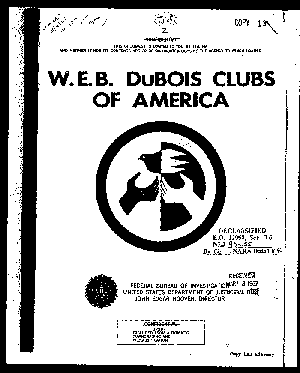
There our movement started out on the campuses — I had founded an SDS chapter at Northwestern by bringing together three or four separate single-issue clubs already recognized —but reached out to link to community groups, especially (in Evanston IL and Chicago) black, mostly church-based organizations. They got us to contribute to demanding better housing and better schools by sit-ins, marches and heavy leafletting, and we helped them make their constituents more aware and more angry about the toll theirs sons were paying in the US's futile and odious Indochina war. Such days. We, or some of us, also made contact with young labor activists. These were workers and mostly union members from those other ethnic communities — Polish, Italian, Ukrainian, Czech, even some Irish — some of whom were discovering Marxism-Leninism through the small, short-lived W.E.B. DuBois Club, where I came into contact with them.

It was during the Democratic Party Convention of 1968 that for the first time in the most dramatic ways we did face the issue of provocateur violence. And especially the absurd plots that the police attributed to the Chicago Seven and the even more absurd (and much funnier) fantasies that the Yippies invented in reply.

We continued to draw on students from many Chicago-area campuses, but the twin issues of racial and ethnic discrimination and the Vietnam war brought us together with young labor activists and then, increasingly, other non-student youth from the several ethnic communities (Appalachian whites in the "Young Patriots", Puerto Ricans in the "Young Lords", Mexicans in a couple of separate "Raza" groups) systematically and intelligently politicized by the Black Panthers, under the very capable leadership of Fred Hampton.

The Panthers made a display of self-defense, but that was mostly a pose; the real violence always came from the police. They assassinated Fred in his bed shortly before Christmas 1969, but he had established a strong enough base that the movement survived and gathered new support — since the murder had been so blatant. (For much more on this, including video clips of Hampton showing why he was such an effective leader and thus such a threat to the likes of Atty. Gen. John Mitchell, FBI chief Herbert Hoover and Nixon, see this 2009 broadcast The Assassination of Fred Hampton on Democracy Now.) The day Fred's lieutenant Bobby Rush sought and received refuge in the church of Jesse Jackson, icon of ML King's non-violent movement, marked a major breakthrough for all of us, a joining of hands of dissheveled young radicals and well-groomed, church-attending family folk who just weren''t going to take it any more.

In sum, what I've taken from all those experiences is that nonviolence must be the preferred strategy — as it was for Fred Hampton — but not an unwavering principle. Not when, as Hampton put it, the enemy doesn't even know what "peace" means, when like the US's Cointelpro then or Bashar al-Assad's tanks and planes today they threaten to wipe out your whole community. But that is not (yet) the nature of conflict in Oakland. As long as possible, nonviolence has to be the preferred strategy because it is the most effective, because the victory sought is not a shift of rulers over the same system but a social transformation, making the blind defense of privilege impossible. But you knew that already.