Or, as Isaac Bashevis Singer used to like to say, we have to believe in free will; we don't have any choice.
Is Neuroscience the Death of Free Will? - NYTimes.com
I find Eddy Nahmias' argument persuasive: "free will" does not depend on a "soul" or any other kind of self outside the brain, and is not incompatible with recognizing that all previous events are involved in shaping new ones (determinism). And like any good philosophical argument, his opens up new questions. One that interests me especially is how unconscious racism can influence conscious actions. And that suggests the further question, how to curb such tendencies, that is, how can our conscious decisions change our unconscious or pre-conscious predispositions? Can we train ourselves to respond "instinctively" in new ways?
Yes, of course we can, and we have all done it at some time — whether learning a new language, giving up (or taking up) smoking, setting ourselves a new exercise routine, or changing driving habits, etc. The fact that we can and do make such changes demonstrates (or at least implies) that our free will can change our "determined" decisions, that is, set new preconscious tendencies. New neuroscience investigations should help us understand how we do this and to do it better.
Showing posts with label pragmatism. Show all posts
Showing posts with label pragmatism. Show all posts


2010/03/18
Sects and violets
My mother was a lover of sects and violets. African violets gave her a pleasure whose source I never quite understood: whether their color, their fuzziness, or their function as reminders of some pleasant time.
I can't be blamed for the violets, but her interest in sects may have been mainly my fault. She probably would have remained content with a vague Protestantism as soft and fuzzy as her violets (especially in its vision of the afterlife). But she accompanied me -- that is, she observed and reflected upon my behavior -- as I searched for the One Great Truth somewhere in the nebula of hints and promises of Protestant Christianity. When I was 13 or 14 I thought that I had found it in Christian Science, that extreme expression of American positive thinking (evil, illness or misfortune are mere illusions). Before I even finished high school I had given up that attempt at faith in the Incredible, but my mother persisted, partly because the Scientific Statement of Being had the added attraction (for her) of having been written by a woman.
In college I read up on Hinduism, Buddhism, Islam, and my college roommates briefed me on Judaism. Some Baha'is took me to their splendid mosque-like temple in Boston (also, incidentally, home of the Mother Church of Christian Science). Baha'ism was appealing, with its claim of the ethical oneness of all religions -- that is, disregarding their peculiar dietary, sartorial and other ritual demands. But if all the gods are the same God, then what is God if not Us? The rules of behavior that the Baha'is claim to find in all the great religions (those that have survived for many generations and that appeal to the largest numbers of believers) are simply those that work best for the survival of our species: don't murder, don't steal, help one another out when someone is in trouble.
By this time I was also reading Marx. We make ourselves and our social orders, and every social order contains forces capable of destroying that order and creating a new one, and we are therefore free to make or destroy if only we understand that we have that power ("consciousness"). I liked that. And although today I would not call myself a "Marxist" (neither would Marx), many of his expressions and his whole approach to philosophical issues remain part of my thinking.
What I would call myself today is a "pragmatist." When I read Rorty, or Peirce or William James, I feel that I'm in a conversation with like-minded friends. Also, Jeremy Bentham (despite his unmusical prose), Benjamin Franklin or Voltaire (much better stylists), all of them (to my mind) pragmatists avant la lettre -- that is, before Peirce invented the term and James and Dewey and others popularized it. It is not an exclusively American philosophy (I've already mentioned Bentham and Voltaire), but it is especially typical of America, a country where anything is believed to be possible and it's up to us to realize those possibilities.
We have no choice but to make choices, though for many people the choice is to deny that we have any choice. That is, they choose to submit themselves to some higher authority (such as Allah, Jehova or karma). Pragmatism, or Marxism, in my reading of it, or any philosophical starting point that denies a higher authority and absolute moral judge, requires more courage than many people can muster. You have to be willing to assume responsibility for your own actions and your own decisions of right and wrong. And to face the music when things go wrong, making do with whatever you have at hand and not expecting some miracle to save you.
I enjoyed this essay by Stanley Fish, which says in more detail and a more complicated vocabulary pretty much what I had worked out for myself, with a lot of help from the authors I read. The problem now is how to survive as a pragmatist in a world full of fanatics. Sometimes the most pragmatic option is to pretend to believe.
Pragmatism’s Gift - Opinionator Blog - NYTimes.com
I can't be blamed for the violets, but her interest in sects may have been mainly my fault. She probably would have remained content with a vague Protestantism as soft and fuzzy as her violets (especially in its vision of the afterlife). But she accompanied me -- that is, she observed and reflected upon my behavior -- as I searched for the One Great Truth somewhere in the nebula of hints and promises of Protestant Christianity. When I was 13 or 14 I thought that I had found it in Christian Science, that extreme expression of American positive thinking (evil, illness or misfortune are mere illusions). Before I even finished high school I had given up that attempt at faith in the Incredible, but my mother persisted, partly because the Scientific Statement of Being had the added attraction (for her) of having been written by a woman.
In college I read up on Hinduism, Buddhism, Islam, and my college roommates briefed me on Judaism. Some Baha'is took me to their splendid mosque-like temple in Boston (also, incidentally, home of the Mother Church of Christian Science). Baha'ism was appealing, with its claim of the ethical oneness of all religions -- that is, disregarding their peculiar dietary, sartorial and other ritual demands. But if all the gods are the same God, then what is God if not Us? The rules of behavior that the Baha'is claim to find in all the great religions (those that have survived for many generations and that appeal to the largest numbers of believers) are simply those that work best for the survival of our species: don't murder, don't steal, help one another out when someone is in trouble.
By this time I was also reading Marx. We make ourselves and our social orders, and every social order contains forces capable of destroying that order and creating a new one, and we are therefore free to make or destroy if only we understand that we have that power ("consciousness"). I liked that. And although today I would not call myself a "Marxist" (neither would Marx), many of his expressions and his whole approach to philosophical issues remain part of my thinking.
What I would call myself today is a "pragmatist." When I read Rorty, or Peirce or William James, I feel that I'm in a conversation with like-minded friends. Also, Jeremy Bentham (despite his unmusical prose), Benjamin Franklin or Voltaire (much better stylists), all of them (to my mind) pragmatists avant la lettre -- that is, before Peirce invented the term and James and Dewey and others popularized it. It is not an exclusively American philosophy (I've already mentioned Bentham and Voltaire), but it is especially typical of America, a country where anything is believed to be possible and it's up to us to realize those possibilities.
We have no choice but to make choices, though for many people the choice is to deny that we have any choice. That is, they choose to submit themselves to some higher authority (such as Allah, Jehova or karma). Pragmatism, or Marxism, in my reading of it, or any philosophical starting point that denies a higher authority and absolute moral judge, requires more courage than many people can muster. You have to be willing to assume responsibility for your own actions and your own decisions of right and wrong. And to face the music when things go wrong, making do with whatever you have at hand and not expecting some miracle to save you.
I enjoyed this essay by Stanley Fish, which says in more detail and a more complicated vocabulary pretty much what I had worked out for myself, with a lot of help from the authors I read. The problem now is how to survive as a pragmatist in a world full of fanatics. Sometimes the most pragmatic option is to pretend to believe.
Pragmatism’s Gift - Opinionator Blog - NYTimes.com
2006/07/15
Religion & its practical consequences
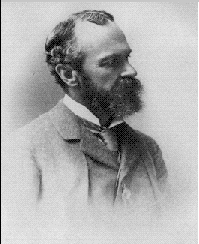 James, William. 1902. The Varieties of Religious Experience: Being the Gifford Lectures on Natural Religion delivered at Edinburgh in 1901-1902. Garden City, NY: Dolphin Books, Doubleday & Company.
To try to make sense of the religious fanaticism that either inspires or serves as a pretext for so much of the violence and destruction we are watching at this moment, I turned to this book, which I had long intended to read. It has been a great pleasure to be in the company of such a rational, good-willed and articulate thinker for nearly 500 pages. I was interested in the subject matter, and amazed by many of the examples he quotes of extreme religious devotion (though the quoted passages are sometimes too tediously extensive), but most of all I was interested in his method. He was working out a way to think rationally about irrational, or supra-rational, experiences.
With a very courteous acknowledgement of "[a]n American philosopher of eminent originality, Mr. Charles Sanders Peirce," he adopts Peirce's name for the method, pragmatism, and paraphrases Peirce's 1878 article laying out its principles. (For a summary of Peirce's thought, see Wikipedia article, Charles Sanders Peirce).
I won't try to summarize the entire book here. That job's well done in the James link below. James is not at all a conventional church-going believer, and confesses that he has no gift for any mystical experience at all. However, unlike such uncompromising atheists as Richard Dawkins (scroll down to 2005/09/25) or Daniel Dennett, he respects the authentic (i.e., not play-acting) prophets and mystics as possessors of a kind of "truth," one which is irrefutably true for them: Santa Teresa, San Juan de la Cruz, George Fox, Joseph Smith, Luther, Gautama Buddha, Mohammed and many others (including the seer I took as my guide during my own, fortunately brief, adolescent religious crisis, Mary Baker Eddy). However, the felt truth of these experiences (visions of God, for example) does not mean they should be accepted as true by anyone who has not personally had them. "The gods we stand by are the gods we need and can use, the gods whose demands on us are reinforcements of our demands on ourselves and on one another," he writes in the 14th lecture, "The Value of Saintliness." (p. 303)
He separates the question of the source of religious vision, which may be anything from an epileptic fit (e.g., St. Paul) to herbal intoxication or simply deep inward reflection, from its "truth," by which he means something like its practical utility. He quotes extensive psychological research (in particular, the studies of a Dr. Starbuck in California) to affirm that "conversion" is an almost universal experience of adolescence, because it is psychologically necessary. By conversion he means a turning away from the chaotic and contradictory messages that assail every young person to find some "process of unification of the self" which always brings "a characteristic sort of relief; and never such extreme relief as when it is cast into the religious mould. Happiness! happiness! religion is only one of the ways in which men gain that gift." (p. 163)
That's because the conversion need not be toward religion. "The new birth may be away from religion into incredulity; or it may be from moral scrupulosity into freedom and license; or it may be produced by the irruption into the individual's life of some new stimulus or passion, such as love, ambition, cupidity, revenge, or patriotic demotion." (163-164) Whatever works for you. For many of us, and apparently for James himself, the "new birth" was into incredulity, i.e., non-believing in a deity. Although James retained some doubt (see his "Conclusions"). After all, his father was a noted Swedenborgian philosopher.
But James is concerned not only about the utility of religious experience for the individual believer, but also about its social utility, its consequences for human society generally. While his language is not entirely clear here, it appears that he does not accept as pragmatic "truth" the kinds of religious sentiment that he calls extreme "Devoutness." "When unbalanced, one of its vices is called Fanaticism. Fanaticism is only loyalty carried to a convulsive extreme. ... The Buddha and Mohammed and their companions and many Christian saints are incrusted with a heavy jewelry of anecdotes which are meant to be honorific, but are simply abgeschmackt and silly, and form a touching expression of man's misguided propensity to praise. ... An immediate consequence of this condition is jealousy for the deity's honor." (310-311) Which leads to such absurdities as the riots over Danish cartoons, or Alabama Chief Justice Roy Moore's placement of the 2.6-ton granite monument of the Ten Commandments in the state building.
I think James was right to respect the personal truth of serious religious believers, and equally right to insist that their truth need not be anybody else's and certainly should not be imposed on anyone. We all have "spiritual" needs, he thinks -- that is, we need some way to put together our otherwise fragmenting "self."(James' notion of "self" seems to anticipate Dennett's formulation of it as "the center of narrative gravity.") But we don't all need to do it the same way. A coherent atheism, or a "healthy-minded" optimism, or a born-again union with the One, are equally valid ways to achieve the "gift" of "happiness," or integration of the self. Whether they are equally good or not depends on their consequences, not only for ourselves individually but in our actions on behalf of others. Makes sense to me.
For more on James and his writings, see William James in the Stanford Encyclopedia of Philosophy.
And don't neglect the sad story of Alice James, which helps us understand the milieu in which her famous brothers William and Henry were working.
Subscribe to:
Posts (Atom)