Showing posts with label Europe. Show all posts

2015/02/20

The Nationalist Solution - NYTimes.com

In considering how to confront religious extremism and the terror it manifests, David Brooks has posed the problem intelligently in his column in today's NYT, The Nationalist Solution - NYTimes.com:
Extremism is a spiritual phenomenon, a desire for loftiness of spirit gone perverse. You can’t counter a heroic impulse with a mundane and bourgeois response. You can counter it only with a more compelling heroic vision. There will always be alienated young men fueled by spiritual ardor. Terrorism will be defeated only when they find a different fulfillment, even more bold and self-transcending.
I think this is true and important. However Brooks' proposed solution for some of those alienated young men is unconvincing: "a revived Egyptian nationalism, Lebanese nationalism, Syrian nationalism, some call to serve a cause that connects nationalism to dignity and democracy and transcends a lifetime."

Yes indeed, revived nationalism may fulfill their need for a bold and self-transcending heroic vision. Revived nationalism is what is fueling the reciprocal slaughter in eastern Ukraine, and fueled the 1990s wars in the Balkans. And rather than an antidote to religious extremism, it may be a facilitator. In the chaotic violence in Libya, Syria and other places, nationalist and religious fanaticism tend to be mutually reinforcing. The decapitators of ISIS are fanatics of that new self-proclaimed "state", whether or not they have any clear notion of Islam.

In his The Varieties of Religious Experience, William James gathered evidence from many cultures that a spiritual crisis in mid- to late-adolescence is almost universal, and can be resolved only by what he calls "conversion":  a turning away from the chaotic and contradictory messages that assail every young person to find some "process of unification of the self" which always brings "a characteristic sort of relief; and never such extreme relief as when it is cast into the religious mould. Happiness! happiness! religion is only one of the ways in which men gain that gift." (p. 163)

Note, "only one of the ways."  James continues: "The new birth may be away from religion into incredulity; or it may be from moral scrupulosity into freedom and license; or it may be produced by the irruption into the individual's life of some new stimulus or passion, such as love, ambition, cupidity, revenge, or patriotic demotion." (163-164)

The histories of Egypt, Syria, Iraq and Iran — and almost every other country — offer examples of other sorts of passions, other visions that united people in heroic struggles to construct something rather than destroy it. Mosadegh in Iran led one such movement. And in the Arab countries, Nasser in Egypt another, and the early Ba'ath in Syria, in those years when "Arab nationalism" aimed at modernization and national development, not religious intolerance. If that is the kind of "revived nationalism" Brooks was referring to, I'm afraid it's too late. Those movements were killed by pressure from more powerful nations in the 1950s (Britain principally, in the case of Iran, with more complicated frustrations in the other cases) which is one reason why they have not been repeated.

In any case, a new inspiring vision is not something outsiders can hope to inject. It can only emerge from within the alienated youth's own ideological and social environment, in the languages and symbols most familiar to them. The most we can do, and this is a lot, is rein in the racism and intolerance that beset those youth resident in Europe and widen opportunities — educational and occupational — for them to resolve their struggles of identity, so that fewer of them turn to destruction. And try not to frustrate so blatantly their new projects of construction, which will almost inevitably be opposed to vested economic interests. 

And don't miss this report by , on how a young well-educated Egyptian from a supportive family became an ISIS terrorist — and his friends' thinking that the same could have happened to them. From a Private School in Cairo to ISIS Killing Fields in Syria (With Video) - NYTimes.com

2015/01/27

The spectre of "real democracy"

A spectre is haunting Europe —and it's scaring the bejezus out of all the older parties. Lessee, what should we call it? Syriza? Podemos? Die Linke? Populism? Maybe we can call it "democracy", that is, rule by the common people. And "solidarity" where people join in groups and collectively try to help each other and take decisions for the whole commonwealth. Or maybe we should just call it "communism", because that's what the word still meant — rule by the common people and solidarity — back in 1848, when Karl Marx and Friedrich Engels popularized it in a manifesto.

But we have to be careful today with that word — the word "communism" has been sullied by the many horrid acts committed in its name. Gulags, purges, inquisitions, restrictions of all types. Like Christianity. Nowadays "populism" has become a popular insult. It's a fear word, with no precise meaning. It just represents that terrifying spectre, the end of the hegemony of "the markets" and the political parties that do their bidding.

Nobody who knows history expects Syriza to fulfill all the expectations of its supporters, or Podemos either. But each in its own way (obviously, conditions in Greece and Spain and the potential alliances in each are vastly different) is shaking to pieces the older Tweedledee and Tweedledum two-party systems. Which have more and more come to look like two faces of a single party, the one subservient to the big financial interests. And that has been a system that produces increasing inequality at such a rate that it is destroying itself, driving its own opposition.

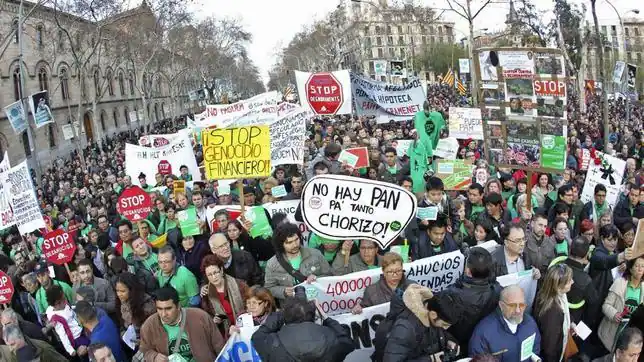
How could a tiny coalition of leftist parties like Syriza triumph over the long-established Pasok and the newer, but well financed, New Democracy? How could Podemos rise from nothing to a real power contender in Spain in the course of just a few months? Not by the brilliance or charisma of its leaders, though those have helped, but by the mass support for change, structural change. What was called "Real democracy now!" (Democracia Real Ya, or DRY) in Spain's famous 15M movement, that began 15 May 2011 and took over public spaces in all the major cities. An impulse shared by masses of people in Turkey (Gezi Square), Egypt (Tahrir), Hong Kong, but which here in Europe may actually succeed. Or at least present a formidable challenge to the Bundesbank, the IMF and all their associated interests, and work to rebuild a society where inequalities are reduced and public wealth goes to public uses.

2014/07/10

What we talk about when we talk about the Left

Left In Europe (World University Library)Left In Europe by David Caute
My rating: 3 of 5 stars

Reflecting on the confusion of aims and strategies of all the parties and movements calling themselves "Left" in Europe today, I turned again to this little book with its capsule histories and profuse illustrations (engravings, photos, posters) of revolutionary movements from the French Revolution of 1789 to the mid-1960s. Caute's intention was evidently to rescue the notion of the Left from many misunderstanding and confusions, but he does not manage to come up with a concise, convincing definition of his own. He critiques descriptions such as anti-racism, anti-clericalism, pacifism, and social reformism because conservatives and even reactionaries may adopt similar positions (Bismarck and Napoleon III were reformists, etc.). Nor are the movements he considers Left always anti-authoritarian (remember Lenin's vanguard party) or democratic, in the sense of always accepting what the greater number of voices demand; he suggests that "'popular sovereignty' is preferable to 'democracy' as a term descriptive of the central creed of the Left" [p. 32], but that hardly solves the problem.

I don't think there's any point in trying to define the Left, with clear delineations of what it includes or excludes; no definition — whether by Lenin, or Caute, or Hugo Chávez or anybody — will be accepted by everybody. The term originated from a vote in the assemblée nationale in Paris on September 11, 1789, where those opposed to a monarchical veto took seats to the left of the chairman; but those députés did not necessarily agree on anything else. Protest movements, then and now, are volatile and contradictory. What we can do, and what Caute's little book does in part, is describe some of them to find common characteristics and aspirations.

Over 50 years ago I was part of an informal seminar with the very young David Caute (I was 5 years younger), discussing some of these same ideas. The controversies live on.

View all my reviews

2014/06/02

Yes, we can! Spain and Europe

What a week this has been in Europe! And particularly here in Spain. The elections to the European Parliament have sent shock waves throughout the EU, the most surprising results in Spain. A protest party calling itself Podemos ("We Can"), only four months old, with almost no funds, no staff, no office space, won over 1.2 million votes and got its slate of five neophytes elected and looks like a major contender in the coming national elections. And just this morning, King Juan Carlos startled us by announcing his abdication — maybe long overdue, but unexpected just as the major parties are trying to hide from their spectacular plunge of votes last Sunday. This could be the perfect opportunity to do away with our outdated and silly monarchy, but it will almost certainly be an opportunity wasted.

But before commenting on this Bourbon comic opera, let's look at those European Parliament elections and especially Spain's Podemos. Because in countries as different from one another as the UK, France, Greece, and even (though this may not be as apparent) Italy, voters have massively turned away from the traditional, established political patterns — but the turns have gone in different directions. In France and the UK, the greatest numbers of votes went to far right, anti-immigrant and anti-European Union parties; in Greece, to the new left-wing Syriza. In Italy, the big triumph went to the established center-left party of prime minister Renzi — was this by borrowing tactics and strategy of Beppe Grillo's anti-establishment party?

Except for Italy, all these newly powerful political movements have been labeled "populist" or "anti-system", which in newspaper usage mean demagogic and dangerous. The voters for Podemos have even been called "frikis", and I suppose something similar is said about the Greek Syriza voters. But, no, they are in their majority responsible, working people, mostly over 35 but also include many students and other younger voters. The rise of something like Podemos, so suddenly and with no big financial backers, is frightening because it tells the old, established, stodgy parties that, like their name says, the can challnge the establishment.

Spain has nothing like the xenophobic parties of France, Holland, or the UK, because the nominally democratic Popular Party absorbs the whole range of right-wing votes. The PP is not officially xenophobic nor anti-democratic in its discourse, only in its practice (razor-wire immigration controls, administrative laws against protests, and its proposed anti-abortion law, for example), and all this plus its close ties to the Catholic Church make attractive to a wide range of conservatives, from fascists to oligarchs to business interests.

The Popular Party has grown of Franco fascism. The Spanish Socialist Party, from trade unionism, its experience in governing the Second Republic (1934-1939),  and from a tradition of resistance to fascism.

But Podemos has emerged from something much newer, mainly from the "15-M", the great mobilization of radicals and moderate democrats that began on the 15th of May 2011 and took over the central plazas of cities across Spain, to protest against the dismantling of the welfare state (cuts in education, health care, other social services), the evictions, and pensions freezes dictated by Brussels and Berlin and implemented by the Socialist government then in office. After that summer of protest and political education, the newly energized citizens went back to their neighborhoods and formed hundreds, thousands of radically democratic movements to confront local problems. It has taken only three years for all that energy to be channeled by a party which is really no more than an open association of like-minded people, joined by Facebook and e-mail and YouTube videos.

Italy and Greece, along with Spain, suggest that, yes, "We can" — Podemos — mobilize the millions of discontented Europeans not to destroy the European Union, but to make it work. To counter the politics of austerity with one of economic growth, to use European funds to save those who need help to survive instead of only the bankers, to enlarge opportunities instead of restricting them by tight regulation from Brussels and without any democratic representation to control the people making the rules.

Those are, I'm pretty sure, the same things that most of the Front National (France) and UKIP (UK) voters want. But in those countries, the xenophobic parties have been the only ones aggressively pushing those issues. Podemos (Spain) and Syriza (Greece), and Renzi's redirection of the PD (Italy), show that it doesn't have to be that way. These movements are the answer to the European Commission's repeated insistence, "No you can't!" Can't increase the deficit, can't spend to increase employment, can't force bankers to lend, etc., etc. And repeated obediently by Spain's Popular Party government: we'd like to do more for our people (they say), we'd like to honor our campaign pledges, but "we can't" — the deficit, the Troika, the markets won't let us.

And Juan Carlos' abdication? The big established parties, the PP and the Socialists, are falling all over themselves to praise his 39-year reign and proclaim their loyalty to the Crown Prince. As though the monarchy were the only thing holding our democratic system together. Well, maybe they have a point; they certainly aren't capable of doing it.

(For some background on the 15M (the big mobilization of 2011), see my article Civil protest in Spain, and another on the anti-eviction movement, Spain's many currents of protest. To see all my past articles on Spain, click on "Spain" keyword below.)

2014/01/05

Wien, auf wiedersehen

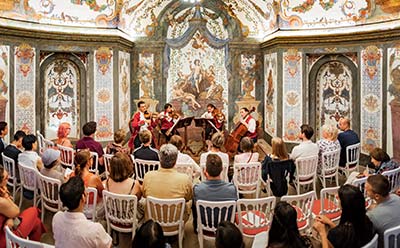
An intimate chamber marvelous acoustics.
We're about to leave Vienna, after 5 cold days of discovery. Most of what we saw, I had read about, but I had to be actually walking through those narrow streets, staring up at enormous baroque vaults, tromping through the kilometer-long courtyard of the immense Karl-Marx Hof, sitting in the tiny vaulted chamber where Mozart and friends played quartets and watching and listening as four young musicians played Mozart, Haydn and Dvorak, for these spaces and that history to come alive for me. More later. 

2013/05/14

Caricature Map of Europe 1914 - StumbleUpon

Caricature Map of Europe 1914 - StumbleUpon

100 years ago. And today's map? Germany would be a fat, greedy banker, Spain a very thin gentlemen in shabby formal clothes with his hand out, Greece a flock of raging demons pursuing foreigners in a boneyard, Italy a grinning Berlusconi sitting on top of some very unhappy people whom Beppe is trying to tickle, France a mass of angry Lilliputians trying to tie down a struggling Marianne, Hungary… , Russia… , and on and on. Things are going nearly badly as they were 100 years ago, but the crisis we're on the brink of today is probably not world war. More like general collapse.  

2013/05/08

Spanias kreative protestb�lge | Radikal Portal

The Norwegian news and opinion website Radikal Portal has invited me to become a regular contributor. Here is my first article, on protest movements in Spain — translated into Norwegian.
 
Spanias kreative protestb�lge | Radikal Portal

Since it's just possible that you don't read Norwegian, here is my English original in Scribd: Spain's many currents of protest

There have been developments since I wrote that piece, the most important being the gutting of the citizens' legislative initiative by the Popular Party to pass a much weaker version. The main argument, however, still stands: that protests surging outside of the traditional channels of parties and trade unions are shaking the whole institutional system in Spain and may be harbingers of serious change.

My next article for this site will be on Venezuela.

2012/10/14

Sad Europe, sad globe

A friend wrote to "congratulate" me on the Nobel Peace Prize to the European Union— I suppose, because I live in a corner of Europe. I thought she was joking, but no, it's true. The Nobel Peace Prize seems like a sad joke, but maybe it's meant as a consolation prize. I had intended to write something about Europe's slow-motion disaster, as one after another of the hard-won social conquests crumbles, but the forces of disintegration have been speeding up. How Europe got into this pickle is pretty clear — I just reviewed a book (Indecentes in my Spanish-language blog) that sums it up blow by blow, the bungling miscalculations since Bear Stearns and then Lehman Bros., followed by the more-or-less covert campaign by Trichet and his successors (and allies in the Bundesbank) to shift the blame to the "middle classes" and the workers, and (the special focus of Indecentes) the totally ineffective and even counterproductive actions by the Spanish government under its man of inaction, Mariano Rajoy.

Anyway, there's no mystery about how we got this close to the impending crash that IMF head Christine Lagarde foresees. And there is no reason to expect the financial powers to change the no-growth, severe austerity policies that they are ideologically committed to and that, short term anyway, appear to benefit German capital while impoverishing everybody else. So what we need to focus on is how to force a change in those policies (while there is still some democratic room to maneuver, in demos, elections, etc.), and most importantly — longer term, for recovery after the foreseeable global collapse if we don't change direction — what kind of more egalitarian, more productive, more environmentally sensitive society we can construct. We can't foresee the future, we can only make it, by omission or commission.

I know there are lots of people working on this, and have been for generations. And though all those struggles — e.g., the Paris Commune, the Spanish 2d Republic, and later social revolutions — have failed their maximalist objectives, we can learn from all of them, to at least fail better. If you haven't already, check out the late Eric Hobsbawm's brilliant compendium of some of those efforts, How to Change the World.

2012/03/09

The pain in Spain

One of my politically astute American friends, journalist and photographer Don Monkerud, has asked how things are going for us in our little town of Carboneras (Andalucía, Spain). I'll share my reply.

Dibujo de Manel Fontdevila en Público
Thanks for asking, Don. Yes, things are going well for us personally, but it's hard not to share the anxiety of our neighbors. Spain has the highest unemployment in the European Union, and several of our friends have lost their jobs and others are naturally worried. The right-wing assault on public services is cutting deep into public health care (Americans don't even know what that is, but in most of Europe and especially in Spain standards have been high and people count on it), public education, research and other frivolities. The new "labor reform" makes it cheap and easy for employers to dismiss workers with very little compensation and for them to disregard contracts simply if their profits have declined over the past 9 months. Only the banks get backing. The attitude of the EU, the European Central Bank and the "Merkozy" team, backed by Spain's new president Rajoy, is: We've got to save the euro, who cares about the Europeans? Regional and municipal governments in Spain have fallen into such deep debt (income that used to come from the building boom, in the forms of licenses and taxes, having disappeared) that in some towns they haven't been able to keep the lights on. Our little town still has street lights, but there's no money for acquisition in the public library and there have been, and will be, other cuts.

I've just been reading Tony Judt, Ill Fares the Land (click link for NYRB article where he summarizes the argument). He explains what has been happening very clearly, though things have got even worse since his death (6 August 2010)— the lands are faring far more poorly. Spain however, as Manuel Fraga (Franco's minister of tourism) liked to say, is "different": out of phase with the general historical pattern. The "neo-conservative" or, as we would say in Europe, "neo-liberal" offensive against the welfare state in the UK, US and other advanced economies coincided with the late beginnings of public services here, under the Socialist Party governments led by Felipe González (1979-1996).

The dismanteling of the state apparatus that protected citizens began furiously, however, when the so-called "Popular Party" under Aznar came to power (1996-2004). And now, after an ambiguous and largely ineffective social democratic return (Zapatero, 2004-2012), with the return of the PP in the context of the huge European economic débâcle, the offensive had been renewed with greater vigor, meeting furious but so far unconcerted opposition. We've got to get our act together! (See Rx above.)

2010/12/08

The strengths of Europe

A look on the brighter side.

The Supreme Strengths of Europe by Stephan Richter and Martin Sieff - The Globalist

It's all true, we do have much less inequality here (in Europe — I'm writing from Spain) and even the poorest are nowhere near as poor as millions of people in India or China or other countries, or even in the poorer areas of the US. If these 27 countries could only get together on major issues like defense or economic policy, Europe could again be a power, and this time (unlike the era of imperialism) for good.

2010/12/06

Review: Postwar by Tony Judt | Books | The Guardian

Another view, more critical than mine, written by Norman Daview in 2005 when the book came out and Tony Judt was still among us.

Review: Postwar by Tony Judt | Books | The Guardian

A book this length and this comprehensive, dealing with so many histories of so many countries, will inevitably have a lapse or two, I suppose. But Davies still seems to be fighting the Cold War, while Judt is not. And this criticism seems to me off-base: "Judt, however, is impervious to religion, unmoved by music and rather complacent about non-French and non-political branches of art and culture." — especially the phrase "unmoved by music." There's quite a bit about popular music trends, hilariously opinionated so he must have cared about it.

Thanks to Andrew Hull for pointing me to this review.

2010/12/03

Why Europeans Think We're Insane | Economy | AlterNet

A friend on Facebook posted this, and when I started to respond I realized it called for a longer analysis.

Why Europeans Think We're Insane | Economy | AlterNet

This is naïve and deserves a more detailed response. Yes, as an American resident in Spain, I know full well: European social benefits are vastly greater than those in the US. But that could not have happened (it's all since WWII) without the US: Marshall Plan, US defense spending & much else. The story is well told in Tony Judt's Postwar. And because of "the Crisis" (which showed how dependent European prosperity has been on US prosperity—it all started with US financial giants finagling their books and US banks overextending credit) the European advantage may not survive the big benefits cutbacks in the UK and elsewhere. Or will almost certainly diminish.

I'll have more to say about Judt's book on modern Europe soon. I'm about half-way through it, reading slowly and carefully (it's a big book) because what he says (whether I always agree with him or not) is so important for understanding where we are now

2010/11/24

Battle Lines Drawn in Catalonia - NYTimes.com

As I was saying: fissiparous tendencies not just in Europe, but even in its constituent countries. Every little nationality wants to be proud, independent and colorful. Like the Most Serene Republic of San Marino.

Battle Lines Drawn in Catalonia - NYTimes.com

Can Europe be saved?

Or save itself? As we sit here in this southeast corner of the Iberian peninsula watching Europe disintegrate, I find myself wondering how "Europe" ever happened and whether it exists at all except in our collective imagination. As Tony Judt remarks in the first lines of Postwar: A history of Europe since 1945, “It is not really even a continent — just a subcontinental annexe to Asia. The whole of Europe (excluding Russia and Turkey) comprises just five and a half million square kilometers: less than two thirds the area of Brazil, not much more than half the size of China or the US.”

Too bad Tony isn't with us to help us understand this new crisis. (He died earlier this year.) In Postwar, he makes vividly clear how nearly “Europe” as a cultural unit came to disappearing as a result of its two world wars. What I mean is the glory and power that had made that territory something more than an annexe to Asia, or the sense of common cultural values that at least seemed to unite the hundreds of language groups and scores of more or less sovereign states (at last count, 46). This time it's not war but simple inability to come to agreements, coupled with nationalist pretensions ridiculously out of sync with national economic potentials, exacerbated by the usual short-sighted opportunism of political parties and factions, that's threatening the economic union holding all these countries together. 

Postwar goes over familiar ground, and most of what it tells us in the first chapters (I'm about a quarter of the way through this big book so far) are things you've probably read or heard before about the enormous destruction of housing, industry and infrastructure along with the millions of lives lost in the Second World War, the anxieties and contradictory demands of the survivors and the beginnings of an improvised, ad hoc postwar division of power we call the Cold War. But there will be many things that you hadn't heard before, or that you had never connected to other elements to see the themes. This English scholar, son of Eastern European Jews and long-time professor in the US, is especially good at explaining how and why the US saved the western parts of the subcontinent and bolstered the defeated and ruined Germany (the part not governed by the Soviets) to regain its industrial strength and prosperity (a complete break with Allied practice after World War I),  along with the equally ruined France and smaller countries such as the Netherlands and Belgium.

Those countries with all their rivalries were able to cohere more or less because of the Cold War. I'll be eager to read Judt's description of the end of that division, the collapse of the “socialist bloc” and disintegration of the Soviet Union — he was there, more involved than most of us (he even went to the trouble of learning Czech).  Left to itself, without the USSR and its subject states squeezing it from the east and the US pressing back from the west, “Europe” had to re-invent itself and define its boundaries. How far west? Are the British Isles part of Europe? Ireland decided it was – though it may now be regretting that choice. England has been more diffident. How far east? Ukraine has been welcomed, but coldly. Turkey? Not yet. France and Germany came to believe they were Europe, and the other countries merely satellites.

I'm going to have to go back to re-read Janet Abu-Lughod's marvelous book on the world system before Europe emerged, back in the 13th century. It may be that we're headed back that way, except that now Brazil and South Africa may join those great pre-European powers China, India and Persia (Iran). “Europe” appears to be voting for its own irrelevance.

2010/02/15

So who are the "PIGS"? Spain & the European Disunion

Greece's financial near-collapse threatens world-confidence in the euro, which would be very bad for business in all 16 members of the European Union that use the euro. A Greek default would be a disaster for banks, both European (especially German) and beyond,so bankers and finance ministers are very anxious to avoid it. And as we've seen, they are horrified by the idea of having to resort to the IMF, associated with handouts to non-Europeans. So then they're going to have to come up with funds in some fashion to meet Greece's obligations. Or… A recent poll shows that 53% of Germans want Greece booted out of the euro zone.

And according to Krugman, the mess in Greece, with its $343 billion GDP (making it the European Union's 15th largest economy) is nothing compared to the far dangers of instability of Spain, the EU's 5th largest with $1,438 billion GDP.

As Krugman is quick to point out, the causes of Spain's precarious economic position (20% unemployment, 11% deficit) are entirely different from Greece's finagling with the books, and only tangentially related to tiny Portugal's problems or Italy's massive and systematic criminal plundering of the state (a lot of it by the head of state himself). Portugal, Italy, Greece and Spain are all very different. But the catchy acronym PIGS covers them all with the same slime in much foreign economic commentary.

What happened in Spain is that a huge and unsustainable construction boom created massive debt (Spanish and foreign banks lent out vast sums of money that they themselves had borrowed in the international market to finance ever bigger development projects), and when the boom busted and prices fell or houses became totally unsellable, there wasn't enough money to pay the labor or the banks or the contractors or, of course, the last guys and gals on the list of creditors, the workers. Construction companies, big realtors, people making and leasing cranes and bulldozers and other machinery for the industry, car manufacturers used to selling high-priced models every year to ever richer speculators, and everybody who worked for any of them, suddenly broke. And the banks stuck with unrecoverable debt and/or repossessed building developments with no buyers.

One currency, many economies just isn't working very well. But the governments that most strongly backed the creation of the single currency -- Germany in particularly -- are also the ones that most firmly resist taking further steps to integrate their economic policies, such as common taxes, pension benefits, health and education budgets, etc. The United States, another large region with a single currency, also has big inequalities of wealth and needs as between, say, Mississippi and Massachussetts, or now-bankrupt California. The diversity of economic policies across the 50 states is still not as great as that between, say, just for example, Greece and Germany, and-- as far as I know, anyway -- nobody is seriously advocating that California abandon the dollar and create its own currency which it could devalue or inflate as needed, but maybe it should be considered.

Anyway, the euro is what we've got, and going back to pesetas (Spain's pre-euro currency) would be pretty traumatic. There are probably more benefits than harms to the common currency, if we can just get through this rough patch. But to do so, to pull out of this very deep recession, the government is going to have take decisive action: job creation, infrastructure investments, pacts with unions and employers to restrain wage and price hikes -- the kind of thing that most of the parties in parliament are trying to work out with the Socialist government, which needs their support to get any laws passed. But that's just what the Partido Popular is doing everything it can to prevent.

Economic failure of the Socialist government looks good for Popular Party electoral chances. The only problem: The way they're going, if they succeed, they'll be governing a ruin, not a functioning economy. And these are the guys, the PP and their allies, who created the frenzied construction boom and enabled the debt. Now they're going to fix things? Fat chance!

Anatomy of a Euromess - Paul Krugman Blog - NYTimes.com

Greece Threatens Bankruptcy, And the Euro Zone - The Atlantic Business Channel

Ben Bernanke, The Global Saving Glut and the U.S. Current Account Deficit (March 10, 2005)

2009/04/25

Maybe you can go home again?

That's what several of our foreign friends and acquaintances in Spain are hoping, such as Rumanians who may have had some other profession but in Spain were working in the once-booming construction industry. See As Jobs Die, Europe’s Migrants Head Home in yesterday's NYT. But "home" isn't what it used to be, either. There will be lots of stories to tell, of kids pulled out of school, repatriated and having to function in a language they´re no longer used to (or maybe never learned beyond talking with their mothers), of marriages in trouble because of new economic stresses, and lots more. Maybe the only upside of this crisis is that it is sure to enrich Rumanian (and Lithuanian and other eastern countries') literature.

2009/03/22

Frittering away a good crisis

My friend and colleague Don Monkerud sent a NYT article, March 16, 2009, Fruit Picking Causes Strife in Andalusia as Natives' Job of Last Resort, by VICTORIA BURNETT. Other American friends may be interested in my response, how things look to somebody (me) who lives there.

Thanks, Don. I hadn't see this article, but I have known about the problem. It's also serious in Jaén, olive country. Spanish bricklayers and plasterers trying to learn how to pick olives (their grandparents knew, but they've forgotten) and competing with all the Moroccans and others. Locally, in Carboneras, some of the Romanians we had come to rely on -- especially a very skilled electrician -- have gone home. There may be no work for them back in Romania either, but at least they have a home there and it's familiar. People from Mali and Mauritania are still arriving, however, risking their lives in overcrowded open boats to get to the Canary Islands, or joining the Moroccans to try to dodge the Guardia Civil patrols and land on some Andalusian beach.

So far, there hasn't been much anti-immigrant violence -- nothing on the scale of the vigilante patrols in the U.S. Southwest. But tensions are building. The Spanish Socialist government is limited in its options by its membership of the EU and the euro (the European Central Bank won't let its members devalue the currency or take other unilateral measures to stimulate exports etc.), and it is afraid to exercise the options it does have or to test the limits. And as you know if you've been reading Krugman, or even if you haven't, the ECB is far too conservative in a climate that demands bold measures.

My impression is that the U.S., China and Brazil are the countries best positioned to weather this crisis. Of the major economies, that is. Brazil and China are still growing (economically), though much slower than last year. Meanwhile, European socialists have forgotten what socialism was all about and, by fearing to break with their "liberal" (in Europe, that means pro-business conservative) colleagues, are letting this perfectly good crisis go to waste.

2008/11/11

Cautionary tales & historical theory: 2 by Diamond

Having been greatly stimulated by Jared Diamond's earlier book, Guns, Germs and Steel (see below), I was eager to read this newer one -- Diamond, Jared. Collapse. How Societies Choose to Fail or Succeed. London: Penguin Books, 2005. But, as you'll see from my notes, I found it disappointing .

In Collapse, Diamond relates cautionary tales of societies that thrived and then collapsed, contrasted to some that still survive, to identify recurrent causes of collapse. In all the cases selected, the main cause (according to him) was the society's misuse and exhaustion of material resources, esp. forests, aggravated in some cases by aggression from other societies -- which is hardly surprising. And he warns us of comparable dangers (but are they really comparable?) to our new, global ecosystem. Stories include Easter Island, the contrasting experiences of 3 dissimilar S. Pacific islands, the Anasazi, Maya, Viking settlements (Greenland, a failure; Iceland still going strong), Japan (Tokugawa success in forest management), Rwanda (Diamond blames environmental stress more than ancient enmities for the genocide of 1994), Haiti's poverty v. the Dominican Republic's much better management of resources (he credits Joaquín Balaguer especially), China, and Australia (still functioning, but precarious because overexploiting poor soil and little water). These tales are all more or less interesting (China less, Greenland more, because the information is less well known), but they don't add up to anything much beyond a reminder that the prosperity of global society requires much better husbanding of resources.

After his "Guns, Germs and Steel," which presented a coherent and audacious theory explaining Europe's rise to preeminence, this is a pious hodgepodge. Here are my notes on the earlier, stronger book:

Diamond, Jared. Guns, Germs and Steel: The Fates of Human Societies. New York: Random House, 1997. 1999 Norton paperback.

The reasons why European whites acquired the "guns, germs and steel" with which they decimated and subdued all other peoples are (according to Diamond) due entirely to accidental geographical advantages: a wider variety of minerals in Eurasia, including the rocks necessary for an efficient stone-age technology necessary as a first stage of development; the availability of easy-to domesticate, highly productive plants and animals enabling people in Mesopotamia to become farmers and produce enough of a surplus to build cities, long before anybody else; and the east-west orientation of the Eurasian continent, with a wide swath in the same latitude with a long growing season and plenty of rain, so that crops developed in Mesopotamia could also be grown as far as western India, all across northern Africa and across southern Europe to its western edge; the absence of major physical barriers also facilitated transfers of inventions (whether in agriculture or devices such as the wheel, practices such as weaving, etc.).

The book's great success ("over 1 million copies sold," the cover proclaims) is mainly because Diamond weaves a coherent story through a huge subject, all human history, that is a plausible alternative to the naïve race theories still current. The problem for many scholars is that the coherence seems too facile, neglecting the complexities of many developments over the millennia and (according to some of those scholars) getting many particulars wrong.

The other reason for both the book's popularity and many scholars' impatience is that Diamond repeats his essential points over and over. This makes it hard to miss them, which must be convenient for the distracted undergraduate, but is wearisome for the attentive reader, especially one who is already familiar with many of the arguments.

2008/09/15

European v. American political consciousness: II

Here's another response to my friend Don Monkerud's query, about differences in political awareness and attitudes between Europeans and people in the U.S. This from Dan Bessie, in France:

Without doing a long sociological study, I believe that greater European political sophistication (and less idiocy - though there is certainly plenty to go around, witness Le Pen in France, right wing quasi-fascist nationalism in the Serbian countries, etc) has to do with a number of factors:

1. They have a longer and more recent association with working class struggles than do Americans. Though much weaker than they once were, socialist and communist parties are both in power in several places (socialists in Spain), communists in a few hundred cities throughout France, Italy and in other countries, and most European countries have unions that still exert far greater influence on economic events than is true in America.

2. Europe has seen two world wars rage across it. Hardly anyone here, including the British, who were bombed extensively, has been untouched by it. Fascism never touched America in the same way, in spite of the number of American deaths during WW II.

3. Large numbers of Europeans travel internally, speak more than one language (several in some cases), and thus have developed a much broader international outlook than that developed by the more or less continuing provincialism of the vast majority of Americans.

4. European media is much more open to being critical of leaders than is American media. American media fears not having access to a candidate. If, for example, the corporate owners of American media conglomerates should let too many of their reporters and commentators really nail McCain-Palin on the issues and on their lies, and, heaven forbid, they should get ELECTED, they might not have ACCESS. So their motto is, I believe, "don't bite the hand that might feed." (Since access is their bread and butter.) Most European commentators are fairly open in their political views (not all, but many more than in the States. During the last election I was in the UK when the results were coming in, and commentators on almost every station were saying substantially the same thing - "What's going on with the Americans? They must be nuts to vote for that guy Bush again.")

5. And yes, far fewer Americas travel than Europeans (though again, a lot of Europeans travel internally).


Europe is not without problems. TV watching is big and addictive here just like there. There are almost as many dumb programs (but a much higher number of quality programs as well). This (France) is also very much a consumer society. But it's someone less focused on big splashy cars and huge TVs (though there are those as well) and more on things like family vacations, seeing that the kids are well prepared for college and careers, etc.

Most Europeans are aghast that America doesn't have a national health plan in place. Here (in France and most of Europe) it's taken as a national RIGHT. Most also know that in terms of overall quality of life - health care, education, environment, standard of living, all the other things that go into making up "the good life," that America (contrary to what most Americans believe) is not #1 (Actually, France is). America, depending on which report one reads, is either #3, 4, 5 or 6 in line).

Are we happier living in Europe? On the whole, yes. But neither Jeanne nor I were unhappy in America.

Our greater happiness, I guess, comes more from what we do than from the actual conditions of life. Because the conditions of our lives here are more or less the same as they were in the States, in terms of standard of living. Some things are much less expensive (health care, for example: Jeanne had to pay about $6000 per year for an "ex-pat" policy for major medical in California. And that one had a $5000 deductible PER INCIDENT. Since she's a member of the EU (as are all Brits), she gets the same health benefits she'd get in the UK - which is about 80% (like Medicare), and spouses, even if they're not EU citizens, get the same benefits. To make up the difference we pay an annual "top up" policy of about $1500 for the BOTH of us. When we go for a doctor visit (GP) we pay a flat 23 Euros. (about $32). More for specialists We get about 75% of that back from the top up plan. Except for a very few things, all medication is included in the top up plan, so it's virtually free.

Food in restaurants are more expensive in general. Food in supermarkets is about the same, but there are a lot of items that the French consider "essential" that are very low in cost (bread, wine of course, canned veggies, etc). Gas is very high (about $7.00 a gallon).

We left the U.S. for a number of very specific reasons:

1. Why do the same thing all our lives? (That's one thing that was very important for us.)

2. Jeanne has family in the UK and she can see them more often. (You can literally fly from here to the UK for as little as about $2.00 sometimes - plus taxes, bringing it to about $25.), because a low cost Irish airline, RyanAir, would rather fill seats in the off season than have an empty airplane, since they fly back and forth to several French airports several times a day.

3. We are central to lots of places to drive to. Barcelona, about 7 hours, Paris about 6, etc, etc. (We've been to Spain once since we've been here, are going again in October, and have also been to Paris and Berlin. Aside from about three trips to the UK and two back to the States - which is getting very expensive now for air fare).

4. We like France a good deal. We live in an area of gently rolling hills, farms, small quaint villages, very friendly people for the most part, and etc. Lots of nature (France is more than 40% forest land).