Showing posts with label democracy. Show all posts

2015/05/25

Pudimos: The Little Party That Could

Yesterday's voting across Spain signaled a major triumph for the Little Party That Could  — Podemos (We Can) can now proclaim Pudimos (We Could).
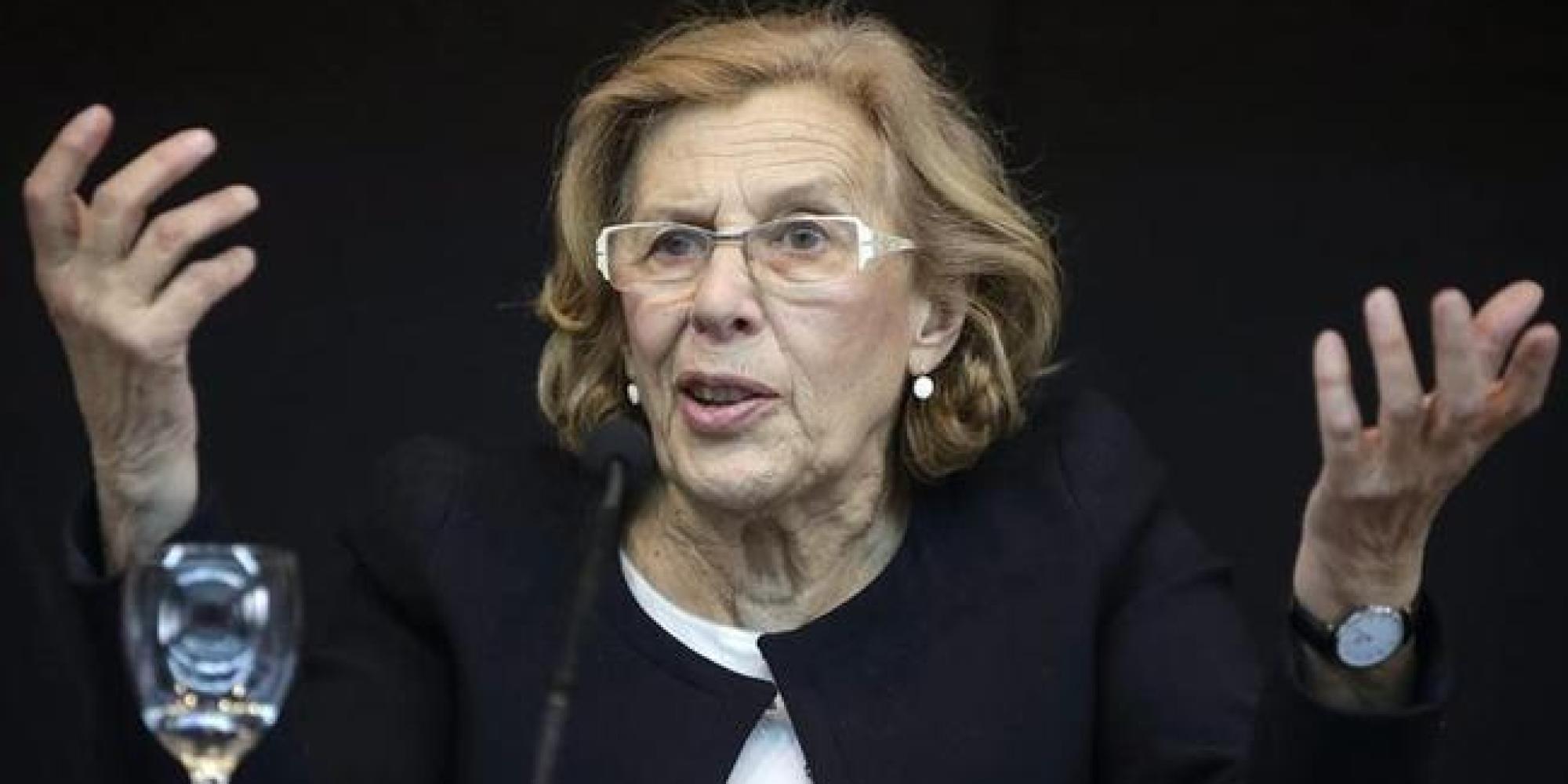
Manuela Carmena, mayor of Madrid?

Could what? Well, not seize the Moncloa (Spain's nearest equivalent to the Winter Palace) in a neo-Bolshevik-Bolivarian revolution, as some hysterical right-wing politicians claimed to fear. Nor even to out-poll the two biggest and most established parties.

But Podemos was either the instigator or a major contributor in the electoral coalitions that will be decisive in forming governments of towns and cities across the country. Most stunningly, especially to the stunned Partido Popular, that party's the two most strongholds, Madrid and Barcelona. In Madrid, the highly respected judge Manuela Carmena, backed by an ad-hoc coalition of progressive groups initiated by Podemos, won enough seats to seize the mayoralty from the PP — assuming, as we expect, that the third-place Socialist Party gives her its support.

Ada Colau, in her anti-eviction T-shirt
And in Barcelona, Ada Colau, leader of the movement against evictions of suddenly impoverished families, running with the backing of another ad-hoc coalition, also with Podemos as a major actor, won more seats than any other party and should therefore become the mayor — though, because the voting in Barcelona was so fragmented, she will have to rely on the support of many smaller groups in order to govern. (Sort of like Netanyahu's fragile government.)

So, se pudo. Now let's see where we go from here.


2015/01/07

Roots and wings

Power in the Global Age: A New Global Political EconomyUlrich Beck died of heart-attack on January 1. To remind us of some of the important contributions of this very original social thinker, I am reposting this review which first appeared here in 2007.


Power in the Global Age: A New Global Political Economy by Ulrich Beck
My rating: 4 of 5 stars

In this much-praised essay, Ulrich Beck, German sociologist and professor at Ludwig-Maximilians Universität in Munich, demonstrates why neither nation-states nor international capital alone can save us from the many dangers of the "globalized" globe, and proposes an alliance of these two forces (which can't be ignored) with global "civil society" movements -- not to withdraw from globalization, but to engage it and realize its potential for making a better world for all of us.

Beck argues that: 1. The most urgent problems are now too global to be dealt with effectively by any state (global warming, pollution, exhaustion of carbon fuels, AIDS and other diseases, immigration, terrorism, etc.); 2. Transnational organizations (UN, WTO, NATO, etc.) are clumsy and ineffective, because they are still playing by obsolete "rules" of seeking common ground among states rather than among citizens; 3. Global capital is thus unrestrained by laws except companies' own "extralegal laws" of agreements among themselves, and exercises power over states by nonviolent means of threatening not to invest (in, say, Bolivia, if its laws become too uncomfortable) -- though companies do have to invest somewhere in order to survive, and fierce competition among and within companies makes their leaders' power precarious; 4. Global NGOs can exploit the vunerabilities of global capital (e.g., by organizing consumer boycotts) and pressuring states (e.g., by mobilizing voters and demonstrators), either to solve terrible humanitarian or ecological problems (e.g., Greenpeace, Amnesty International) or exacerbating them (e.g., al-Qaeda -- which is another kind of global nongovernmental organization).

The only hope for humanity is for these three forces (states, which are still necessary instruments of power, enlightened global capital, and global civil society) to combine forces as cosmopolitans, meaning that they feel themselves as belonging simultaneously to the cosmos and to the polis ("glocalization"), not to impose a Western vision of democracy or American culture or any other particular ideology ("universalism" of this sort is imperialism), but recognizing and accepting "the otherness of others" (die Andersheit der Anderen), different strokes for different folks, all recognizing one another's rights to live in a better world.

He says all that in far too many words (my favorite, from p. 286, is Globalisierungsbefürwortungsgegner, rendered by the translator as "opponents of the pro-globalization lobby") and occasionally surrealist metaphors (cosmopolitans should have "both roots and wings" he says over and over), repeats ideas and even phrases, and tells you many things that you already knew (e.g., Pres. Bush's attempt to impose his own sketchily-developed vision of a world order has had and can only have disastrous results, in Iraq and everywhere). Still, the basic ideas (the 4 points numbered above) are probably valid and well worth thinking about and maybe even acting upon -- the utopian (his term) cosmopolitan vision is a lot better than any of the alternatives under discussion.

View all my reviews

2014/06/18

Spain: Populists, demagogues and democrats


"Populism" has become the big scare word in  political invective of Spain, especially since the débâcle of the big established parties in the European Parliament elections. What politicians and supporters of those parties mean is any new movement that gathers the votes they think should have gone to them, whether far Right like Marine Le Pen's Front national or socialist like Podemos. What they are implying is something like the movement of the guy grinning in the photo. He called his movement "Fascismo".

Let's not let them confuse us. A xenophobic, chauvinist and national protectionist movement like Marine Le Pen's and an open, egalitarian and internationalist assembly like Podemos are aiming at very different kinds of political changes. Front national was founded by a neofascist pied noir, Le Pen père, in 1972 and has a long racist history that it has tried to prettify but has never apologized for; Podemos came into existence just last January, through a radically democratic assembly process and a selection of candidates through open primaries, with a ten-point program of reforms for economic guarantees, protection of social services (public health, education, and scientific investigation), all pointing to the left of the policies of the Spanish Socialist Party (PSOE). What they have in common is that they challenge  politics-as-usual and the subservience of their respective national governments to big banking interests, and that they been able to attract large numbers of voters.

"Populism" didn't used to be a bad word. In fact, it's pretty close to what Spain's right-wing party uses to describe itself, the "Partido Popular" — literally, "people's party". To that earlier People's Party in the U.S., "populism" meant responding to the real needs of the people. But in current usage in Europe, it means demagogue, implying blatant use of attractive symbols to gull the ignorant masses into supporting leaders who may take them anywhere — even into war or bankruptcy. 

Demagoguery works when the people are easily gulled. Podemos (so far, at least) is dedicated to educating people so that they won't be gulled. And it also has built-in guarantees against creating a closed, self-referential leadership capable of leading docile masses to extreme actions. I've been participating in our local, Carboneras Podemos "circle", a group of about 15 men and women of varied opinions and backgrounds, where we are focusing on local issues in an atmosphere of complete free discussion. It feels a lot like the old SDS (Students for a Democratic Society) gatherings I was involved in the the U.S. in the '60s, when the practice was "participative democracy".  SDS, as you may remember, was eventually taken over by a radical Maoist organization, taking advantage of the very open leadership structure to get their own activists elected and to change the rules. The same could happen to Podemos, if we're not careful. But so far, the possibility looks remote. And if it does happen, why, then we real democrats will move on to something else.

Meanwhile, there are worse things than being called, or even than being, a "populist". 

Cartoon borrowed from Hightower Lowdown


2014/06/11

Spain: Which way Left?

For a time, I was writing about political and social developments in Spain almost weekly, as my way of getting to know this country better. But then, the collapse of coherence in the Socialist Party (PSOE, Partido Socialista Obrero Español) in the months leading to the 2011 elections, permitting the easy victory of Party of Privilege (PP) and the disastrous policies that followed so discouraged me that I preferred to write about almost anything else. But things are moving again here, political currents that are at least rocking the boat and may even manage to force a change of course.

Actually, the PP refers to itself as the "Popular Party," implying both that it is well liked (it isn't) and that it represents the common people (it doesn't). It was elected on promises of bringing up employment, protecting benefits in health and education and generally preserving the welfare state much better than the PSOE. What it did was slash employment (with "reforms" making it easier and cheaper to fire workers), cut funding for hospitals and schools (and trying to privatize both, by selling them to their associates to turn them into for-profit corporations), cut budgets of regional and local governments, and do everything it could to bring down already low wages. And try to set back abortion law to the restrictive policies of the Franco era. The only people it has been helping have been the bankers (huge bailouts), corporations, and their own party officials, by doing everything possible to prevent judges from bringing them to justice for the huge corruption scandals. The latest has caused practically the entire PP government of Santiago de Compostela to resign — sometimes the scandals are just too blatant to hide.

What to do? As Lenin asked in 1902 (What is to be done?) Same question, but too late to give the same answer. Times have changed, the suffering masses now have Internet or at least What'sApp, and nobody is going to tolerate a vanguard party dedicated to enlightening the rest of us without a lot of debate.  Which doesn't mean that nobody will try — veteran leftists find it hard to break old habits — only that it's not going to work. And more and more of those veteran leftists, and newcomers to politics mobilized sometimes by personal crises, know that we have to try other ways.

The Right, with its absolute majority of the Party of Privilege now in power, has proven itself to be an absolute disaster, incapable of fulfilling even its own aims of guaranteed enrichment of the upper classes, strengthening the repressive authority it hopes to share with the Catholic Church, or winning elections. In fact, both major parties — PP and PSOE — saw their votes plummet in the May 25 European elections. So more and more people are ready to turn left.

But which way is that?
The big, unexpected success of Podemos in the May 25 elections — a brand new party with almost no funding that elected its whole slate of 5 to the European parliament (see last week's note here) is a big hint that openness to the voices and candidacies of all supporters, and a radically democratic process for arriving at political decisions and choosing candidates, are strategies that have enormous appeal. Will Podemos succeed in turning itself into a stable, organized party? And if it does, will it lose that old spontaneity and mass appeal by institutionalizing itself? Now that they've had such electoral success, so many people with different agendas are flocking to join and creating such internal tumult — just like every other new, radical group in history, since the Jacobins and on through the Mensheviks-vs.-Bolsheviks before 1917, or Occupy Wall Street more recently — that we can't say what will happen. 

But they've jolted the whole, broad family of the Left in Spain. Even the Socialist Party is now trying to shake itself free of old bureaucratic habits and promises to hold primaries. The principle enemy of the Left in Spain, as in Italy and many other countries, has always been the Left. In Spain, the party calling itself (optimistically) Izquierda Unida, a coalition run mainly by the small Communist Party, against the Socialist Party, regional left parties like Catalonia's ERC against both, and a multiplicity of smaller outfits — Izquierda Abierta, a breakoff from the Communists, and more narrowly focused groups like the anti-eviction PAH — all bickering, all rivals.

But that is changing. Amazingly, after years of bitter antagonism, PSOE and Izquierda Unida have even joined to form a regional government in Spain's biggest region, Andalusia. And all of them are learning from experiences such as the mass mobilizations of 15M (May 15, 2011) and from those of one of 15M's offspring, Podemos. We may not know for sure which way is Left — where to look for the solutions to our multiple economic crises and social inequality — but we know that we're going to have to find the direction together, without all-knowing vanguards, but lots of tumultuous democracy.

2014/06/02

Yes, we can! Spain and Europe

What a week this has been in Europe! And particularly here in Spain. The elections to the European Parliament have sent shock waves throughout the EU, the most surprising results in Spain. A protest party calling itself Podemos ("We Can"), only four months old, with almost no funds, no staff, no office space, won over 1.2 million votes and got its slate of five neophytes elected and looks like a major contender in the coming national elections. And just this morning, King Juan Carlos startled us by announcing his abdication — maybe long overdue, but unexpected just as the major parties are trying to hide from their spectacular plunge of votes last Sunday. This could be the perfect opportunity to do away with our outdated and silly monarchy, but it will almost certainly be an opportunity wasted.

But before commenting on this Bourbon comic opera, let's look at those European Parliament elections and especially Spain's Podemos. Because in countries as different from one another as the UK, France, Greece, and even (though this may not be as apparent) Italy, voters have massively turned away from the traditional, established political patterns — but the turns have gone in different directions. In France and the UK, the greatest numbers of votes went to far right, anti-immigrant and anti-European Union parties; in Greece, to the new left-wing Syriza. In Italy, the big triumph went to the established center-left party of prime minister Renzi — was this by borrowing tactics and strategy of Beppe Grillo's anti-establishment party?

Except for Italy, all these newly powerful political movements have been labeled "populist" or "anti-system", which in newspaper usage mean demagogic and dangerous. The voters for Podemos have even been called "frikis", and I suppose something similar is said about the Greek Syriza voters. But, no, they are in their majority responsible, working people, mostly over 35 but also include many students and other younger voters. The rise of something like Podemos, so suddenly and with no big financial backers, is frightening because it tells the old, established, stodgy parties that, like their name says, the can challnge the establishment.

Spain has nothing like the xenophobic parties of France, Holland, or the UK, because the nominally democratic Popular Party absorbs the whole range of right-wing votes. The PP is not officially xenophobic nor anti-democratic in its discourse, only in its practice (razor-wire immigration controls, administrative laws against protests, and its proposed anti-abortion law, for example), and all this plus its close ties to the Catholic Church make attractive to a wide range of conservatives, from fascists to oligarchs to business interests.

The Popular Party has grown of Franco fascism. The Spanish Socialist Party, from trade unionism, its experience in governing the Second Republic (1934-1939),  and from a tradition of resistance to fascism.

But Podemos has emerged from something much newer, mainly from the "15-M", the great mobilization of radicals and moderate democrats that began on the 15th of May 2011 and took over the central plazas of cities across Spain, to protest against the dismantling of the welfare state (cuts in education, health care, other social services), the evictions, and pensions freezes dictated by Brussels and Berlin and implemented by the Socialist government then in office. After that summer of protest and political education, the newly energized citizens went back to their neighborhoods and formed hundreds, thousands of radically democratic movements to confront local problems. It has taken only three years for all that energy to be channeled by a party which is really no more than an open association of like-minded people, joined by Facebook and e-mail and YouTube videos.

Italy and Greece, along with Spain, suggest that, yes, "We can" — Podemos — mobilize the millions of discontented Europeans not to destroy the European Union, but to make it work. To counter the politics of austerity with one of economic growth, to use European funds to save those who need help to survive instead of only the bankers, to enlarge opportunities instead of restricting them by tight regulation from Brussels and without any democratic representation to control the people making the rules.

Those are, I'm pretty sure, the same things that most of the Front National (France) and UKIP (UK) voters want. But in those countries, the xenophobic parties have been the only ones aggressively pushing those issues. Podemos (Spain) and Syriza (Greece), and Renzi's redirection of the PD (Italy), show that it doesn't have to be that way. These movements are the answer to the European Commission's repeated insistence, "No you can't!" Can't increase the deficit, can't spend to increase employment, can't force bankers to lend, etc., etc. And repeated obediently by Spain's Popular Party government: we'd like to do more for our people (they say), we'd like to honor our campaign pledges, but "we can't" — the deficit, the Troika, the markets won't let us.

And Juan Carlos' abdication? The big established parties, the PP and the Socialists, are falling all over themselves to praise his 39-year reign and proclaim their loyalty to the Crown Prince. As though the monarchy were the only thing holding our democratic system together. Well, maybe they have a point; they certainly aren't capable of doing it.

(For some background on the 15M (the big mobilization of 2011), see my article Civil protest in Spain, and another on the anti-eviction movement, Spain's many currents of protest. To see all my past articles on Spain, click on "Spain" keyword below.)
2012/04/30

David Damberger: What happens when an NGO admits failure | Video on TED.com

As a veteran of what we then called community development projects abroad — in my case, in the hillside barrios of Caracas — I recognized immediately the problem this young engineer is addressing. Our organization, like almost any NGO then or now, was shaped for the donors, not the end users, so if the project looked good, that was enough even if it didn't make people's lives any better.

I applaud the bold solution that Engineers Without Borders has adopted— acknowledging failure when it occurs and figuring out how to remedy it instead of replicating it.

David Damberger: What happens when an NGO admits failure | Video on TED.com

For more, check out the EWB Canada branch's Failure Reports.

2009/07/23

When is a coup not a coup?

The defenders of acting Honduran president Roberto Micheletti have put together as close to a coherent argument as possible, I suppose, that sending soldiers into the president's bedroom and rousting him out of bed and out of the country is not a coup, but a constitutional democratic act.

They may have a point, that President Manuel Zelaya was flouting the constitution (by calling for a constitutional referendum without approval of the established organs). Presidents tend to do that whenever they can get away with it, even in places with sturdier institutions (I'm thinking of G. W. Bush and Guantánamo, etc., but there are plenty of other examples). But then, who wasn't flouting the constitution? Where in the Honduran constitution does it say that the Supreme Court is authorized to send in the army to oust the president?

The Honduran constitution needed, and needs, reform. Zelaya's problem with it was that it was designed to keep economic and political power in the hands of the old elites, in part because of the stacking of the Supreme Court and other obstacles, and so limited his powers to reform the economy. The political right's problem with it was that, while it was designed to protect the privileged, it didn't contemplate any serious challenge from a democratically elected president (the right was hoping to control and limit elections as they always had), and so had no mechanism for impeachment. They expected constitutional interpretation always to be malleable to their wishes, especially since they control the Supreme Court.

Joaquín Villalobos was right when he wrote a few weeks ago that the weakness and instability of Central American governments is by historical design, beginning with independence and the division of the region (under the influence of Great Britain and the U.S. subsequently) into five (or six if we count Panama, seven if we also count English-speaking Belize) little states, each intended to be too weak to buck outside economic or political pressure. Except when they do. And even when at great cost a popular movement has struggled to victory or at least stalemate vis à vis the local oligarchy, as in Nicaragua or El Salvador, they still are poor and vulnerable.

The solution will be a long time coming. It will have to be some sort of economic and political union, not necessarily fusion into a single Central American state but mechanisms of cooperation with other countries within or beyond the region. The need for such larger support is of course what impelled Zelaya's groping for Hugo Chávez's outstretched hand. Whereas the Honduran oligarchy preferred the U.S.'s impending boot.

Meanwhile, we have to insist that military intervention to solve political disputes is unacceptable. Isolating this regime by cutting off trade, aid and political contacts seems to me like the best policy, to encourage other democratic forces within Honduras. And we may hope that whatever leadership emerges will be less clumsy than Mel Zelaya, and that it will have created more space for reform by changing the Supreme Court and other institutions. In short, there's no easy solution, but this crisis can be the prelude to needed reforms.

YouTube - Union Civica Democratica -- July 4 -- Democracy Alive and Strong Because The Constitution Works

2003/12/09

Cuban tragedy

À propos of recent reports and denials of a financial scandal in Cuba's Ministry of Tourism (one of the few places where anybody can get hold of large number of dollars there), a friend asked me a provocative question: what I thought of Cuba today. Here's the answer he provoked:
Briefly, what I think is that the tragedy of Cuba is that its people have not been permitted to assume [excuse me, I'm using this in the Spanish sense of asumir -- to "appropriate," or to "accept as theirs"] the enormous achievements of 1957 (beginning of the war) or 1959 (triumph of the revolution) to, say, 1970 (when the colossal failure of the "10-million ton sugar harvest" demonstrated the weakness of a command economy) and move on. Those achievements were, 1st, freeing the island from the heavy hand of US capital so that its people had some room to breathe and maneuver ("Cuba libre"); 2nd, hugely reducing disparities in wealth and life-chances (between black and white, rural and urban, rich and poor); 3rd, bringing the entire population to literacy and expanding educational opportunities to create a highly skilled, critically conscious population; 4th, infrastructural and industrial development projects that -- while mostly uncompleted and in some cases misdirected (importing a windowless Czech factory to make refrigerators, for example, or trying to convert the green zone around Havana into an immense coffee plantation) -- nevertheless pointed the way to greater economy autonomy and improved standards of living.

Having done these things, and having developed a literate population fully capable of rational debate, they should have been allowed to open political contests to groups outside the party, and let the enormous ingenuity of the people go into economic projects more constructive than building rafts to float to Miami, or "barbacoas" (improvised lofts) as a homemade solution to the housing crisis. Some very stubborn Cubans inside the party and a pack of crazed and persistent Cubans in Miami conspired (with lots of help from Washington) to keep tensions so high that party leaders are afraid to relax their grip or let Fidel retire.