2006/07/26


Hezbollah: an empire worth millions - Haaretz - Israel News
If reporter Zvi Bar'el of Ha'aretz is right, then it looks like the Israeli bombing campaign is not only murderous, it is futile. Hezbollah is also murderous, but on the evidence of this article, hardly futile:
According to Hezbollah spokesmen interviewed in the Arab media in recent years, at least 14,000 children are enrolled in the movement's school system, which employs several thousand teachers. For these children, Hezbollah is not only a system of studies, teachers and buildings, but also summer camps, youth movements, excursions and parties such as the celebration mentioned above of Victory Day.Hezbollah: an empire worth millions - Haaretz - Israel News
...
The numerous services granted by Hezbollah, such as the water system it built in the southern neighborhood of Beirut, which supplies water to about one-half of its residents, have essentially supplanted the Lebanese government, which is not present along the border with Israel and does not come close to matching Hezbollah in providing services to residents along the southern border. Hezbollah is believd to be currently providing services to more than 200,000 people. But according to another estimate, it provides services to about 10 percent of all of Lebanon's citizens - about 350,000 people.
Even if Hezbollah is miraculously disarmed, it will continue to dominate Lebanon's public life, and not only in the south, and that the government's declared ambition of controlling the border area would at best be translated into partial control, unless it takes full responsibility for providing services to the villagers.
2006/07/25
Contradictions of the Israeli campaign
My friends in Ramallah, Lois and Khalil Nakhleh, just sent me the latest article by Jonathan Cook, Five Myths That Sanction Israel's War Crimes. A useful recap in case you get into an argument with anyone who is defending the Israeli attacks. More stuff here: Jonathan Cook's News Archive - Israel Palestine.
I also found this argument partly persuasive, on the unattainable (and undefined) goals of the Israeli bombing campaign: The IDF Will Become Even More Violent: Why Israel is Losing By ASHRAF ISMA'IL. He may be right in very broad terms, but he doesn't seem to know much in detail about Israeli politics. I thought it prudent to check Ha'aretz, where I found this article: Tory MP: Lebanon raid reminiscent of Nazi atrocity on Warsaw ghetto - Haaretz - Israel News. Wow! If they're losing the Tories, it looks like their public relations campaign is not going brilliantly.
This Israeli view of the contradictions of U.S. policy is also interesting: D.C. argument / Operation time - Haaretz - Israel News
I also found this argument partly persuasive, on the unattainable (and undefined) goals of the Israeli bombing campaign: The IDF Will Become Even More Violent: Why Israel is Losing By ASHRAF ISMA'IL. He may be right in very broad terms, but he doesn't seem to know much in detail about Israeli politics. I thought it prudent to check Ha'aretz, where I found this article: Tory MP: Lebanon raid reminiscent of Nazi atrocity on Warsaw ghetto - Haaretz - Israel News. Wow! If they're losing the Tories, it looks like their public relations campaign is not going brilliantly.
This Israeli view of the contradictions of U.S. policy is also interesting: D.C. argument / Operation time - Haaretz - Israel News
Reason, God and Other Imponderables
As Cornelia Dean sums it up in Faith, Reason, God and Other Imponderables - New York Times,
The problem with the anthropomorphic vision, that there is a "Creator" with something like what we human beings flatter ourselves by calling "intelligence," is that then people (presumably less sophisticated than Dr. Gingerich) are mighty tempted to attribute intentionality to it, as though it were a person. "Things are the way they are because God made them that way" is a formula for irrational resistance to change. "We are acting on God's will" is even more dangerous, allowing people to grant themselves divine permission to do great harm to other people. That's why I prefer the "terrain to be explored" metaphor; if and when we do meet God in our explorations, He, She or It will no doubt turn out to be nothing less (and nothing more) than a fuller understanding of the universe. Meanwhile, let's leave the hypothetical divine personality out of it.
In “Breaking the Spell: Religion as a Natural Phenomenon,” Daniel C. Dennett, a philosopher and theorist of cognition at Tufts, refers again and again to the “brave” researchers (including himself) who challenge religion. In “The God Delusion,” Richard Dawkins, a professor of the public understanding of science at Oxford, once again likens religious faith to a disease and sets as his goal convincing his readers that atheism is “a brave” aspiration.But supposedly on the other side,
In “God’s Universe,” Dr. [Owen] Gingerich, an emeritus professor of astronomy at Harvard, tells how he is “personally persuaded that a superintelligent Creator exists beyond and within the cosmos.”If that's all they're arguing about, it's not about anything. That is, it's about nothing that makes any difference in the real world. Dawkins and Dennett have no problem acknowledging that there are things about how the universe works that we don't yet understand, they just don't anthropomorphize the Great Unknown. They think of it rather as Terrain to be Explored. Gingerich and the other authors Dean reviews here are happy calling it "a superintelligent Creator." Neither side can disprove the other, because they are talking about nothing -- nothing at all, except which metaphor makes them happy.
The problem with the anthropomorphic vision, that there is a "Creator" with something like what we human beings flatter ourselves by calling "intelligence," is that then people (presumably less sophisticated than Dr. Gingerich) are mighty tempted to attribute intentionality to it, as though it were a person. "Things are the way they are because God made them that way" is a formula for irrational resistance to change. "We are acting on God's will" is even more dangerous, allowing people to grant themselves divine permission to do great harm to other people. That's why I prefer the "terrain to be explored" metaphor; if and when we do meet God in our explorations, He, She or It will no doubt turn out to be nothing less (and nothing more) than a fuller understanding of the universe. Meanwhile, let's leave the hypothetical divine personality out of it.
2006/07/24
London burning, spirits dancing, gardeners gathering

 Winterson, Jeanette. 1989. Sexing the Cherry. Vintage International, New York.
For all you excitable Mickey Spillane fans, this is not about what you think it is. And it really isn't about botany, either, although John Tradescant's experiment of grafting cherries is mentioned briefly. Rather it is an oneiric, Rabelaisian romp, told by two characters from one of London's seamiest neighborhoods in the 17th century, and then by those same two (or consciousnesses much like theirs) in the late 20th, meant to suggest that all eras are really simultaneous.
All the fun however is in the 17th century, when big things were happening in London, all narrated by the horridly ugly, monstrously powerful, gigantic, illiterate and lovable person who calls herself the Dog-Woman: civil war, regicide, plague and the burning of London (a firm royalist herself, Dog-Woman happily maims any Puritan with the audacity to cross her path, and while not actually igniting did throw oil on the flames that consumed the city). Too huge and ugly to have ever had a boyfriend, she is so ignorant about sex that when she bites off a man's penis (thinking that that was what he was asking her to do), she imagines that it will grow back again. Other men she dismembers (that is, their limbs, not their "members"), and two of her special foes, great Puritan hypocrites, she beheads with an ax in a brothel. But she has her sweet side: she has pulled a baby boy out of the filthy Thames and named him "Jordan" (for a cleaner, holier river). The boy loves her and also loves boats, and grows up to be a sailor who accompanies John Tradescant on his expeditions to gather exotic fruit such as the pineapple. In his rovings, he stumbles into an enchanted city that floats above the planet and espies a dancer there, scampering gracefully across a tightrope high above the nothingness, and he falls in love with her.
In his pursuit of this dancer who (he thinks) may not really exist, he discovers her eleven sisters, also dancers, each with a tale of how she resolved an unhappy marriage. The twelfth was agile enough to escape marriage all together, and now teaches other girls, transformed into spinning lights, to be as agile.
The flow of language and of images, from the crudest farce to the airiest acrobatics, make the reading a delight. And incidentally will remind you of those terrible events in London. What the book is really about, I think, is the great power of a mother's love (Dog-Woman goes to great and violent lengths to protect her adopted son) and the son's inevitable departure, and also (those twelve dancing sisters) about the various ways women must scheme to escape their brutish, or egotistical, or simply stupidly demanding husbands. Male humans are OK as long as they are your sons, or (in the case of Tradescant) your son's tutors, but you wouldn't want one for a partner!
Top: Great Fire of London - 1666; Portrait of John Tradescant the Younger (1608-1662) from Museum of Garden History Portraits
Word magic and dizzying change in Brazil
 Andrade, Mário de. 1984 [1928]. Macunaíma. Translated by E. A. Goodland. New York: Random House.
This is an amazing, perplexing book by a poet, folklorist and musicologist, so unlike anything else I've read recently that I didn't know what to make of it. The publisher of the translation calls it a "precursor of magic realism," but Andrade is not interested here in anything like "realism." It is more "real" than that, in another way, the reality of dreams. Most of all it is an endless inventive series of linguistic displays, so it seems pointless to read it in translation -- though I thought the translation (very fluid, very funny) must be brilliant. The story is just a device to get the game going, but there is a story: Macunaíma is a kind of monster or demigod (Andrade calls him a "Hero"), born magically into the Tapanhuma tribe in the Amazon jungle, at a time that is both the beginning of the world and the modern era. He is a trickster who loves to fuck, and does so at every opportunity. He is also a shape-shifter, turning himself into noxious insects or birds, or from a mewling infant to a strapping young man with a powerful sex urge. He is present at the creation -- and sometimes is himself the creator -- of animals, plants, constellations and pasttimes. For example, he introduces (unintentionally) the addiction to coffee, the boll weevil, and football, "three of the main pests in the country today." Stumbling into an enchanted pool, he magically turns from black to white with blond hair and blue eyes, but there is not enough magic water left for his brothers to do the same: one just turns red and the other remains black. Now of the right complexion for the city, he travels to São Paulo and discovers that he has to learn two new languages, formal written Portuguese and popular spoken Brazilian -- and, being a hero with divine powers, he does. To confront a giant, he goes to the orchard where pistols grow on trees and shakes one loose -- but it turns out to be useless against the giant's magic. He is bitten by fire ants, pursued by monsters, and killed at least twice, one time from shock after a monkey tricks him into smashing his own testicles. Along the way, you get a sense of the enormous changes occurring in Brazil in the 1920s. And you also pick up some useful information. Did you ever wonder where the sun goes at night? Why, she goes home! Her name is Vei and she has three daughters -- one of whom marries Macunaíma, but the relationship ends when on that same day she discovers him in bed with another trollop. Anyway, the sun and her daughters live in a house on Avenida Branco in Rio de Janeiro. Just so you know.
Some day I hope to be able to read it in the original. It must be amazingly funny. When I do, I may come back to this page, which has helped me glimpse what I'm missing.
2006/07/23
The bombardment: images of horror
From Israel To Lebanon. After looking at these pictures -- too, too gruesome-- , please sign the petition if you are so moved. And how could you not be? I did. Petition
2006/07/22
Maybe God didn't drop by at all
Shaw, Irwin. 1973. God was here but He left early. New York: Arbor House.
I had this book on my "to read some day" shelf for so long that I finally took it down last night & read it. Two short stories (about magazine length) and 3 long ones (70 pp. or more, too long for the magazines). The blurbs have it right: Shaw was a skilled story-crafter. He created intriguing situations, and vivid characters who talked in revealing and often arresting ways. But--
The longer pieces are comic fantasies, like Vonnegut but without the mad imagination. In "Whispers in Bedlam," a not very bright professional football player who has never thought deeply about anything suddenly acquires the power to hear distant whispers and even unspoken thoughts -- enabling him to acquire riches and fame (in business, poker, and football) but revealing a world of hypocrisy and deceit that so horrifies him that... Well, you can guess the rest. In "The Mannichon Solution," a nebbish chemist working in the detergents department while dreaming of the Nobel Prize accidently discovers a solution that might make him rich and famous but that kills any organism with yellow pigment, and for which the only likely buyer is the C.I.A. (to drop into the Yangtze to solve the "yellow peril" problem). And "Small Saturday" links the efforts of a little bookseller to get a date with a bigger woman to the stories of each of the women he calls-- clever, cute, but not very probing bouquet of anecdotes about the NYC singles scene circa 1967.
Of the shorter pieces, "Where all things wise and fair descend" is mostly an opportunity for Shaw to quote some of his favorite 19th century poetry, which contributes sweetly to the maturing of a nice, good-hearted college boy. Don't bother, unless you want to read Shelley and don't happen to have a copy of the original handy.
The title story is the best -- though the cute title has almost nothing to do with it. A very believable, attractive, intelligent and divorced American professional woman is trying rather desperately to arrange an abortion in Europe. We never learn whether she succeeds or not, because what interests Shaw is how she develops and what she learns in her sometimes cagey, sometimes direct attempts to achieve something that Is Just Not Talked About.
Like the critics say, Shaw's writing did sometimes remind me of Hemingway, especially in the title story, which is about the revelation of character rather than the closure of some action. But then, Hemingway's famous story "Hills like White Elephants" is so much subtler that some readers don't even recognize that it's about the same subject.
I had this book on my "to read some day" shelf for so long that I finally took it down last night & read it. Two short stories (about magazine length) and 3 long ones (70 pp. or more, too long for the magazines). The blurbs have it right: Shaw was a skilled story-crafter. He created intriguing situations, and vivid characters who talked in revealing and often arresting ways. But--
The longer pieces are comic fantasies, like Vonnegut but without the mad imagination. In "Whispers in Bedlam," a not very bright professional football player who has never thought deeply about anything suddenly acquires the power to hear distant whispers and even unspoken thoughts -- enabling him to acquire riches and fame (in business, poker, and football) but revealing a world of hypocrisy and deceit that so horrifies him that... Well, you can guess the rest. In "The Mannichon Solution," a nebbish chemist working in the detergents department while dreaming of the Nobel Prize accidently discovers a solution that might make him rich and famous but that kills any organism with yellow pigment, and for which the only likely buyer is the C.I.A. (to drop into the Yangtze to solve the "yellow peril" problem). And "Small Saturday" links the efforts of a little bookseller to get a date with a bigger woman to the stories of each of the women he calls-- clever, cute, but not very probing bouquet of anecdotes about the NYC singles scene circa 1967.
Of the shorter pieces, "Where all things wise and fair descend" is mostly an opportunity for Shaw to quote some of his favorite 19th century poetry, which contributes sweetly to the maturing of a nice, good-hearted college boy. Don't bother, unless you want to read Shelley and don't happen to have a copy of the original handy.
The title story is the best -- though the cute title has almost nothing to do with it. A very believable, attractive, intelligent and divorced American professional woman is trying rather desperately to arrange an abortion in Europe. We never learn whether she succeeds or not, because what interests Shaw is how she develops and what she learns in her sometimes cagey, sometimes direct attempts to achieve something that Is Just Not Talked About.
Like the critics say, Shaw's writing did sometimes remind me of Hemingway, especially in the title story, which is about the revelation of character rather than the closure of some action. But then, Hemingway's famous story "Hills like White Elephants" is so much subtler that some readers don't even recognize that it's about the same subject.
A peek into mad America
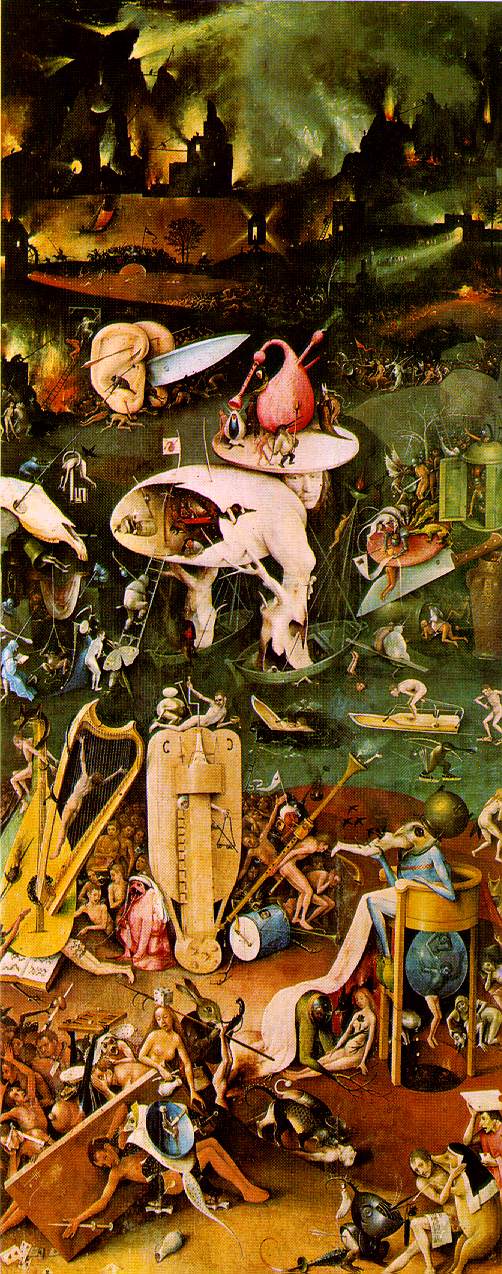 A link from another site got me to the Drudge Report, which was like peeking into the fantasies of Hieronymus Bosch (except that Bosch's madness was more coherent). First I found an ad for a pamphlet proving that global warming is all a big lie. We'll all be able to drive our SUVs all the way to heaven (special provision in the Rapture). NewsMax.com: America's News Page But for truly concentrated looniness, check out the designed-to-offend T-shirts.
(Wait a minute, that's all wrong! Drudge's site is in almost every sense the opposite of Bosch: Drudge features chaotic and higgledy-piggledy ad placement instead of an artistic sense of harmony and disharmony, highlights safe prejudices instead of dangerous passions, and anxieties about homosexuals, liberals, immigrants, feminists, whatever instead of the true terror being or becoming the most monstrous "Other" of all-- the anti-Christ or one of his minions-- without knowing it. So despite my first misguided metaphor, I'll leave the image up here, because Bosch is so much more interesting to look at.)
Image from Web Museum
Subscribe to:
Posts (Atom)