2010/06/16

Too much to say from Paris

One of the commonest reasons a would-be writer sits paralyzed before a blinking computer screen or a blank sheet of paper, or the tribe's singer commands attention but is unable to speak, is that there is too much to say. Another reason might be that he is using an unfamiliar French keyboard where the letters are in unexpected places. But let's return to the first impediment. The keyboard doesn't stop me, it just makes everything painfully slow. And it's late here, so all I'll attempt tonight is a brief list of thoughts that this return to Paris brings to mind.

Some context: a tiny apartment in Montmartre (18è arrondissement), rented this week so I can be at the presentation of a book (Above Ground, where I have a story) this Thursday at the Village Voice Bookshop here. Susana and I arrived on Saturday, and so far we've experienced:
  • Palais de Tokio, the museum of contemporary art now showing "Dynasty", exhibition of 40 installations by upcoming (if they're lucky) young artists;
  • The headquarters of the Parti communiste français, a big and graceful building by Oscar Niemeyer, that can be my "hook" to talk about what has happened and what is happening with the Left in France;
  • The funiculaire up to the top of the Butte Montmartre, now supporting the huge and ugly Basilique du Sacre Coeur, but important to me for an earlier memory that the big church (with its around-the-clock prayer services) was meant to erase. That was where the revolt that sparked the Commune took place, 18 March 1871. The Paris Commune, a defining episode of the European and global Left--well, that's one of those topics on which there is too much to say: So far I've only made one small attempt, in a short story, but I'll come back to it again. And again it will be through fiction, to try to reach the sensation of such exuberant hopes and disappointment;
  • Musée du Quai Branly, vastly improved since our earlier visit--another topic I'll want to write about when I'm back to my familiar keyboard.
Geoffrey Fox introduces Above Ground
Le siège du Pcf d'Oscar Niemeyer
Butte Montmartre, 18 mars 1870

2010/06/09

Losing the narrative in Spain

It's probably just as well that Elena Salgado (economics minister and 2d vice president) and José Luis Rodríguez Zapatero (president) have not asked my advice about how to rescue the Spanish economy and their government, but maybe they should—they've clearly run out of ideas and when they pretend to have some, end up contradicting each other. Maybe following my counsel wouldn't save them (I fear it's too laate for that), but it could at least lend a little dignity to the débâcle.

In case you haven't been following, here's what's been happening. Zapatero and his ministers, facing a "crisis" that has hit Spain harder than any other major industrial economy in Europe (see my earlier blogs on why), have suddenly announced drastic cuts of social benefits they had promised never to cut. This is supposed to reduce the deficit, but since it is also sure to slow the recovery and cut government income to cover essential costs, it may not even do that. Cutting those benefits has also meant alienating the Socialist Party's usually steadfast supporters, the unions, who very reluctantly are finding themselves forced to strike. Reluctantly, because they know that damaging the government can only benefit the other major party, the Partido Popular, which they expect to be much more anti-labor. Yet the union leadership feels forced to respond to the anger of their members in order to preserve their own legitimacy as leaders, and their most powerful weapon has always been a strike. So they call a strike that they know will have no effect except as a demonstration of anger, and certainly won't help revive the economy. The government cannot be forced to reverse the cuts, and the strikers cannot reach their real targets, if there really are any.

If the government asked me, I'd tell them (I'm a writer, so this is the way I see things) that a big part of their problem is that they don't have a good story. It has always been an essential part of any successful leadership to explain why we are where we are and where we're going and how we plan to get there. An outstanding contemporary example has been Fidel Castro: such a magnificent story-teller that he has been able to keep a very large proportion of the Cuban population loyal to his vision even through the most disastrous crises—some of them crises that could easily be blamed on his faulty decisions, but not the way he tells it.

But that's an extreme example. Here's another one: Obama. A different vision (from Fidel's), but a coherent one that he can explain convincingly. You don't have to convince all of the people, but you have to convince a large part of them if you want them to follow you.

Zapatero used to have a story, kind of flimsy and contradictory, but good enough for his purposes of getting elected and cobbling together enough votes from different parties to pass important legislation. The story was that he represented some kind of socialism-lite, never clearly defined beyond what he called its good "talante" or, roughly, vibes. A socialism that was conciliatory (always open to dialogue), in favor or rights for all kinds of minorities including invalids (subsidies for caretakers was one of his proudest legislative victories), homosexual marriage, a more liberal abortion law; a socialism that would always favor workers and pensioners, and a socialism that would maybe free the state just a little bit from the stranglehold of the Catholic Church. Where all this was going, that is, what sort of society he imagined he was constructing, was never even mentioned (a big difference from earlier Spanish socialists), but it didn't matter, because the other guys—the unpopular Partido Popular—was so awful on just these issues.

Now with these deep cuts, he's disappointed everybody who was trying to believe in him. He's lost his story.

It may be too late for him (who will believe him now if he reverses policy again?), but the Socialist Party should still be able to recover. If the Populares win the next elections because the Socialist supporters stay home (a likely scenario), their government is almost sure to be dependent on the support of other parties and their famously indecisive leader, Mariano Rajoy, can be counted on to botch things so badly that voters will hunger for an alternative. So a PP government, if it happens, will probably be brief. But the Socialists will need to recover their story.

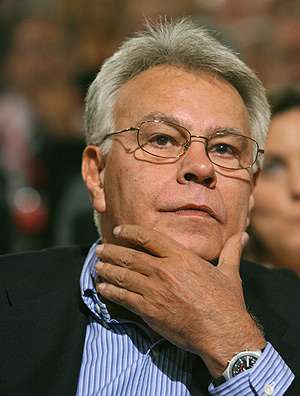
And they have one. It's just that their current leadership has forgotten it, or has chosen to ignore it. The Socialist Party think tank run by Jesús Caldera has elaborated a vision of where Spain should be going, toward a more equitable, more efficient, better educated and freer society exploiting Spain's great human and natural resources. They came up with a sensible plan that was published and cheerfully ignored. And that one-man think tank Felipe Gónzalez, the man who recreated the Socialist Party and led it after Franco and who new presides over the European Community's council of "wise men", also has some excellent ideas; he has always been one of Spain's most convincing storytellers. And there are other thinkers, younger ones, who will emerge and be heard. But they've got to get their story together.

(For my earlier comments on Caldera's think tank, on Felipe González and other Spanish issues, just click on the keyword "Spain" below.)

El Banco Mundial advierte de que la situación de España es "muy grave" — ELPAÍS.com

2010/06/04

My Spanish blog siesta explained (sort of)

At the beginning of the year I promised you and myself to write an essay on Spain every week. We could chalk up my missing the latest deadline (last Spain note was on May 14) to laziness, but that would be too lazy an answer. Laziness means avoiding effort, so to understand it I should spell out just what kind of effort I've been avoiding, because that may help explain something about Spain and my complex feelings about this country. I think there have been at least three things involved.

Number one: The persistent stupidity of the judicial system in driving out their one world-famous judge on totally spurious charges (I've written about this stupefyingly absurd assault by judges on their own value system—the concerted mutifront attack on Judge Garzón—in several earlier essays) so bummed me out that it has been painful for me to think about it. Garzón personally will do fine, in the International Court of Justice in the Hague for now and later as (at least) a very distinguished lecturer on human rights and international law, though he would rather be back in Spain doing what he does better than any other judge here: pursuing evil-doers regardless of their political party, their money, or their capacity for violence. So the damage is to Spain and its international reputation and its capacity to protect its institutions and its citizens.

However Garzón's impact was so enormous that even the cabal of Supreme Court Judge Luciano Varela, the Falange, the Partido Popular and their allies, even driving him off the bench, has not stopped the cases he opened up.

To sum up: The accusation of "knowingly exceeding his legal authority" (prevaricación) by investigating the crimes of the Franco dictatorship was based on a skewed interpretation of Spain's 1977 Amnesty law and of Garzón's own actions (he had actually removed himself from the case after initial investigation) and an utter disregard of international law and treaties signed by Spain; the simultaneous and unrelated charge of taking money from Banco Santander to drop a case against the bank's president was completely phony and had already been dismissed as baseless, but was revived on the flimsiest pretext; the charge of breaking the law by ordering phone taps of lawyers in contact with jailed suspects of political corruption was likewise a very distorted interpretation of both the law (the wiretaps had been approved by court authorities above Garzón) and of Garzón's actions. The whole three-front attack was kept going mainly because of pressure from the Partido Popular, to torpedo Garzón`s investigations of corruption of some of its most powerful chieftains, including the long-time party treasurer and practically the whole top leadership of the Valencia region.

But it hasn't worked. They managed to get rid of Garzón, but the evidence he had gathered is just too massive to ignore, so now the PP is up against other judges.

A second effort I've been avoiding is explaining Spain's perilous economic state and the diverse proposals for getting out of it. How Spain got to where it is—20%+ unemployment, soaring deficit, rocky credit rating—is no mystery. Even I, a relative newcomer and not an economist, could see back in 2007 that the real estate boom and the rapid economic growth of recent years was unsustainable. (See my blog entry Bubbles, bombs and bombast from Columbus Day, 12 October 2007). Now what? I haven't figured it out, but the danger is that the hasty improvisations by the Socialist government and its cutting of salaries and benefits make it more likely that the corrupt Partido Popular, which inflated the bubble, may come back to power to make things even worse.

And finally, I want to write something really clear and powerful and useful, to offer you something you haven't found anywhere else. And that requires a real effort. The one I've been avoiding. And since coming up with something original is so difficult, I hope next to offer you an essay on a book I've just finished reading, the thorough and insightful study of foreign correspondents in the Spanish Civil War, We Saw Spain Die by Paul Preston. Coming up next.

2010/05/18

Fiction & politics - Ernesto Sabato

 Our Carboneras reading club's recent selection of Ernesto Sabato's famous 1948 novel El túnel (The Tunnel) reminded me of this interview I did of Sabato in his home near Buenos Aires in January, 1986:
Fiction and Politics: Interview with Ernesto Sábato
Ernesto Sábato and Geoffrey Fox
The Threepenny Review, No. 32 (Winter, 1988), pp. 4-6
Sabato at the time was under police protection from right-wing gangs because of his prominence as chair of the commission that investigated the "disappearances" of civilians by the military regime of 1976-83. We talked about those tensions, of course, but especially interesting is his insistence on the importance of fiction for saving a country "from madness." After quoting Karl Jaspers on the Greek tragedians as "educators of their people and of its ethos," he goes on to say
 In a very profound sense, as mysterious as that of dreams, fiction molds, shapes, giving form to a country. … Fiction does not operate only with the head. It works with passions, with feelings, with intuitions, with symbols, with myths. All that we call poetic thought. And that is educative, and is saving. The dream saves us from madness. The nocturnal dream, of all men. We cannot survive without dreaming. Without that kind of collective dream that is fiction, neither could a nation survive. The nation learns, has its catharsis, in dreaming and in fiction. And without cathaarsis man cannot live.

(Note: His name is commonly written with the accent mark to indicate the stress on the first syllable; he himself has always written his name as his Italian parents did, without accent mark, so you will see it both ways in bibliographies. I mention this trivial question only because it took up hours of communications with Wendy Lesser and even phone calls to Buenos Aires.)

2010/05/14

Envy in the courts

Friend and colleague César Chelala just sent me a link to his latest opinion piece, Elie Wiesel's Wrong Move on Peace | CommonDreams.org   I just dashed off a reply which I'll share here with you, about a different issue of great concern.
Thanks. I was unaware of Wiesel's letter and the response. It is appalling that he could be making such statements.

Speaking of appalling, I am deeply, deeply disturbed by the campaign of a cabal of jealous judges to humiliate the best of their fraternity, Baltasar Garzón. And I'm deeply impressed by the dignity of the man under attack, who, despite all, continues doing his job and just yesterday appeaed and spoke at a conference commemorating the attacks on Jews during Argentina's dirty war. There's nothing I can do to help him, other than to express my support; the whole world of human rights jurists has mobilized in his defense, but those few Spanish judges, jealous of his fame, remain determined to do him in, as an exemplary sacrifice of any of their number who dares stand up to power.
The latest is a maneuver by Judge Luciano Varela, supported by a coterie of anti-Garzón judges, to head off the possibility of Garzón's acceptance of a temporary (7-month) appointment to the International Court of Justice in The Hague, where prosecutor Luis Moreno Ocampo was eager to have his assistance. They are completely unconcerned about the enormous damage they are causing to Spain's international reputation as an upholder of justice, a reputation that was perhaps undeserved, because it depended almost entirely on the work through the years of Baltasar Garzón.

 Judge Luciano Varela (in Spanish)

Luis Moreno-Ocampo - Wikipedia, the free encyclopedia

2010/05/13

Cognitive Theory For Breakfast | Radio Litopia

These people just discovered me on Twitter, and I'm glad they did. You writers and readers (that must include anybody who ever looks at this blog) should also enjoy this.
Cognitive Theory For Breakfast | Radio Litopia

If you don't want to listen to the whole thing (a lot is pretty silly), here are the 4 rules for big e-sales of books, even by a completely unknown author (from Joe Konrath, who writes under various pseudonyms):
  • Have a professionally done, eye-catching cover. This is extremely important on the internet and on eReading devices when it’s often reduced to the size of a posted stamp. It should pop. It should be colorful. You should be able to clearly read the author’s name and the book title on it. And it should draw your eye. It should be interesting.
  • Have a well-done product description. And a product description is the same thing that’s on the back of paperbacks or the inner jacket copy of hardcovers.
  • Have a well-written book. Well, that should go without saying. On all eReading devices, you could download a sample first. If your first chapter doesn’t hook, the reader instantly, why is anybody going to buy it?
  • And the last, of course, is the most important of all: have it cheap.
He means under $5. He claims to be making $140,000 a year on sales of e-books priced at $1.99.

2010/05/09

Spain in the World

Today we are going to talk not just about Spain, but about the World -- because, as Professor von der Vogelweide might say, there isn't anything else. And because Spain, where I now sit before this computer window, is as good a place as any, and better than most, for observing the challenges to democracy in this rapidly changing world.

Friday night we were fortunate to catch the interview of Felipe González by one of Spain's most respected media journalists, Iñaki Gabilondo, on the eve of González's presentation of the report by the European Council's "Group of Wise men," which González chairs, on new directions for Europe.

González is one of a very few active statesmen who thinks clearly and disinterestedly (he's no longer running for anything) about Europe and the globe. His thinking is informed by his experience in the underground against Francisco Franco and as Socialist Party leader and president of Spain (1982-96) during the post-Franco democratic transformation known here as "the Transition". He knows that what happens in Spain is critical for determining the future of Europe, and whether Europe is able to sustain physical well-being and democratic rights for its people will matter to the entire world. Not in the ways or to the extent it used to, when Europe ran the world, but still as one important player with a lot to offer.

Spain's economy is either the 9th or 10th largest in the world, according to IMF, World Bank or CIA rankings, its population of 47 million is the 5th largest in the European Union; and as if that weren't enough, I just discovered that its National Library is the fourth most important in the world! (El País, today).

But Spain matters for other reasons, beyond its comparative rankings, because of its unique history and geography. Its language is spoken almost as widely as English, as the national language of over a score of countries in Latin America and in Equatorial Guinea in Africa, and is still remembered at least in traces in its former colony of the Philippines -- and is a second language for many more people in all continents. Even more important, its relative success and its sometimes conspicuous failures in establishing the rule of law and democratic rights, in the wake of a long and especially brutal dictatorship, have been examples to the many countries facing comparable challenges. Its long history of intimacy with the Muslim world, its many governmental aid programs in Latin America and elsewhere (including both central government and programs by autonomous regions such as Andalucía) and all that energetic NGO activity by its private citizens give Spain an international presence well beyond, say, Japan's or the U.S.'s in proportion to population and GDP.

Thus Spain's successes and failures set off vibrations around the world, especially in Africa and western Asia and Latin America.

Often we look at the gross inefficiencies and partisan politics in the court system, the high unemployment and private debt in the economy, the attacks on public services, the high incidence of political corruption, and we are dismayed that things are not working better. But then, if we look at where the country is coming from, it's a wonder that they work at all. A constitutional democracy built out of the ruins of Franco-ist law and military traditions, monarchy, regional nationalisms (Catalans, Basques, Gallegos, Valencianos and others), trade union demands and Republican aspirations is a structure of precarious stability. Keeping it together and consolidating it matters to a whole lot of people, far beyond Spain and far into our future.

That's why I get so upset by stupid Spanish self-sabotage, like the judiciary's attacks on Judge Garzón, or the dismanteling of the pretty good public health system by regional presidents such as Esperanza Aguirre, or the refusal to cooperate in a national economic rescue plan, an educational reform or anything else constructive by Mariano Rajoy and his Popular Party. And that's why I keep writing about Spain.

Project Europe 2030 - A report to the European Council by the Reflection Group on the Future of the EU (English, pdf)

Felipe González llama a refundar Europa (El País)

Proyecto Europa 2030  - (Español, pdf)

Spain's 1978 Constitution

Professor Walter von der Vogelweide (Severn Darden) explains it all, in his Lecture on Metaphysics:
"Vy, you ask, am I going to talk about zee Universe? Because zer isn't anysing else!!"  
(Photo of Severn Darden in another role from Cinefania, "Planet of the Apes")

2010/05/01

The Real Reason Why Arizona Passed Such Harsh Immigration Laws

This argument by Greg Palast (link below) makes a lot of sense. Of course, an alternative policy for Republicans panicked by the growing Hispanic vote would be to give them some reason to vote for their party instead of the Democrats. Like, including their voices and their concerns in their platform. Republicans have learned to do that in Florida; why not Arizona? (I think I know why: there are more rich Cubans than rich Mexican Americans; Cubans have, after a long hard struggle, bought their way into the GOP in Florida.)
The Real Reason Why Arizona Passed Such Harsh Immigration Laws | | AlterNet

2010/04/30

Bearish on Spain

Simon White of "Variant Perception" is worried by Spain's private debt. Just to let you know. Me, like a lot of people in this country, I'm more worried about Barça right now (fútbol is a new passion of mine -- first time I've cared much for a team in any professional sport). And about the enormous confusion and political paralysis caused by the dysfunctional justice system, but private debt maybe should go on the list as 3rd priority. Here you can hear and see Simon White on the Business News Network (of the CTV of Canada's Globe and Mail).

Market Morning : April 29, 2010 : Bearish on Spain [04-29-10 11:05 AM]

Variant Perception