Showing posts with label Turkey. Show all posts

2013/07/16

Bir Cihan İki Sultan — first reviews

I just discovered last night that the Turkish translation of my novel A Gift for the Sultan is now being offered on the websites of more than a dozen Turkish vendors, including this one:

Bir Cihan İki Sultan (Timur ve Yıldırım'ın Mücadelesi) - Işık Kitabevi

And more importantly, this big chain of culture and entertainment media: D&R

And best of all, the first reviews have appeared.

As far as I've been able to work out with my Turkish-English dictionary, the review at the kitaplarix.com site is pretty positive.  They seem surprised that a Westerner can be so objective — at least, I think that's what this says:
Harvard Üniversitesi'nde ders veren Fox, Yıldırım ve Timur'un ölümüne mücadelesini bir Batılıdan beklenmeyecek kadar başarılı ve objektif yazmıştır.
The Turkish in the brief comments on other websites is too colloquial for me to make out — I can't tell whether they love the book or think it's a menace.  But at least the comments show that people are aware of and reading it.

Readers of the English version have generally understood the novel to be a romance about a Byzantine princess and an Ottoman brigand; the Turks are presenting it as a political and military history of the clash between two giants of their history, Timur (or Tamerlane) and Bayezid I (Yıldırım Beyazıt). That's all fine (those stories indeed are part of the book), but I hope some readers in both languages will appreciate the broader story that frames the others: that of the struggle of a great city against an anti-urban force bent on destroying it.

In the end, as the book can only hint at in the last pages, the resolution will begin 51 years later with the conquest of Constantinople by the Ottomans (A.D. 1453). The city will not just survive, but by its many subtle resources will transform the Ottomans into a cosmopolitan and multi-ethnic urban power, reaching from their capital in Constantinople to govern a tri-continental complex of subject cities (Northern Africa, Western Asia and Eastern Europe). Now that was one very powerful city. And still is, under its new name of Istanbul.

P.S.: One of my Turkish friends has given me a more accurate translation of the quote above:
"Fox, who is a lecturer at Harvard University, has written about Yildirim and Timur's to-the-death struggle in such a successful of objective manner that is beyond what we can expect of a Westerner." Or, ".... that could not have been expected from a Westerner."
I'm not and never have been a lecturer at Harvard University, but I studied there, so it's a pardonable error which may sort of locate me intellectually for a Turkish reader.

2013/06/28

Backgrounder on Turkey

Turkey: What Everyone Needs to KnowTurkey: What Everyone Needs to Know by Andrew Finkel
My rating: 4 of 5 stars

This concise, quick read will be a good starting point for anyone who needs to know about this surprising country. Finkel covers a breadth of topics and suggests linkages among them — language, regional disparities, ethnic history and conflicts, political history, current party and government structure, economic potential and weaknesses, religious tolerance and conflicts, and Turkey's complex and fluid geopolitical strategy. Not a word about the country's vibrant arts scene — theater, literature, film, painting, etc. — but on other aspects, clear and opinionated (he's a fierce defender of free speech, which is sometimes in danger).

Andrew Finkel is an American journalist with long experience in Turkey. He is also the husband of historian Caroline Finkel, author of the monumental history of the Ottoman empire, Osman's Dream, which I reviewed here earlier; she describes him (in her acknowledgements) as an "academic manqué" (he mentions having worked on a Ph.D. dissertation), and indeed he approaches journalism with a scholar's seriousness and the expectation that his readers will be able and happy to follow a sometimes subtle and sophisticated argument. He was fired from Turkey's big daily Today's Zaman in 2011, he believes for defending a critic of the paper's founder and backer, the controversial Islamic preacher and charter-school empresario (in the U.S.) Fethullah Gülen (look him up — Americans should know about him). Finkel now has a regular column in the International Herald Tribune, still reporting from Turkey.

View all my reviews

2013/06/23

Back from the U.S. of A.

Susana and I got back home to Carboneras (Almería, Spain) yesterday after nearly a month in the USA (and a few days in Madrid), our first trip back there in nearly four years: Cambridge and Boston MA, for my college reunion; Galisteo and Santa Fe NM to see old friends; Arizona to hang out with my two sons (one in Prescott, the other in Flagstaff), and finally New York, for many personal and business reasons, including a meeting with the editor for our current book-in-progress, a history of architecture and urbanism in Latin America.

So this is just to explain why you hadn't seen anything from me over the past month — we were too busy traveling and had too infrequent and interrupted access to the Internet for me to sit down and write anything interesting. Now we're back in our seaside home and ready to get back to work on projects including:
  • first, that book I just mentioned (volume I, the pre-Columbian history, is written; the volume on 20th and 21st centuries is well advanced; we're saving for last what we expect to be the least challenging portion, on the long colonial period and the first post-independence century).
  • My new novel, still in early stage.
  • More commentary on current events. Next up, an article on Turkey and its protests.
This will keep us busy while everybody else is at the beach. Maybe we'll get to go down to the beach, too, from time to time. It's right outside my window, mighty tempting.

2013/04/16

Bir Cihan İki Sultan

I'm pleased to announce that the Turkish language version of my novel A Gift for the Sultan is now available from Nokta Kitap publishers in Istanbul.  Just 11.20 Turkish liras (4.76 € or US$6.25).


kitapyurdu: kitap - Bir Cihan İki Sultan & Timur ve Yıldırım'ın Mücadelesi - Geoffrey Fox,Orhan Tuncay, 138186159
(Click on the "kitapyurdu.com" link to see the book, or if it doesn't pop up, type my name in the search box — "Arama" — at top left of the "kitapyurdu.com" page.)

For the original (English language) version, go to Amazon or (e-book only) Smashwords.  For a complimentary review copy, e-book, English (if you think you might review it), just let me know.

2012/12/05

Blog Hop … The Next Big Thing

A day late and a dollar short. I was supposed to do my "Blog Hop" entry yesterday, but things happened — including, believe it or not, a visit by Omar Sharif to our little fishing village in Almería (Spain), where he filmed part of "Lawrence of Arabia" 50 years ago! But back to this blog hop.

Me reading at a local bookstore, Librería Nobel in Vera, Spain
Mary Tod tagged me for this "hop" which somebody (we don't know who) started and called THE NEXT BIG THING. The idea is for each author to answer 10 questions about a work in progress (WIP) or recently published book, and then tag other authors to do the same the following week. 

What is your book's title?
 
A Gift for the Sultan takes place in and around Constantinople in 1402, when that city was under ferocious siege by the Ottomans. I've already written here previously about its development, but answering these ten questions may be a good way to sum up the experience. My new novel, or WIP, is too fresh to talk about and as yet has not found its title.

Where did the idea come from for the book?

I had just completed a nonfiction book on social issues in the U.S. (Hispanic Nation, University of Arizona Press) and was ready for something completely different. On a visit to Istanbul and from there into the interior of Turkey, I was deeply impressed by the rich mix of cultures and overlapping histories of successive invaders and settlers, especially the long period of uneasy co-existence between the Greek-speaking, urbanized Christians and nomadic, newly Islamized Turks. And while reading up on that history, I was surprised to learn two facts. First, that Christian emperors and satraps had frequently offered their daughters in marriage to Turkish chieftans in order to buy peace. What, I wondered, would that sudden immersion in an utterly alien culture be like for the young Christian bride? Second, that under the terrible stress of bombardment and isolation, the ruler of Constantinople was prepared to surrender the city to the Sultan, but, afraid of the reaction of the populace, he had to carry out his negotiations in utter secrecy.  What were the many tensions within that city?  I was also thinking of the more recent siege of Sarajevo by Orthodox Serbs and other cities under stress.

What genre does your book fall under? 

It is being marketed as "historical fiction", but it is really, or also, a sociological study of the shifting alliances and betrayals that emerge when two powerful cultural systems — in this case, urban Greek-speaking Christians and Ottoman Muslims — collide. The fictional characters are closely patterned on real social types of that place and time, and everything I have invented is something that really could have happened that way. But "historical sociological fiction" is too unwieldy a label, so let's leave it as "historical fiction".   

Which actors would you choose to play your characters in a movie rendition? 

A Turkish translation of the book has just been published in Istanbul. I will be delighted if some Turkish filmmaker or TV producer takes it on, and casts some dashing, dark, 30-ish actor (there are several who might be available) as the Turkish warrior who is supposed to deliver the princess to the Sultan; a pretty young woman who can pass for the adolescent Greek princess who suddenly finds herself among the rough Turkish horsemen; and some good comic actors for the parts of the Christian merchant trying to profit from this new event, the English mercenary palace guard, and the various other Turkish, Greek and other personalities. 

What is the one-sentence synopsis of your book? 

A great city calls on all its resources — magical, military and monetary —to survive assault by a powerful urban force.

But there is another story, of special interest to  the readers of the Turkish translation The supremely arrogant sultan Bayezid, called "Thunderbolt" ("Yildirim" in Turkish), meets his downfall at the hands of the very astute, chess-playing war chief from Samarkand, Timur (Tamerlane). Even today, families in Turkey frequently name their sons Yildirim or Timur. 

Is your book self-published or trade published? (The original form of this question said "or represented by an agency?")  

Oddly enough, the answer is "Both". I published it myself in English in 2010. A major Istanbul publisher, Nokta Yayıncılık Dağıtım ve Pazarlama, then purchased translation rights and published it last month (November 2012).   

How long did it take you to write the first draft of your manuscript? 

A very long time. The original idea came to me on that first trip to Turkey in 1997. But I knew almost nothing about Turkey or what we call the Byzantine empire, their languages or customs, or the details of their long, involved history. I put the work aside several times and wrote other things (several short stories, journalistic articles), but I was too intrigued by the story to abandon it. I now know an awful lot about those peoples and their history, and even began studying Turkish. I completed the draft in 2008 or 2009.

What other books would you compare this story to within your genre?

I'm not modest. I'll say Tolstoy's War and Peace, for its interplay of sociology and history, and also certainly Albanian author Ismail Kadaré, The Siege

Who or What inspired you to write this book? 

My experience in Turkey, as described above, and also my reading of the news. I think there is much to be learned from this momentous conflict about Muslim-Christian relations today, and about the terrible fear and rage against urban civilization that motivates much of contemporary terrorism. 

What else about your book might pique the reader's interest?  

A very gallant, though very superstitious Ottoman warrior, and a bold and perky young Christian princess rebelling against the fate designed for her. And many dramatic and some quite comic scenes. 
 ∞∞∞∞∞

And here are some of the other blog-hopping authors you'll want to check out:

Jan Alexander is a fiction writer and financial journalist, currently putting finishing touches on a fantastical, satirical novel about New York, the new China, and the process of fictional creation. She plans to tell you all about it next week (December 12) on the blog of a small collective of writer-editors that she co-founded, http://thothbooks.blogspot.com.es/ 

Mary Tod, who "tagged" me for this post, is a writer of historical fiction whose blog has just that title: http://awriterofhistory.com/author/awriterofhistory/ Thanks, Mary, for the invitation to the blog hop.

Sophie Schiller is a writer of historical fiction and spy thrillers. She has a recent book called Transfer Day. Her own blog is at  http://sophieschiller.blogspot.com
Richard Sutton has written two novels, The Red Gate and Gatekeepers about the O'Deirg family and the ancient secret they are charged to protect. He blogs at  http://www.sailletales.com
Kirstie Olley lives in Australia and calls herself a speculative fiction writer. And she is pleased to have completed NaNoWriMo. She blogs at http://www.storybookperfect.com/.

2012/11/29

"One World, Two Sultans"


BİR CİHAN İKİ SULTAN — "ONE WORLD, TWO SULTANS"

This is the Turkish translation of my novel A Gift for the Sultan, just published by Nokta publishers in İstanbul.

The phrase at the top is Timur ve Yıldırım'in Mücadelesi —“The struggle of Timur and Yildirim”

Timur was the khan from Samarkand we know as Tamerlane; Yildirim (or Yıldırım in Turkish), "Thunderbolt", was the nom de guerre of Sultan Bayezid (1354-1403), defeated by Timur in the Battle of Ankara, July 1402.

The novel is about much more than the struggle of these two fierce warriors — it is also about how a great city, Constantinople, confronts a terrible siege and about the complicated relations between Orthodox Greeks and Ottoman Muslims in this frontier period, when neither had unchallenged dominance of the region. But Timur and Yildirim's struggle is a big part of the story, and is of special interest to Turkish readers as part of their founding history.

A Gift for the Sultan (English-language original)


2012/11/19

Top Ten Ingredients of Favourite Historical fiction - A Writer of History

Here's a thoughtful discussion, sparked by historical fiction author Mary Tod and continued in a whole series of lively comments.

Top Ten Ingredients of Favourite Historical fiction - A Writer of History

I think she's got a good list of the most common features of popular historical fiction. But I don't take it as a recipe for my own work, and I don't suppose any serious writer would. For me, the aims of re-imagining events of the past are, first, to learn something that might be useful in our future actions, and second, to understand better how things got the way they are. My novel about the 1402 Ottoman siege of Constantinople (A Gift for the Sultan) is really about how any great city draws on its most diverse resources when under tremendous stress, and also about how such a polyglot, multiethnic and territorially expansive system as the Ottoman Empire (with all its consequences down to the Balkan wars of the 1990s and Syria today) got its start.

2011/12/04

The longest dynasty

Osman's Dream: The History of the Ottoman EmpireOsman's Dream: The History of the Ottoman Empire by Caroline Finkel

My rating: 3 of 5 stars


Covers the entire Ottoman dynasty from the original Osman (14th century) to the last sultan (exiled in 1922). Focus is narrowly on the reigns of all of them, some brilliant (Mehmet the Conqueror, Suleyman the Magnificent), others bumbling and at least one of them mad. Probably because a full accounting of all the intrigues involving the sultans requires so much space, Finkel offers only scant contextual information, for example on how the society and the many cultures gathered into the Ottoman empire were evolving (Anatolian Muslims, Balkan Christians and Muslims, Greek and Armenian Christians, Kurdish Muslims, Arabs and others in Syria, Egypt, etc.). This makes the book dense with data that seem disconnected and hard to follow — for example we read that a certain Sheikislam (highest religious authority) or upstart Janissary officer conspired in a certain way, but what drove that action and what did it mean to others (besides the sultan) in that time? Reading it straight through is probably not the best approach; it will be an invaluable reference source for anyone investigating particular aspects or episodes in this very long history.


View all my reviews

2011/11/22

Honoring the Enemy, A Lesson From Gallipoli

Thanks to our friend César Chelala for this article from his series International Perspectives with Dr. Cesar Chelala in Epoch Times.

Honoring the Enemy, A Lesson From Gallipoli | Viewpoints | Opinion | Epoch Times

As César points out, there are many lessons from Gallipoli, for all the countries involved. Also several films and books, memorials and cemeteries, and political careers destroyed or enhanced. This history, and the magnanimous gesture recounted by César Chelala, go far to explain the reverence for Mustafa Kemal in modern Turkey.

Our anonymous friends at Wikipedia offer a detailed and thoroughly researched article which lists films, books, etc. Gallipoli Campaign

Map is if from the Gallipoli Guide — Anzac Day for New Zealanders, which offers a virtual tour of the peninsula.

2011/11/20

Red dervish

  
I could not resist buying this miniature by Özcan Özcan last Tuesday in Sultanahmet, İstanbul. 
The Ottoman script forming the dervish's skirt and tunic says "Ya hazreti Mevlana" — "Oh! Most holy Master" (i.e., the Mevlana Rumi). 

I suspect he has been watching the news of all the street demonstrations, from Tahrir Square to Homs and Madrid and Oakland and Wall Street. Its enough to keep you spinning, Oh! Enlightened Ones.

Or maybe he just been reading Rumi's Divani Shamsi Tabrizi. That too is well worth a whirl.

This Is What Revolution Looks Like | Common Dreams

Perfectly said, by Chris Hedges:

This Is What Revolution Looks Like | Common Dreams

When I described myself as a "red dervish" a little while back, this is what I meant: red (as in revolutionary), and like a Sufi dervish personally drawing strength from my vision, the vision of our latent collective power — that of all humanity — to conquer the evil within and among us and release our more powerful impulses of love and solidarity. A Sufi would call that evil "Sheitan," a more modern name is "capitalism."  Or as the great Turkish poet Nazım Hikmet (himself something of a red dervish) put it, to live "like a forest in solidarity, / this is our yearning."
Yaşamak bir ağaç gibi tek ve hür
ve bir orman gibi kardeşçine,
                                bu hasret bizim. 
Davet (Invitation); for the complete translation, see this Wiki version.


Whirling to freedom

The Forty Rules of LoveThe Forty Rules of Love by Elif Shafak

My rating: 3 of 5 stars


The encounter and transforming love between Rumi and the wandering dervish Shams i-Tabriz in the 1240s is background, context and explanation of the transformation in 2008 and 2009 of Ella Rubinstein, Jewish American housewife in Northampton MA, through contact with their story. Shams turns the respected and sedate scholar Rumi into a poet and co-founder (along with Shams) of the whirling dervishes; their story turns Ella from a self-repressed, resigned wife in a loveless marriage into a free and adventurous woman. Alternating chapters are told from the points of view of Ella or Shams and the many people who come in contact directly with him in Konya, Damascus or Tabriz. His stern but gentle manner and his preachings of love arouse strong reactions, ranging from murderous hostility on the part of Islamic zealots to almost total identification by Rumi, from respect and devotion by outcastes whom he has consoled and aided to the one kind of love he cannot allow himself, the passionate, carnal kind. Which may be what you thought this book was going to be about, but no, Shams' 40 Rules of Love are Sufi rules, of accepting one's fate but aiding and preventing harm to others and trusting in God's overall just design of all things. The book is a welcome introduction to this moment in Sufism and the origins of the Mahlevi whirling dervishes ("Mahlev" or master was what Rumi was called), and the twin stories — of the 13th and of the 21st centuries — come to a satisfying conclusion.

However, Shafak's narrative structure and voice here are so limited that one longs for a little break now and then. Each chapter tells us the thoughts and observations of just one character at a time, often telling us things that they would be unlikely to say even to themselves, and everybody sounds alike, whether a drunk or a prostitute or enlightened one in Konya in 1246 or Ella Rubinstein in 2008. The drunk tells us he is drunk but he doesn't sound drunk, the angry zealot tells us he is an angry zealot but doesn't sound very excited about it, and so on. “"Beauty is in the eye of the beholder," Shams kept saying.” (p. 268) He sounds just like Ella. These limitations are quite unlike Elif Shafak's approach in her earlier novel, The Bastard of Istanbul (see my review), where there are different voices and narrative points of view, including a genie and an Internet forum. But "40 Rules" comes to a good, perfectly Sufi ending, which goes far to compensate for other weaknesses, and in the course of reading it we learn much about why Sufism is so appealing to so many.


View all my reviews

2011/11/12

Coming together in İstanbul

Istanbullians Istanbullians

by Buket Uzuner

My rating: 3 of 5 stars


This short (125 pages) graphic novel (adapted and translated into English from Uzuner's Turkish-language novel İstanbullular) illustrates contemporary Istanbul and its mingling of extremely diverse people. An attractive 40-something genetics professor and diplomat's daughter is returning with trepidation to her home city after years of working abroad, when she is trapped in Atatürk Airport in an emergency blackout along with İstanbullular (Istanbullian) of all backgrounds, including her Kurdish artist lover, a Turkish Greek professor, various Armenians, a Jew, a weary bathroom attendant, a wealthy entrepreneur, at least one fierce Turk and anti-Kurd nationalist, a headscarf-bearing young Muslim woman, a gay bartender, etc. Though their stories are never fully resolved, we know that this crisis will have changed all their lives in some way. Buket Uzuner is author of several other novels, of which this is the first graphic one. Illustrations of social types and places by Ayşe Nur Atsoy are realistic and vivid. The book is a charming and informative introduction to the complexity of this enormous (nearly 14 million population) city and tempts this reader to seek other works by Buket Uzuner.

For more on and by this author, see her website Buket Uzuner.


View all my reviews

2011/11/09

Is the Kurdish movement leftist or nationalist? - Hurriyet Daily News

This piece of good investigation and clear argument by Ruşen Çakır helps clarify the context of a complicated political struggle. As he says, the Marxist rhetoric has become mere adornment of the movement — reminiscent of what happened to the Basque ETA after the end of Franco.

Is the Kurdish movement leftist or nationalist? - Hurriyet Daily News

2011/11/08

Edirne 2 : the red dervish smiles

Eski Cami interior
Today as our bare feet padded on the thick carpet of Edirne's Old Mosque — the Eski Cami — and we looked up at its wide dome and laterally to the passionate calligraphy calling out from the walls,  I thought again of the verses of the only Sufi dervish I know well, Yunus Emre. Which surely were not the verses being sung by the earnest young imam squatting before a flock of veiled, attentive young women.
Eski Cami, Edirne

The Eski Cami was completed in 1414, probably a century after the time of Yunus, but when Ottoman Islam was still young and its architecture exuberant in intent but simple in engineering. Yunus spent little or no time in mosques and regarded ritual with benevolent amusement as a distraction from faith. But I think even he would not have felt uncomfortable in this quiet place with its dome beckoning like a gate to heaven.


http://upload.wikimedia.org/wikipedia/commons/4/4e/Edirne_7333_Nevit.JPG
Selimiye Camii, Edirne (WikiCommons)

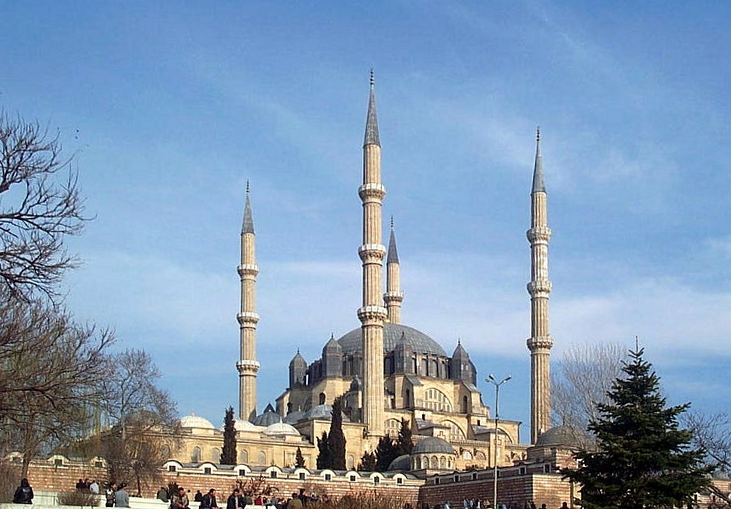
Only a few hundred meters away stands the Selimiye Mosque, completed in 1575 and designed by Sultan Suleyman I's master architect, Koca Mimar ("Architect") Sinan, who was then 80 years old. He had designed many mosques including Istanbul's famous Süleymaniye, completed in 1558, as well as other large, graceful buildings. But Edirne is considered (and was so considered by the mimar himself) to be his finest and most perfected work. It is an engineering marvel, with an immense dome with a diameter of 31.30 meters whose center rises 43.28 meters above the floor. That enormous structure is supported by an ingenious system distributing the weight to its eight external pillars, with no pillars interrupting is prayer space 1,629 square meters. The booklet from the tourism offices further tells us that "the entire mosque covers an area of 2,475 m2, the largest in architectural history." The proportions are beautiful and its generous space inspires awe.

But if I were to spend a longer time in Edirne, it would be to the Eski Cami that I would come, perhaps to stand, perhaps to kneel, to meditate on our world and my joyous place in it. Yunus Emre said that of course we must believe in God because otherwise He would not exist — or, as I interpret him, God is our creation and must be respected and preserved as such. As a god-fearing atheist, I feel akin to that smiling, gentle poet. And in the Eski Cami of Edirne, I feel myself a kızıl dervişi—a red dervish.

2011/11/07

Edirne : music therapy

It has been cloudy and chilly in this dusty city where Turkey's Thracian province reaches out to touch Bulgaria and Greece, a quiet day, the second day of the Kurban Bayramı or "Festival of the Sacrifice," and many businesses are closed.

Merely by looking at a map, even without any historical reading on the area, you will see why Edirne, the Turkish name for Emperor Hadrian's Adrianopolis, has been the site of so many battles and sieges. “Military historian John Keegan identifies it as 'the most contested spot on the globe' and attributes this to its geographical location,” says the Wikipedia article.

But there were also long periods of peace after Murad I conquered it from the Bulgarians (1365) to make it the Ottoman capital until his great-great grandson Mehmet II (the Conqueror) moved the capital to newly-conquered Constantinople in 1453. Edirne continued to be a major concern of the sultans, as a military and administrative district for their European territory and a pleasant retreat from the more hectic life of Constantinople/Konstantiye/Istanbul. They built magnificent mosques here, including one considered to be among the finest of Suleyman the Magnicent's favored mimar (architect) Sinan, the Selimye (1575) — and which we plan to see tomorrow. 

Today we visited an earlier mosque-complex ("küliye"), built in 1682 under the auspices of Sultan Bayezid II, a 30-minute walk from the center to the outskirts of town. This II. Bayezid Külliyesi is famous for its hospital and medical school, which served patients free of charge from its founding until 1916. (The text on the linked page is all in Turkish, but it's the best site I've found for photos.)  It is now a health museum, with displays of medical instruments and mannequins representing medical procedures illustrated in the textbooks of the 17th-18th centuries, some of them pretty scary. One orthopedic procedure involved strapping the patient to a kind of rack to manipulate his vertebra back into place — he didn't seem to be enjoying it. And then there was all that cauterizing.

But best of all, and most pleasant to contemplate, was the music therapy, part of an ancient Turkish tradition from well before they reached Anatolia from the Asian steppes. By Bayezid II's time it had developed from shaman's drumming and humming to a professionalized and elaborate practice, with trained musicians on a variety of instruments performing the specific musical modes prescribed by the physician. There were particular modes for particular illnesses, their effects enhanced by the sound of water — in the kulliye produced by a fountain in the center of the domed inpatient pavilion.

At the moment, in our hotel, we are listening to a collection of İsfahan Makami ("makam" is a musical mode) that might have been prescribed to sharpen "intelligence and clearness of mind" (as well as to cure illnesses accompanied by fever) and is said to be especially effective on Mondays. A group called Tümata has recovered this musical therapy music and performs it on instruments like those used in Bayezid's time. It seems to be working. After all, it is Monday.

2011/11/06

In İstanbul: a 5-star jail and other wonders

We love this city, and since we had already seen the top 3-day tourist attractions on previous visits (Hagia Sophia, Topkapı, etc.) and since we're spending more than a week here (of the 3 we're devoting to exploring Turkey) we feel free to stroll around, take the feribot up the Halıç (the "Golden Horn") and take in some  of the museum exhibitions aimed mainly at a Turkish public.

Thursday evening was my talk about my book A Gift for the Sultan before a gathering sponsored jointly by the Harvard and MIT alumni organizations where, fortunately, everybody could understand my English —though I started out with a couple of sentences that I had prepared in Türkçe. My accent is probably all wrong, but they were tolerant. Thanks to Şeyma Yavuz (president of the Harvard Club of Turkey) for organizing it and to all those who came out on this rather inconvenient evening, as it was close to the eve of the Kurban Bayramı (Eid al-Adha in Arabic countries) or festival of the sacrifice which is the beginning of a week-long holiday.

The event was held in the Blue Room of the Sultanahmet Four Seasons Hotel, which is the former Sultanahmet Jail, which from 1919 to 1969  "served mostly as a prison reserved for writers, journalists, artists as intellectual dissidents sentenced," according to Wikipedia. After years of abandonment (the prisoners had been transferred to another jail),  it was converted into this luxury hotel that opened in 1996. What was then the exercise courtyard is now an open-air restaurant, and unless you knew this history you would never guess that the penthouse rooms at each of the four corners had been the guard towers. It was the best jail I had ever visited, and I've visited several, a couple of times (in a Venezuela mix-up and in Chicago after a civil rights sit-in) as an unwilling guest. None of the others offered such a splendid array of olives and cheeses along with the wine. One thing did continue from the old days: the people gathered around me on Thursday were indeed writers and intellectuals, and posed very interesting questions and new thoughts regarding my book and other things. I hope and plan to see them all again on future visits.

On Friday, we spent almost all of the day at two exhibitions at the İstanbul Modern art museum. One was the biennial featuring works inspired by the Cuban-American artist Félix González Torres (check out the links for more detail). González-Torres' own works were not presented but were described and alluded to, for art from many countries aimed at making us painfully aware of violence and censorship. Many women are included amont the artists, but the other big show in the main building was exclusively of women with explicitly feminist themes. A good way to celebrate a Muslim holiday, it seemed to us. The pieces by Turkish women were especially interesting to us. One by Asıl Sungu is a pair of videos, featuring her first with her father and then with her mother, asking opinions on what to wear — pretty funny, the differences between the way her father and her mother wanted her to look: he, favoring a more professional, businesslike style that might be more protective of her, and she (the mother) urging a sort of little-girl costume. But on the whole the works that impressed us most were the old ones: Tina Modotti's marvelous photographs in Mexico, and Martha Rossler's more satiric portraits combining scenes of the Vietnam war (occurring at the time of these works) with consumer paradise images from the US.

Well, that was exhausting. Hours on our feet at two big exhibitions requiring a lot of attention. So next day, yesterday, we took the feribot up the Halıç to Bilgi Üniversitesi, near Sülüce on the far shore of the Halıç. The ferry is large, with two interior decks and and an upper exposed deck, a coffee and snacks stand, comfortable seats, and the fare is the same as for other public transportation, a mere 2 TL (less than 1 euro). Susana was interested in Bilgi for its setting and its architecture, and also for an exhibition on LeCorbusier. It has a good, kind of funky (colorful and intentionally inelegant) restaurant, Otto Santral. And from there we took a taxi to the huge Eyüp mosque complex. "Eyüp" is the Turkish version of "Abu Ayyub al-Ansari, the companion and standard bearer of the Prophet Muhammad",who is said to be buried there. (Wikipedia). From there, we took the teleferik up to the Pierre Loti Cafe, where the French novelist is said to have hung out. Great views, good Turkish coffee. I bought a couple of Loti's boks there. I'll let you know more after I read them. He was a very curious character, whose Turkish experience I hadn't known much about. I'd only read his Pecheur d'Islande, about a very different part of the world, when I was in high school.

Now we're off to Edirne. Talk to you again soon.

2011/11/01

Among the Turkish Kurds

We are in Sultanahmet in İstanbul now, at 6:30 pm Salı (Tuesday) and the muezzin is calling out from the Blue and other mosques. Despite this medieval throwback (amplified by 21st century loudspeaker technology), this is one of the most sophisticated, diverse and populated (nearly 14 million people) cities in the world. We landed here yesterday after a 6-day tour of a very different Turkey, as sharp a contrast as one can imagine to İstanbul: southeastern Anatolia, the provinces of Şanlıurfa and Diyarbakır. Kurd country, with pockets of Arab-speakers, mostly poor and rural, but changing rapidly — too rapidly for many nomadic herders and pastoralists to comprehend. The famous old city of Diyarbakır, military stronghold and site of repeated mass violence from the 13th century BC to the massacres of 1925, has burst out from its ancient walls as the swelling population spreads out to the west, and new construction is everywhere, in some places knocking down millenial neighborhoods.
Diyarbakır grew from 30,000 in the 1930s to 65,000 by 1956, to 140,000 by 1970, to 400,000 by 1990, and eventually swelled to about 1.5 million by 1997. Today the intricate warren of alleyways and old-fashioned tenement blocks that makes up the old city within and around the walls contrasts dramatically with the sprawling suburbs of modern apartment blocks and cheaply-built gecekondu* slums to the west. (Wikipedia
*Turkish for "built overnight".
The children now have opportunities that their parents had never imagined — not all of them healthful. The rapid changes here, as they always do, create such disparities in knowledge and wealth that corruption and crime grow along with everything else. Much of the change is spurred by the huge GAP, Güneydoğu Anadolu Projesi or "Southeastern Anatolia Project", a huge scheme centered on the building of the Ataturk Dam on the Euphrates. Jobs, construction, hydroelectric power and irrigation are among the more positive effects, flooding of ancient sites and rapid influx of population are among the more problematic ones. Places that had water for millenia suddenly went dry as rivers were diverted, other places went under water. The flooded sites are lost forever, but gradually water is coming back, through pipes, to villages that had lost it. Rapid development is always an uneven and unsettling process.

The GAP is not the only thing changing peoples lives. The kids are all (or mostly) in school now, all  learning to speak proper Turkish regardless of what they speak at home. Although it cannot be used as a medium of instruction, as far as we could tell there are no restrictions on using Kurdish outside of government-sponsored institutions. There are now newspapers and radio stations in Kurdish (for a while they were outlawed), and Kurdish is what most people (except those Arabs) speak most of the time, but at least in the bigger towns everyone understands Turkish.

And the Kurds we spoke with consider themselves "Turks", not as an ethnic label but in its relatively new — invented at the time of the founding of the Republic in 1923 — sense of "citizen of Turkey". But clearly our limited experience in the area leaves out a whole lot of the story of tensions between Kurdish-speaking and Turkish-speaking Turks, which a glance at Hürriyet Daily News will show you are still high. Those tensions, and ethnic conflicts generally in what is now Turkey, are not ancient or inherent, but were energetically fostered by foreign powers aiming to split and seize parts of the old Ottoman empire, beginning in the 18th century. But that's a subject for another, longer essay, which will in part be a reflection on Caroline Finkel's massive Osman's Dream, which I just finished reading.

Zeus and friends atop Mt. Nemrut (Virtourist)
We covered some 1,400 kilometers, from Şanlıurfa to Mardin and Diyarbakır, with our very patient and punctual driver Mehmet Tanık. Our starting and end point was the very poor village of Yuvacalı, where Alison Tanık has organized the whole extended family around these tours. We saw some amazing ancient sites, from Göbekli Tepe (thought to be the most ancient temple anywhere) to the relatively recent — a mere 2,000 years old or so, from the time of Julius Caesar — statues atop Mount Nemrut, still more recent (13th-16th century AD) Seljuk and Ottoman structures, and all that 20th and 21st century building and Lake Ataturk.  I'll tell you more about our adventures in future posts. Meanwhile, if you are interested in doing something like this, check out Nomad Tours Turkey.

2011/08/31

Art meets politics in Istanbul and the Armenian diaspora

The Bastard of IstanbulThe Bastard of Istanbul by Elif Shafak

My rating: 4 of 5 stars


A 19-year-old Turkish Istanbuli girl oblivious to the past and nearly suffocated by her overdevoted relatives, meets a 19-year-old Armenian-American girl obsessed by the past and nearly suffocated by her overdevoted relatives; the first discovers a past that has been suppressed, and the second learns to partially free herself from the past and savor the present.

This is an artfully constructed book with two contrary agendas, both essential, but not entirely comfortable with one another.

First, the literary agenda: The quirks, foibles and virtues of a large number of complex characters, understandable even when not exactly lovable, are described in rich and vivid language, their personal dramas interwoven and mostly resolving in surprising and satisfying ways. The literary ambition is signaled in the opening chapter — the sounds and sensations of rush hour in Istanbul in a rainstorm, and the furious and impious thoughts of young Zeliha as she hurries through the broken streets to a critical appointment, are delightful, frightening and hilarious, and will be unforgettable. And then we meet the other badly split family of the Armenian American girl, and then back to Zeliha and her three sisters, each eccentric in a different way, and her mother and grandmother living in sweet but comical confusion.

But there is another agenda, political and didactic: Elif Shafak wants us to face a terrible tragedy — the killings and deportations of Armenians in 1915 — and to help all of us, but especially Armenians and Turks, to come to mutual comprehension and forgiveness today.

The contemporary Turks of the novel (and, I think, in reality) have no problem whatever with their Armenian compatriots. None of Zeliha's friends thinks it remarkable that her lover, Arman, is Armenian; for them, "Armenian" is just another variety of Turk. But when Zeliha's now 19-year-old daughter Asya introduces her new friend Amy — or Armanoush — to her friends in the bar as an Armenian American, they are suddenly on the alert.
Now the word Armenian wouldn't surprise anyone at Café Kundera, but Armenian American was a different story. Armenian Armenian was no problem — similar culture, similar problems — but Armenian American meant someone who despised the Turks.
As Asya begins to tell the tragedy of Armanoush's Istanbulite family, the execution of her great grandfather because he was an intellectual, one of the drinkers at the table blurts out, "That didn't happen."

The problem is that Armenians in the diaspora cannot forget their terrible history, while Turks cannot remember it or, if they have even thought about it, accept a version where both sides did awful things and nobody now is to blame — 1915 was long before they were born, Turkey was a different country, and none of that has anything to do with them.

But Shafak insists that it does have to do with them, because until Turks recognize and acknowledge the pain of the Armenians they are in effect accomplices of a massive cover-up. But on the other side, would Armenians in the diaspora ever accept any reasonable concessions or admissions by the Turks?

When Armanoush gets Asya to take part in an on-line forum of Armenian Americans, one of them immediately demands that she as a Turk recognize the genocide. The young but well-read Asya writes back, "Genocide is a heavily loaded term… It implies a systematic, well-organized, and philosophized extermination. Honestly, I am not sure the Ottoman state at the time was of such a nature. But I do recognize the injustice that was done to the Armenians. I am not a historian. My knowledge is limited and tainted, but so is yours."

And then she asks, "Tell me, what can I as an ordinary Turk in this day and age do to ease your pain?" And the Armenian Americans, never before confronted by such a question, have no plausible answer. Apologize, says one after a long pause. For something she had no part of? Get the Turkish state to apologize, demands another. But how could she get the Turkish state to do anything?

But then another Armenian American forum member joins in, one who calls himself "Baron Baghdassarian" and whom we have been taught to expect to be wiser than the others, and surprises everyone by typing:

“Well, the truth is… some among the Armenians in the diaspora would never want the Turks to recognize the genocide. If they do so, they'll pull the rug out from under our feet and take the strongest bond that unites us. Just like the Turks have been in the habit of denying their wrongdoing, the Armenians have been in the habit of savoring the cocoon of victimhood. Apparently, there are some old habits tht need to be changed on both sides.”

And whether or not you believe that a real Armenian American might write that in an on-line forum, it is clearly the opinion of Elif Shafak.

The on-line forum allows Shafak to introduce political discourse by characters who have no existence beyond their cyber presence. And to describe events for which there is no human testimony, an ancient djinni who has been magically enslaved by Zeliha's eldest sister, the clairvoyant Banu, gives his eye-witness account.

In this literary tale all the decisive actors (actresses) are women and the men, whether comical, sympathetic or pathetic, are necessary but secondary figures like Poins or Bardolph in Henry IV, useful for displaying some aspect of the more complex (and always female) protagonists. That for me was one of the pleasures of the book, allowing me to enter the consciousness of so many and such complex girls and women.

The blatantly political segments interrupt the flow of the other, literary story, sometimes jarring the reader's willingness to believe. But they enable Shafak to describe that terrible history.

The book is charming, sometimes stunningly beautiful, often outrageously funny, sometimes deeply sad. And because of its political content, it is also a very brave book. Elif Shafak knew she was taking a major risk when she published the original version in Turkish, that she would offend powerful members of the state and risk imprisonment. And I imagine that her version of events will also greatly offend members of the Armenian diaspora, for the very reason "Baron Baghdassarian" expounded. And for all these reasons, it's a book we need to read.

View all my reviews

Armenians in Turkey - Wikipedia, the free encyclopedia