Here's a thoughtful discussion, sparked by historical fiction author Mary Tod and continued in a whole series of lively comments.
Top Ten Ingredients of Favourite Historical fiction - A Writer of History
I think she's got a good list of the most common features of popular historical fiction. But I don't take it as a recipe for my own work, and I don't suppose any serious writer would. For me, the aims of re-imagining events of the past are, first, to learn something that might be useful in our future actions, and second, to understand better how things got the way they are. My novel about the 1402 Ottoman siege of Constantinople (A Gift for the Sultan) is really about how any great city draws on its most diverse resources when under tremendous stress, and also about how such a polyglot, multiethnic and territorially expansive system as the Ottoman Empire (with all its consequences down to the Balkan wars of the 1990s and Syria today) got its start.
2012/11/19


Drifting through Paris in the 1980s
 Dans le café de la jeunesse perdue by Patrick Modiano
My rating: 4 of 5 stars
Beautifully told, sad story of a lost child of Paris in the 1980s, whose brief passage through their lives has left an indelible and unresolved impression on at least four men who knew her. Daughter of an unwed mother with a night job in Le Moulin Rouge, disappointed and ashamed because of her rejection of admission by the Lycée Jules-Ferry (her one attempt to escape her poor routine), Jacqueline Delanque drifts into a cocaine habit with a new, more sophisticated girlfriend, then drifts into the Café Condé where the habitual idlers baptize her "Louki"; she also allows herself to be pulled into an insipid marriage with the much older director of a real estate agency where she finds work as a temp, but finding no satisfaction in his house or his circle of friends, simply decides not to return there one night but to stay with a boyfriend almost as aimless as she. She is remembered years later by a former student in l'École de Mines, by the private investigator hired by her husband to find her, and by the boyfriend who perhaps, in his immature manner, also drifting, perhaps loved her.
Besides all these people, the quartiers of Paris, each with its social class connotations, and their changing character since those days when "Louki" frequented the Café Condé, are characters in the novel.
This is the first Modiano I've read. I'll want to read more of such beautiful, lyrical expression. And maybe improve my French enough to review him in that language.
View all my reviews
2012/11/17
Generations of mothers of rebellion
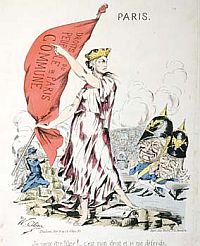
The motherhood of revolution must go back to Eve, the original rebel. That is, if we mean "origin". But of course revolution has had many generations of mothers, each spawning offspring that had to adapt to its times.
What caught the attention of everybody in the late 19th century, revolutionary or counterrevolutionary, was that the Commune erupted in one of the principal cities of industrial capitalism. This could mean either that it was the last flare of the big one of 1789 or the harbinger of an ever more potent urban revolt. And that among the declarations of the communards were visions of a society that translated Liberté, Égalité, Fraternité into what were then modern, practical terms.
The Commune and all the earlier revolutions my friend mentions were many things at once, aiming in different directions, impelled by different and often contrary groups. I'm drawn to the communards because they are more of my time than Saint-Just, Robespierre, Danton et al., in language and proposals. Europe and the world had changed enormously since the revolution of 1789, in large part because of that revolution (and American independence, and Napoleon and his wars, and of course the steam engine, etc.).
To us today, pre-1789 is a much more foreign place than 1871. When I read about poor, brave Eugène Varlin, or about the women at the barricades (there were hardly any in 1789, but they were everywhere in 1871), they stir memories of our own days of rebellion, of 20th century Communists I've known, of debates I suffered and engaged in. Like all analogies, reading 1871 through, say, 1968 or the 1970s distorts both, I know that, but still, they stir me. And I want to get to know them better, by imagining their lives in my novel. They (the metalworkers, bookbinders and seamstresses, to name 3 of the main participating occupational groups) feel closer to me than the sans culottes, but if I live long enough, maybe one day I'll want to write about them too.
In any case, the Commune acknowledged its own "mothers" and "grandmothers" — especially 1789, 1830 and 1848 — and its offspring have included Lenin's and Trotsky's concepts of revolution, much of the language and aims of the Spanish Second Republic (the one finally defeated by Franco), the many guerrilla movements in Asia, Africa and Latin America in the 1960s, '70s and '80s, and even in rebel discourse today.
2012/11/10
Understanding the society that produced the Commune
 Paris Babylon: the Story of the Paris Commune by Rupert Christiansen
My rating: 5 of 5 stars
Wittily told and extensively researched, this brief account of the Second Empire, the Franco-Prussian War and the Commune has two special merits. First, it is more sociological than ideological: Christiansen aims neither to condemn nor exalt the revolutionary Communards or the Versaillais who tried (and ultimately succeeded) to destroy them, but rather to understand all sides. He is of course appalled by the atrocities, a few by the communards (much exaggerated by Versailles propaganda, but there were some) and far more by the Versailles government troops, especially during the semaine sanglante and following, but such horrors by one side do not necessarily justify the decisions and confusions by the other. The book's second great virtue is its descriptions of curious aspects of Paris and Louis Napoleon's II Empire on the eve of the series of disasters that destroyed it: war with Prussia, then the siege of Paris and finally the Commune. There is a brief account of Baron Haussmann's transformation of the city's space, and its unintended social and economic consequences. And the chapter, "The Spermal Economy," on French medical opinion and prejudices about sex (how much to indulge and how, and how upper-class men used the Opéra as their exclusive brothel) is very amusing, though of doubtful relevance to the Commune, whose proletarian defenders' sexual behavior surely had little to do with such official notions. The account of the war is too brief to understand it, and the intense debates among Blanquistes, Prudhonniens and Marxistes, Républicains, and monarchists and other conservatives, are merely alluded to.
For readers new to the subject, this book provides a lively and fair overview of events, with bibliographic notes for those who want to understand more. And for anyone, its anecdotes and portraits, e.g. of the Empress Eugénie and of the pathetic and mysteriously uncommunicative Emperor, or Haussmann and even of the young and insolent Rimbaud (who may or may not have got to Paris during the Commune — we don't really know) make it a lively and suggestive addition to the bibliography.
For me, as I continue developing my new novel around this dramatic episode, it will be more helpful for portraying the bourgeois, in the middle between the great revolutionary and reactionary forces.
View all my reviews
2012/11/09
Afghanistan: a personal view of the traumas
 The Kite Runner by Khaled Hosseini
My rating: 3 of 5 stars
A rich boy grows up with a terrible sense of shame for a childhood act of cowardly betrayal, and only decades later redeems himself in a punishing campaign requiring great courage. This is the story thread for a book that is really about the traumas of Afghanistan, in its several stages: from the almost feudal stability under the king (overthrown in 1973), when the narrator's widowed merchant father and others in the dominant Pashtun ethnic group could live very comfortably at the expense of the despised Hazara servant caste, to the Communist government where the push for rapid reforms and the rise to power of other ethnic groups (including Hazara) roused violent resistance, to the triumph of the Taliban, celebrated as liberators but then quickly become far worse tyrants than any of their predecessors. The descriptions of how such a rapid chain of disasters affected the urban, educated Kabul élite are vivid and memorable. Also closely observed and moving is their struggles to cope with their sudden plunge of status as exiles in California, the narrator's once-powerful father as a gas station attendant, an ex-general living on his pride and the dole, and both of them trying to sell junk in a weekend market. All this makes the book worth reading — though the story is too melodramatically neat, every punishment exactly fitting the crime. There's also a movie, which is much weaker and insipid, because it leaves out all that makes the book's episodes scary in order to focus on the thin story of redemption.
View all my reviews
The book should be a stimulus to find out more of what's behind the current disasters of that country. Hosseini does not pretend to any political acuity, that is, he does not attempt to evaluate or explain these huge events, but he may lead the reader to try to find out more. The conditions of the Hazara people , for example, have been a major part of the nation's drama but little discussed outside the country — or even among Afghans, because it's a source of shame. We really need to re-examine the Communist period, which began to accomplish many good things, especially in reforming ethnic relations and opening opportunities to women, before the resistance by patriarchal tribal leaders, abetted by the U.S., escalated the violence and the Soviet army invaded with all the usual clumsiness of invaders, causing the violence to escalate even more, and so on. There were some missed chances for creating a freer society.
La Commune: a lesson in audacity | Agnès Poirier | Comment is free | guardian.co.uk
Here's an excellent summary which will help you understand why I feel passionate enough about this episode to make it the center of my new novel — which I am just now starting.
La Commune: a lesson in audacity | Agnès Poirier | Comment is free | guardian.co.uk
La Commune: a lesson in audacity | Agnès Poirier | Comment is free | guardian.co.uk
2012/11/08
City of revolution: (my) work in progress
We were so busy in Paris these past few days that I didn't have a chance to blog about it. Here's what I wrote the night before we left, at the invitation of Red Room to write about that city:
City of revolution | Geoffrey Edmund Fox | Blog Post | Red Room
Two things I've decided about my next book: it will not be "historical fiction" in the sense that Mario Vargas Llosa dismisses that term, i.e., a costume drama of two or three characters with "history" as the stage set. Rather it will be an attempt to understand history itself, or rather one of its most world-consequential chapters. And that Paris, the whole of Paris, with its millions of individuals, factions, conflicting interests and desires, will be the protagonist. The chapter of interest will be the Commune of 1871, along with the war (France v. Prussia, 1870) and ensuing the siege that led up to it, and the repercussions still felt down to our times in places as far away as Tahrir Square in Cairo. Many of the actors and actions of the Commune are well-documented and hotly debated; more than a thousand books were published on it in the first 50 years (somebody took the trouble of counting, in the Bibliothèque Nationale). But other characters and events — including the anonymous proletarians of the Commune, the later readers inspired by their example for other movements in other lands — can only be reconstructed imaginatively.
What I propose is to try to comprehend history through characters like Weber's invention of "ideal types", but instead of leaving the "types" as abstractions, imagining them into life in all their confusions and complexity. The book I envision will be essay and novel, analysis and fiction, all meant to say something not about a dead past but about our living aspirations. Like Tolstoy's War and Peace, or Javier Cerca's Soldados de Salamina, and even Vargas Llosa's "non-historical fiction" recreations of the past (La fiesta del chivo, La guerra del fin del mundo, etc.) and all imaginative literature that aims at more than entertainment.
City of revolution | Geoffrey Edmund Fox | Blog Post | Red Room
Two things I've decided about my next book: it will not be "historical fiction" in the sense that Mario Vargas Llosa dismisses that term, i.e., a costume drama of two or three characters with "history" as the stage set. Rather it will be an attempt to understand history itself, or rather one of its most world-consequential chapters. And that Paris, the whole of Paris, with its millions of individuals, factions, conflicting interests and desires, will be the protagonist. The chapter of interest will be the Commune of 1871, along with the war (France v. Prussia, 1870) and ensuing the siege that led up to it, and the repercussions still felt down to our times in places as far away as Tahrir Square in Cairo. Many of the actors and actions of the Commune are well-documented and hotly debated; more than a thousand books were published on it in the first 50 years (somebody took the trouble of counting, in the Bibliothèque Nationale). But other characters and events — including the anonymous proletarians of the Commune, the later readers inspired by their example for other movements in other lands — can only be reconstructed imaginatively.
What I propose is to try to comprehend history through characters like Weber's invention of "ideal types", but instead of leaving the "types" as abstractions, imagining them into life in all their confusions and complexity. The book I envision will be essay and novel, analysis and fiction, all meant to say something not about a dead past but about our living aspirations. Like Tolstoy's War and Peace, or Javier Cerca's Soldados de Salamina, and even Vargas Llosa's "non-historical fiction" recreations of the past (La fiesta del chivo, La guerra del fin del mundo, etc.) and all imaginative literature that aims at more than entertainment.
2012/10/21
Four words | Geoffrey Edmund Fox | Blog Post | Red Room
Red Room, the authors' site, invited us to write about learning a foreign language. Here's my little memoir.
Four words | Geoffrey Edmund Fox | Blog Post | Red Room
Four words | Geoffrey Edmund Fox | Blog Post | Red Room
2012/10/14
Sad Europe, sad globe
A friend wrote to "congratulate" me on the Nobel Peace Prize to the European Union— I suppose, because I live in a corner of Europe. I thought she was joking, but no, it's true. The Nobel Peace Prize
seems like a sad joke, but maybe it's meant as a consolation prize. I had intended to write something about Europe's slow-motion disaster,
as
one after another of the hard-won social conquests crumbles, but the
forces of disintegration have been speeding up. How
Europe got into this pickle is pretty clear — I just reviewed a book (Indecentes
in my Spanish-language blog) that sums it up blow by blow, the bungling
miscalculations since Bear Stearns and then Lehman Bros., followed by
the more-or-less covert campaign by Trichet and his successors (and
allies in the Bundesbank) to shift the blame to the "middle classes" and
the workers, and (the special focus of Indecentes) the totally ineffective and even counterproductive actions by the Spanish government under its man of inaction, Mariano Rajoy.
Anyway, there's no mystery about how we got this close to the impending crash that IMF head Christine Lagarde foresees. And there is no reason to expect the financial powers to change the no-growth, severe austerity policies that they are ideologically committed to and that, short term anyway, appear to benefit German capital while impoverishing everybody else. So what we need to focus on is how to force a change in those policies (while there is still some democratic room to maneuver, in demos, elections, etc.), and most importantly — longer term, for recovery after the foreseeable global collapse if we don't change direction — what kind of more egalitarian, more productive, more environmentally sensitive society we can construct. We can't foresee the future, we can only make it, by omission or commission.
I know there are lots of people working on this, and have been for generations. And though all those struggles — e.g., the Paris Commune, the Spanish 2d Republic, and later social revolutions — have failed their maximalist objectives, we can learn from all of them, to at least fail better. If you haven't already, check out the late Eric Hobsbawm's brilliant compendium of some of those efforts, How to Change the World.
Anyway, there's no mystery about how we got this close to the impending crash that IMF head Christine Lagarde foresees. And there is no reason to expect the financial powers to change the no-growth, severe austerity policies that they are ideologically committed to and that, short term anyway, appear to benefit German capital while impoverishing everybody else. So what we need to focus on is how to force a change in those policies (while there is still some democratic room to maneuver, in demos, elections, etc.), and most importantly — longer term, for recovery after the foreseeable global collapse if we don't change direction — what kind of more egalitarian, more productive, more environmentally sensitive society we can construct. We can't foresee the future, we can only make it, by omission or commission.
I know there are lots of people working on this, and have been for generations. And though all those struggles — e.g., the Paris Commune, the Spanish 2d Republic, and later social revolutions — have failed their maximalist objectives, we can learn from all of them, to at least fail better. If you haven't already, check out the late Eric Hobsbawm's brilliant compendium of some of those efforts, How to Change the World.
Pursuit of agents
Here's something I posted in another blog, in the author's website
Red Room. It's a personal account, but may be of interest to other book
writers.
Pursuit of agents | Geoffrey Edmund Fox | Blog Post | Red Room
Pursuit of agents | Geoffrey Edmund Fox | Blog Post | Red Room
Subscribe to:
Posts (Atom)