 |
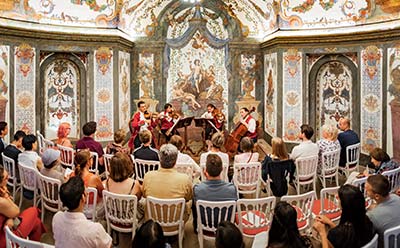
| An intimate chamber marvelous acoustics. |
2014/01/05
Wien, auf wiedersehen


2013/12/20


2013/12/16
Poor sailing for Spain
 |
| Fritz (Ricardo Olivera) |
- Catalonia, with almost 1/6 of the population and the highest GDP in Spain, is threatening to secede;
- Nationwide, unemployment is surpassed in the Eurozone only by Greece;
- Social services including health, education, and aid to caregivers of dependent relatives are being slashed, generating enormous "tides" of protest almost every day;
- Thousands of families are homeless due to evictions for nonpayment of mortgages while the banks are stuck with millions of empty new homes:
- The bankers that set up those unpayable mortgages and drove their banks to ruin claim and usually get multimillion euro bonuses;
- Corruption scandals among the political elite are multiplying, but few are punished and nobody ever resigns;
- The government is not only refusing to investigate Franco era crimes (despite UN and World Court demands), it is also reviving Franco era repressive legislation;
- The Catholic Church continues to use its state subsidies to return Spain to the middle ages.
The most divisive issues in Spain were not really resolved in the 1978 Constitution, but simply covered over in deliberately ambiguous language to achieve the broadest consensus. These divisive issues were mainly:
- Representative government —If the people were to be sovereign, who were "the people" and how direct could be their participation in government? Powerful forces wanted to maintain the institutions set up by Franco, including the supremacy of the military hierarchy and of the recently restored monarchy. With so many rival political parties — including Franco's arch enemies, the Communist Party and newly reorganized and re-invigorated Socialist Party, plus all the new regional parties that were springing up, all facing the die-hard Franco-heirs in Alianza Popular — how could the government remain stable and avoid a resumption of civil war, perhaps by other means? The expedient decided upon was an electoral system skewing votes so that one or another party's electoral advantage would be multiplied to give it enough parliamentary seats that it could not easily be overturned.
- Territorial and ethnic divisions —Large regions remained attached to languages and traditions that had been suppressed by Franco, the largest being the Galicians (gallegos or galegos), the Basques and Catalan-speakers (including not only those of Catalonia but those speaking related dialects in Valencia and Baleares). Was Spain one nation, or a union of nations with distinct laws, though gathered under a federal state? The pseudo-solution was regional "autonomy," understood differently by the different parties and subject to future determination by the courts.
- Monarchy or Republic? The ad-hoc solution (after much fierce debate) was a sort of republican monarchy, where the king reigns but does not rule. This was a major symbolic concession by the Left, standard-bearer of the Spanish Republic, but considered acceptable because of the apparently peaceable and pro-democratic posture of Juan Carlos — who owed his investiture to Franco.
- Church and State: Franco had defined his government and the country as "National Catholic" meaning that, for him, Fascism and Catholicism were two faces of the same reality, and a "Concordat" with the Vatican assured state funding of the Church. The Left representatives wanted to cut that funding entirely. The compromise was that "all" creeds would be recognized, the country was declared officially laic (id est, with no official religion), but the state continued to exempt the Catholic Church from taxes (even on commercial property) and to pay the salaries of teachers of religion in the public schools and of priests in military.
The ambiguity on the second point allowed pressure from the centralizing, conservative Partido Popular, through its influence on the courts, to overturn a reform of Catalonia's governing statutes (involving the relative emphasis on the national language, castellano — what we call "Spanish" — and Catalan and other issues of self-determination), taken in Catalonia as unpardonable meddling (intromisión), especially since a very similar statute was approved in neighboring Valencia (which also speaks a variety of Catalan, but was governed by the conservatives whereas Catalonia had at the time a coalition leftist government).
The other problems listed above stem mainly from the rigidity and inconclusiveness on the territorial and democratic procedure issues. There are too many courts (Audiencia Nacional, Tribunal Supremo, Tribunal Constitutional all top-ranked in the justice system, and all the regional courts) with different criteria and stacked with judges placed there by political pressure or, in some notorious cases, removed when they take justice issues too seriously: Baltasar Garzón is the best known, but there have been others. This makes it very difficult to prosecute corruption cases against politicians who have their party's support. And has for similar reasons made it almost impossible to control the banks and financial markets — since the people supposed to do the controlling are part of the problem.
As for the Church — well, we'll save that for later. (Though I've already discussed the issue in earlier notes, for example Claiming the soul of Spain (2008/02/10). If you're curious about other thoughts I've had on these themes, just click the link "Spain" below and the blog notes will pop up.
| . |
2013/12/11
Hard-pressed | Harvard Gazette
Hard-pressed | Harvard Gazette
Patterson's critique of superficial, ill-sourced reporting by reporters who don't know anything more about their subjects than what they have read hurriedly from other reporters is surely valid. What I doubt is the relevance of his proposed remedy, "knowledge-based reporting". More rigorous training of journalists won't protect us from those who (deliberately or blindly) mislead us, or from those who claim to know more than they do. There are well-informed and objective reporters, even now, along with the idiot or lazy scriveners and paid propagandists, but it takes practice and good critical judgment to know which reporters and which reports can be trusted.
Our only real protection is, as it always has been, knowledge-based reading. And with today's communications resources, including Google and Wikipedia and our ability to e-mail or Skype anyone we know who might be able to fill us in on something puzzling, the knowledge-base is more accessible. It's up to you and me, pal, to find out enough about what interests us to know whose version is most credible.
"Gripes about the dismal prospects of the Fourth Estate are probably as old as the printing press itself. News consumers are uninformed and ill served by journalists who focus on the superficial, too often delivering a narrow and inaccurate portrait of the nation’s public affairs, protesters typically declaim."So begins the Harvard Gazette article, recognizing that the critique Thomas Patterson offers in his new book Informing the News is not new and is thus not news to most of us, either. But it is worth thinking about in new ways, because we are in a new communications environment, utterly different from that known to Oscar Wilde or Walter Lippmann or even George Orwell, who maybe came closer (in 1984) to imagining our world of today.
Patterson's critique of superficial, ill-sourced reporting by reporters who don't know anything more about their subjects than what they have read hurriedly from other reporters is surely valid. What I doubt is the relevance of his proposed remedy, "knowledge-based reporting". More rigorous training of journalists won't protect us from those who (deliberately or blindly) mislead us, or from those who claim to know more than they do. There are well-informed and objective reporters, even now, along with the idiot or lazy scriveners and paid propagandists, but it takes practice and good critical judgment to know which reporters and which reports can be trusted.
Our only real protection is, as it always has been, knowledge-based reading. And with today's communications resources, including Google and Wikipedia and our ability to e-mail or Skype anyone we know who might be able to fill us in on something puzzling, the knowledge-base is more accessible. It's up to you and me, pal, to find out enough about what interests us to know whose version is most credible.
2013/11/26
Mockingbird
 To Kill a Mockingbird by Harper Lee
My rating: 4 of 5 stars
The voice of the perky, inquisitive, acutely observant Scout Finch from age 6 to 9 captures the reader so strongly as to hold together a whole string of disparate episodes — originally conceived by the author as separate short stories. Mainly, we get to know various characters of a poor little Alabama town during the Depression, their peculiar rituals and class and racial prejudices, and their sometimes redeeming acts of generosity. In this, it is more like Mark Twain's Adventures of Tom Sawyer, another child's-eye view of a southern small town told as a series of anecdotes, than like Twain's later and more tightly structured Adventures of Huckleberry Finn.
Scout's most piquant observations of hypocrisy, neurosis, arrogance, or cowardice are of the white folks she knows best. But she also reports with fascination the courage and kindness of a few individuals, including especially her father Atticus Finch, a neighbor woman, Maudie, and the Finches' black maid Calpurnia. A particularly beautiful moment is Scout's visit with Calpurnia to her First Purchase AME Church, a revelation to this protected white girl of black devotion and dignity and a whole community close by but separate from the little white hamlet.
The book is best remembered for one episode that is expanded to extend over several chapters and which is a pleasing, though historically misleading fable: the trial of a black laborer accused of rape of a poor white woman, and his defense by Scout's father Atticus. Sadly, nothing like the judicial fairness of the Maycomb judge, the opportunity of the defendant to legal defense and serious cross-examination of the plaintiff ever happened or could happen in Alabama in the 1930s in a black-on-white rape case. What Harper Lee evidently had in mind when she wrote it was the famous Scottsboro Boys trial in 1933, where no such judicial niceties occurred. But there were defense attorneys — mostly northerners — who, a bit like Atticus Finch in the novel, made the effort, often at the risk of their own lives.
But it is the voice that saves this and all the stories in the book. You have to love this tomboy when she tells you in a hurt voice that, when she tried to hold her big brother back from some dangerous adventure, "Jem told me I was being a girl…" Or when she observes, back in her white church, "the Impurity of Women doctrine that seemed to preoccupy all clergymen."
On the Scottsboro boys, see the NYT November 21, 2013, article,
Alabama Pardons 3 ‘Scottsboro Boys’ After 80 Years
View all my reviews
2013/11/24
The slowly creeping insight
 Too Much Happiness by Alice Munro
My rating: 4 of 5 stars
What is amazing is how much Munro can make out of so little, the lives of observant but unexceptional people, most of them in and around London, Ontario, in the 1990s or 2010s, who perhaps once in their lives have experienced an exceptional event. Within this restricted fictional territory, the author finds innumerable variations.
After the first few stories I was hoping for a change of scenery and skipped to the last, and title, story of the collection, "Too Much Happiness," and was surprised by something quite different. Here the protagonist is an entirely exceptional person and so far from contemporary Canada she probably could not even imagine the Ontario forests and suburbs. The Russian mathematician Sofia Kovalevskaya (1850-1891) was the first woman to earn a doctorate in a European university at a time when women weren't admitted even to sudy in universities (summa cum laude, University of Göttingen, 1874). Kovalevskaya's extraordinary triumphs and disappointments, including difficult romance with another Russian intellectual exile, all really occurred. The fictional imagination is in making us feel as though we are she, living all these frustrations and sometimes wild hopes, until the fatal "too much happiness."
This is not the only wonderful story in the collection. Other favorites of mine included "Wood," which seems to understand a man's loneness — his need to be alone, but in a place where he feels himself as part of something greater — as clearly as Munro's other stories understand women's ways of relating to, and sometimes, avoiding one another. "Some Women" and "Child's Play" are especially about that complicated ballet. "Free Radicals" is another memorable story — or rather, two memorable stories, first of a woman's sudden and unexpected widowhood, and then of a startling irruption into her life that seems to reconfigure the meaning of everything. But even in this story, the conclusion is not an event but the protagonist's sudden understanding of events in a new way, even though she, or he, or we, may not be able to describe just what that new understanding is.
View all my reviews
2013/11/15
Hands, heads and revolution
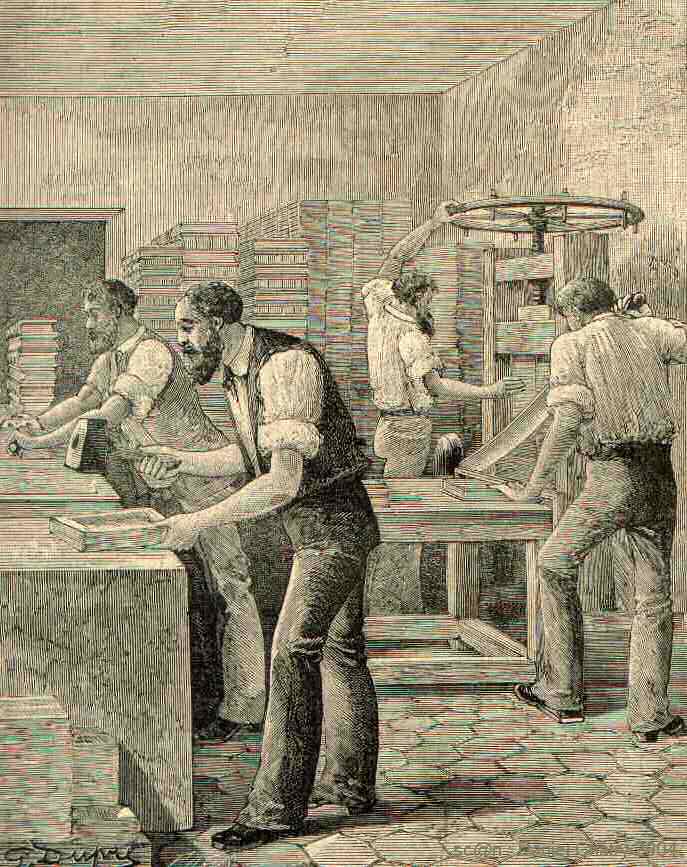 |
| http://www.vieuxmetiers.org/gravure/imajpg/relieur.jpg |
In the course of research, I discovered that the two most revolutionary groups of workers in Paris were the bronze workers and bookbinders, the latter organized by Eugène Varlin and, for the many women in that trade, Nathalie Le Mel. What a man or woman does with the hands, and the context of one's daily work routines, must explain much about how that person sees the world. So this is what I'm trying to learn now.
 |
| http://www.alaintruong.com/archives/2008/12/15/11764701.html |
I have some idea of how the bronze workers worked in that period, and hope to learn more. These men (and they were all men) molded not only chandeliers, kitchen basins and cookware, bathroom fixtures and (for the bourgeois) ornaments, statuary and pretty clocks like the one at left; they were also the men who fashioned the cannons that defended Paris.
But the bookbinders (both men and women) are especially interesting, both because of the extraordinary personality of Varlin and because, by the very nature of their work, they had contact with the written word. I want to know what it would be like for, say, a young apprentice bookbinder with an 11-hour workday in an atelier of 20 or 30 laborers when a big order came in. What was the order of work, from the time the printed sheets came in to the final ornamentation of the cover? And how difficult was it to operate presses and clamps, knife, guillotine, sewing frames, gluing, etc.? What impressions — of literature, politics or philosophy — might the apprentice retain from glimpses of the pages he was required to bind? Besides consulting library and museum sources in Paris and Madrid, I hope to learn from people living today who are actually doing that sort of work.
This was the first great urban revolt in a modern metropolis (Paris 1871 as opposed to pre-industrial 1789), the first city-wide socialist reform movement ever put into practice (public education and health, labor rights, democratic procedure), and a demonstration of the capacity of ordinary workers with ingenuity and good will to run a city of over a million inhabitants. A close examination of the work lives and home lives of those ordinary workers should help us understand this enormous phenomenon.
The Commune and its defenders were annihilated in street-by-street fighting during the “week of blood” (May 21-28, 1871), demonstrating the precariousness of revolt and the ruthlessness and duplicity of threatened regimes everywhere. But despite that, because of its accomplishments and its declared though unfulfilled programs during its brief life (just over two months), the Commune has continued to serve as a model for aspirations of social justice in revolutionary movements ever since.
For newcomers to this blog, my previous novel, A Gift for the Sultan, was about a much earlier great urban crisis, in Constantinople just 51 years before its capture by the Ottomans. That book has now also been translated and published in Turkish as Bir cihan, iki sultan (“One world, two sultans”). I now think of that novel as practice for this one, about the Paris Commune of 1871.
2013/11/13
Censor this? No, keep the press free
I just received a call to join a censorship campaign against Richard Cohen: Group Calls for the Washington Post to Fire Columnist Richard Cohen Over Remarks on Interracial Marriage
Outrage After Washington Post Columnist “Represses Gag Reflex” Discussing NYC Mayor de Blasio’s Interracial Marriage
Seems like some people get outraged awfully easily. Maybe they should just take a deep breath and learn to read. The sentences that caused the outrage I quote below.
Richard Cohen: Christie’s tea party problem - The Washington Post: "…People with conventional views must repress a gag reflex when considering the mayor-elect of New York — a white man married to a black woman and with two biracial children. (Should I mention that Bill de Blasio’s wife, Chirlane McCray, used to be a lesbian?) This family represents the cultural changes that have enveloped parts — but not all — of America. To cultural conservatives, this doesn’t look like their country at all."
My response:
(1) I don't see how de Blasio, Chirlane or anybody else could take offense; Cohen is not saying he gagged, but describing what he imagines (correctly, I fear) to be the reaction of "People with conventional [sic] views". Well, conventions are different in different places. Not the views of New Yorkers, obviously; they voted for him.
(2) And even if a columnist offends me, I'm not going to demand to shut him up, but rather to have an opportunity to reply. I'm with Voltaire on this principle.
Outrage After Washington Post Columnist “Represses Gag Reflex” Discussing NYC Mayor de Blasio’s Interracial Marriage
Seems like some people get outraged awfully easily. Maybe they should just take a deep breath and learn to read. The sentences that caused the outrage I quote below.
Richard Cohen: Christie’s tea party problem - The Washington Post: "…People with conventional views must repress a gag reflex when considering the mayor-elect of New York — a white man married to a black woman and with two biracial children. (Should I mention that Bill de Blasio’s wife, Chirlane McCray, used to be a lesbian?) This family represents the cultural changes that have enveloped parts — but not all — of America. To cultural conservatives, this doesn’t look like their country at all."
My response:
(1) I don't see how de Blasio, Chirlane or anybody else could take offense; Cohen is not saying he gagged, but describing what he imagines (correctly, I fear) to be the reaction of "People with conventional [sic] views". Well, conventions are different in different places. Not the views of New Yorkers, obviously; they voted for him.
(2) And even if a columnist offends me, I'm not going to demand to shut him up, but rather to have an opportunity to reply. I'm with Voltaire on this principle.
2013/10/29
Waltzing to revolution
 Eugène Varlin, chronique d'un espoir assassiné by Michel Cordillot
My rating: 5 of 5 stars
Clearly written, extensively documented intimate biography of one of the most impressive leaders of the Paris Commune. We learn not only of the very serious side of Varlin, a country boy eager to learn, who became a master bookbinder (very proud of his trade), organizer first of the bookbinders union then of other unions, and a leader of the International Workingmen's Association (the "First International"). He also learned to sing in choral groups and to dance, becoming a tall, handsome idol to thousands of the low-paid women brocheuses, assigned to the menial folding and assembling of "brochures" (paper-covered books) in the book binderies. In London at the farewell party of a meeting of the International, he preferred to waltz with Marx's daughters to spending the evening debating economics with their father. A firm and fierce feminist (opposed to his Proudhonnien comrades' view that a woman's place was in the home and she therefore should not hold union office), he worked with Nathalie Le Mel, already a leader of women bookbinders, in numerous projects. Reading his story helps us understand how such a momentous upheaval as the Paris Commune could occur and why at that moment, and also how and why it collapsed before the massacre of the "week of blood" by troops from the extremely conservative government in Versailles. It will also help answering the third question, how it has shaped revolutionary movements up to our day, as the song says: "She [the Commune] is not dead" (Elle n'est pas morte).
View all my reviews
2013/10/27
If War is Peace, Ignorance is Strength
 Nineteen Eighty-Four by George Orwell
My rating: 4 of 5 stars
Re-reading this book today, as so many people are doing, reminds us of how gloomy the world looked in 1949. And especially how gloomy it looked to Orwell, who had spent his entire life and lost his health in struggles for what he imagined as a more decent society — one where people care about and care for one another. The book is a biting satire of what he thought of as the muddle-headed reformism of the British Labour Party, heading toward a totally controlled society called "Ingsoc", Newspeak for "English Socialism", but the permanent anxiety-inducement, psychological manipulation through the distortion of language, and crude but effective torture were inspired more by Nazi Germany and, especially, Stalin's Soviet Union. The technology of surveillance by "Big Brother" seems laughably primitive today, in the face of Edward Snowden's revelations about the working of the NSA, but Orwell's vision of pseudo-friendships among individuals too frightened to really connect seems almost to foreshadow those on Facebook and Twitter.
Orwell's great strength was as a moral essayist, a writer with a very definite view of how things ought to be and a critique of all that fell short of that. And it is as a moral essay that this book continues to matter, not as an effort of belles lettres. It is not pleasing to read, the flow of the language is jarring, the characters unlovable and barely understandable as people — and that is surely just what Orwell intended. But those unlikeable characters all serve his two purposes: to point out the dangers of an all-controlling state and to remind us once again of how language can be corrupted in ways not to advance and express thought, but to impede it. And also perhaps to express one faint hope: Winston Smith, by resisting as long as he does, even though he finally succumbs, demonstrates that the system's control can never be absolutely complete.
View all my reviews
Subscribe to:
Posts (Atom)